Spring Dawn over the Elixir Terrace
Artwork Details
- 元 陸廣 丹臺春曉圖 軸
- Title: Spring Dawn over the Elixir Terrace
- Artist: Lu Guang (Chinese, ca. 1300–after 1371)
- Period: early Ming dynasty (1368–1644)
- Date: ca. 1369
- Culture: China
- Medium: Hanging scroll; ink on paper
- Dimensions: Image: 24 1/4 x 10 1/4 in. (61.6 x 26 cm)
Overall with mounting: 87 1/2 x 17 5/8 in. (222.3 x 44.8 cm)
Overall with knobs: 87 1/2 x 20 5/8 in. (222.3 x 52.4 cm) - Classification: Paintings
- Credit Line: Ex coll.: C. C. Wang Family, Edward Elliott Family Collection, Purchase, The Dillon Fund Gift, 1982
- Object Number: 1982.2.2
- Curatorial Department: Asian Art
Audio
7419. Spring Dawn Over the Elixir Terrace, Part 1
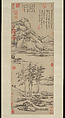
MIKE HEARN: The rebellions accompanying the disintegration of the Mongol Dynasty forced artist Lu Guang to flee his home in Suzhou. This painting celebrates his return and reunion with an old friend after years of exile and isolation. The painting and the accompanying poem evoke optimism and hope for a more peaceful age at the dawn of the new Ming Dynasty. The painting’s Taoist imagery—like the temple nestled in the mountains and the altarlike terrace on the plateau above the temple—carry auspicious associations that presage an era of longevity and peace. During the Mongol period, many scholars sought refuge in Buddhist or Taoist churches that offered a place for sympathetic lay people to hang their hats. Lu Guang uses religious imagery as a way to reference his political hopes without being explicit. The founder of the new Ming Dynasty was a humble Buddhist monk turned rebel, and in the early years there was no telling whether his dynasty would survive. The composition’s receding river valley and tall peaks hark back to the monumental landscape paintings of the tenth century, another period wracked by political turmoil and dynastic collapse. If you’d like to hear a translation of the poem that accompanies this painting, press play now.
Listen to more about this artwork
More Artwork
Related Content
Timeline of Art History
Entries and chronologies from The Met's art encyclopedia.
Publications
Books, guides, and catalogues published by The Met.
Research Resources
The Met provides unparalleled resources for research and welcomes an international community of students and scholars. The Met's Open Access API is where creators and researchers can connect to the The Met collection. Open Access data and public domain images are available for unrestricted commercial and noncommercial use without permission or fee.
To request images under copyright and other restrictions, please use this Image Request form.
Feedback
We continue to research and examine historical and cultural context for objects in The Met collection. If you have comments or questions about this object record, please contact us using the form below. The Museum looks forward to receiving your comments.
Content Notice
The Metropolitan Museum of Art presents over 5,000 years of art from around the world, and our online collection reflects ongoing work conducted over the course of our more than 150-year history. You may encounter objects or images that may be inappropriate for some viewers or information that may be outdated.