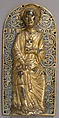
Placa de Pentecostés
Artwork Details
- Título: Placa de Pentecostés
- Fecha: ca. 1150–1160
- Geografía: Países Bajos meridionales, valle del río Mosa
- Material: Esmalte champlevé y translúcido sobre cobre dorado
- Dimensiones: 10,3 x 10,3 cm
- Crédito: Colección de Los Claustros, 1965
- Número de inventario: 65.105
- Curatorial Department: Medieval Art and The Cloisters
Audio
56. Plaque with the Pentecost
Gallery 14
NARRATOR: The subject of this small, square plaque is the Pentecost, the Descent of the Holy Spirit on the Apostles fifty days after Easter. Six of the apostles are seated on a bench before the city of Jerusalem. The triple arch at the top, labeled "DOM[US]" represents the house in which the miracle of the Pentecost occurred. In the center of the plaque is St. Peter, receiving the central red ray from the left hand of God above. The inscription around the hand can be translated as an abbreviation for Father, and the inscription on either side of St. Peter is an abbreviation for the Holy Spirit. This twelfth-century plaque was undoubtedly carved as part of a series representing the Life and Passion of Christ that may have been made for a cross base, a pulpit, or some other liturgical furnishing. Julien Chapuis.
JULIEN CHAPUIS: This is one of the best examples of a Mosan enamel, by which I mean that the plaque has the quality of a Matisse or a Schiele drawing. The artist chooses the line as his foremost creative medium. The line has a tremendous variation. It is not the same width everywhere. And he's able, by using variations in the line, to create a sense of space, a sense of volume. If you look, for instance, at the figure of the Apostle on the right, you will see that he really is standing in space. And this tremendous sense of presence is what makes this work.
More Artwork
Related Content
Timeline of Art History
Entries and chronologies from The Met's art encyclopedia.

Publications
Books, guides, and catalogues published by The Met.
Research Resources
The Met provides unparalleled resources for research and welcomes an international community of students and scholars. The Met's Open Access API is where creators and researchers can connect to the The Met collection. Open Access data and public domain images are available for unrestricted commercial and noncommercial use without permission or fee.
To request images under copyright and other restrictions, please use this Image Request form.
Feedback
We continue to research and examine historical and cultural context for objects in The Met collection. If you have comments or questions about this object record, please contact us using the form below. The Museum looks forward to receiving your comments.
Content Notice
The Metropolitan Museum of Art presents over 5,000 years of art from around the world, and our online collection reflects ongoing work conducted over the course of our more than 150-year history. You may encounter objects or images that may be inappropriate for some viewers or information that may be outdated.