Zampogna
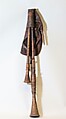
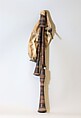
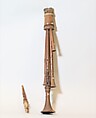
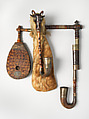
This is a zampogna a chiave (keyed bagpipe) from the Molise/Abruzzo area. Its defining characteristics are the flared open bells at the end of each chanter, as well as sparse turning and a plain fuselage. However, the melody chanter and the small drone both have a closed bell and more wood-turning features and seem to borrow aesthetics from the more southern Lucanian style. The bass chanter and longer drone, however, are both clearly in the Scapolese style, which is associated with pipes from Abruzzo and Molise, where the main contemporary pipe making center is in the town of Scapoli, Molise. Interestingly, although the wood-turning aesthetics of the small drone are of the Lucanian style, it is a dummy drone, which fits into the Scapoli, Molise zampogna traditions, where zampognas only featured one functioning drone (the bass drone). The discrepancy between the drones and melodic pipes, suggests that this instrument could be composite with pieces made by two different makers, possibly as a restoration project, with newer parts made by a Lucanian maker, who followed the idiosyncracies of the Scapolian instrument, such as the dummy drone.
The head stock presents a crack, which was covered with red wax. The stock is also reinforced with a metallic brace, in order to prevent the crack from growing. These measures confirm that the original instrument was restored at least once.
The zampogna was traditionally played by shepherds and is still used for a variety of cultural practices, devotional and secular. In the Lucania region and parts of Calabria and the Abbruzzi they are often played in a duo formation with a ciaramella/piffero, a double reeded shawm. This duo has become emblematic of the Christmas season, where traditionally dressed pipers walk from village to village playing the ‘novena’, a form of devotional music (Scaldaferri 2022). Zampogna players have secular and religious repertoires. The former is used for the novena and devotional processions, while the latter are used to accompany dancing and singing.
(David Marker and Cassandre Balosso-Bardin, 2023)
Technical description
2 separate semi-melodic pipes of unequal length, made out of light wood with screw-on flaring bell, conical bores: r 320 mm, 5/1 holes, 2 ventholes; L 565 mm, 3/0 holes, 4 ventholes, 1 metal key covered with typical perforated barrel;
reeds missing (typically cane double reeds);
2 wooden drones aesthetically flared, but internally cylindrical bells, cylindrical bores – the top section has a narrower cylindrical bore than the lower section: 92 mm in 1 section, 337 mm in 2 sections, reeds missing (typically double cane reeds);
conical wooden blowpipe 120 mm;
dressed goatskin bag without cover;
cylindrical stock for blowpipe, large conical stock with 4 holes for sounding pipes, with metal reinforcing band;
all pipes and stocks with grooved turning.
References
Baines, Anthony, 1960. Bagpipes. Oxford: Oxford University Press.
Scaldaferri, Nicola, 2022. ‘The Bagpipes in the Mount Pollino Area (Southern Italy): Morphology and Musical Repertoires.’ In Playing Multipart Music: Solo and Ensemble Traditions in Europe: European Voices IV. Vienna: Böhlau Verlag. pp. 71-93.
Vereno, Michael Peter, 2021. The Voice of the Wind: A Linguistic History of Bagpipes. Lincoln: International Bagpipe Organisation.
Artwork Details
- Title: Zampogna
- Period: 19th century
- Geography: Italy or Sicily
- Culture: Italian
- Medium: Wood, goatskin, metal
- Classification: Aerophone-Reed Vibrated-bagpipe
- Credit Line: The Crosby Brown Collection of Musical Instruments, 1889
- Object Number: 89.4.1568
- Curatorial Department: Musical Instruments
More Artwork
Research Resources
The Met provides unparalleled resources for research and welcomes an international community of students and scholars. The Met's Open Access API is where creators and researchers can connect to the The Met collection. Open Access data and public domain images are available for unrestricted commercial and noncommercial use without permission or fee.
To request images under copyright and other restrictions, please use this Image Request form.
Feedback
We continue to research and examine historical and cultural context for objects in The Met collection. If you have comments or questions about this object record, please contact us using the form below. The Museum looks forward to receiving your comments.
Content Notice
The Metropolitan Museum of Art presents over 5,000 years of art from around the world, and our online collection reflects ongoing work conducted over the course of our more than 150-year history. You may encounter objects or images that may be inappropriate for some viewers or information that may be outdated.