Zuqqara
This specific type of Northern African bagpipe is most commonly found in Tunisia, where the local bagpipe (mizwid), documented since at least the late 19th century, features five fingerholes. There are very few historical references of bagpipes in Egypt, most of them from the beginning of the 19th century. Guillaume-Andre Villoteau, considered as one of the first musical ethnographers, was attached to Napoleon Bonaparte’s scientific mission to Egypt in 1798. During three years, he documented Egypt’s musical styles, and collected instruments. Despite actively looking for bagpipes he only found them three days before his departure in 1801 (Legrain 1917), suggesting that they were not easily found, nor commonly played, at least in the circles he moved in.
(Cassandre Balosso-Bardin, 2023)
Technical Description:
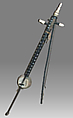
Two cane chanters with oblique ends and two horn bells, cylindrical bores, fingerholes;
holes knife-cut;
chanters tied together with waxed black string and cloth, and hemp-wrapped and waxed into a flat, disk-shaped wooden stock;
reeds inaccessible;
turned wooden blowpipe with disk-shaped integral stock, protruding 97 mm outside of bag, with wax band around mouthpiece and two flaps of leather emerging between bag and disk at base of pipe, indicating a flap vale inside;
rough, semi-tanned goatskin bag with hair turned in, with hind end tied off inside, fore legs tied outside with leather thongs, and chanter in neck.
References
Legrain, Georges, 1917. ‘Guillaume-Andre Villoteau, musicographe de l’expedition d’Egypte (1759-1839)’, Bulletin de l’Institut Egyptien, 56(11), p1-30.
Artwork Details
- Title: Zuqqara
- Date: ca. 1800–1889
- Geography: Egypt
- Culture: Egyptian
- Medium: Cane, wood, goatskin, leather
- Classification: Aerophone-Reed Vibrated-bagpipe
- Credit Line: The Crosby Brown Collection of Musical Instruments, 1889
- Object Number: 89.4.2717
- Curatorial Department: Musical Instruments
More Artwork
Research Resources
The Met provides unparalleled resources for research and welcomes an international community of students and scholars. The Met's Open Access API is where creators and researchers can connect to the The Met collection. Open Access data and public domain images are available for unrestricted commercial and noncommercial use without permission or fee.
To request images under copyright and other restrictions, please use this Image Request form.
Feedback
We continue to research and examine historical and cultural context for objects in The Met collection. If you have comments or questions about this object record, please contact us using the form below. The Museum looks forward to receiving your comments.
Content Notice
The Metropolitan Museum of Art presents over 5,000 years of art from around the world, and our online collection reflects ongoing work conducted over the course of our more than 150-year history. You may encounter objects or images that may be inappropriate for some viewers or information that may be outdated.