Sistrum
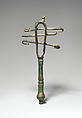
This arc sistrum is a type seen outside Egypt in the Roman period in the context of Isis cults that encircled the Mediterranean. It does not show the goddess face at the juncture of arc and handle, presumably because the ancient fetish of Bat / Hathor was not understood as necessarily relevant. Indeed, the naos sistrum iconic for Hathor apparently did not move beyond Egypt at all. Atop this sistrum lies a cat, wearing a crescent and disk, with her young. The cat may represent solar associations, or the pacified aspect of the goddess Hathor soothed by the sistrum, or she might simply evoke an Egyptian atmosphere. At either side, below the projecting ends of the bars on the flat sides of the arc are what appear to be a crown of Isis and a pine-cone, the latter a Roman symbol of good fortune.
Artwork Details
- Title: Sistrum
- Period: Roman Period
- Date: 1st–2nd century CE
- Geography: From Egypt or Italy, Southern Europe
- Medium: Bronze or copper alloy
- Dimensions: h. 20.6 cm (8 1/8 in); w. 14 cm (5 1/2 in)
- Credit Line: Gift of C. and E. Canessa, 1919
- Object Number: 19.5
- Curatorial Department: Egyptian Art
More Artwork
Research Resources
The Met provides unparalleled resources for research and welcomes an international community of students and scholars. The Met's Open Access API is where creators and researchers can connect to the The Met collection. Open Access data and public domain images are available for unrestricted commercial and noncommercial use without permission or fee.
To request images under copyright and other restrictions, please use this Image Request form.
Feedback
We continue to research and examine historical and cultural context for objects in The Met collection. If you have comments or questions about this object record, please contact us using the form below. The Museum looks forward to receiving your comments.
Content Notice
The Metropolitan Museum of Art presents over 5,000 years of art from around the world, and our online collection reflects ongoing work conducted over the course of our more than 150-year history. You may encounter objects or images that may be inappropriate for some viewers or information that may be outdated.