
Pushing beyond the straightforward creation of likenesses, the recent acquisitions featured in Galleries 963 and 965 examine the cultural and political significance of depicting the figure and explore ideas of bodily presence and absence. These works by artists working today approach representation through an array of materials—clay, collage, and painted surfaces—and experiments with form. Collectively, they consider myriad possibilities for constructing a figural presence. Informed by the unique histories and vantage points of their subjects, these works engage with politics, whimsy, humor, family, sanctity, and the social sphere. While Rose Simpson draws on personal history to explore ancestral memories and the impacts of colonialism, Daniel Boyd and Aliza Nisenbaum engage with legacies of violence across broader communities. Sudhir Patwardhan and Woody De Othello transform simple tools into charged attributes, binding the human form to systems of labor or to spirituality. Across these works the sense of the figure emerges through its entanglement with place—within the rooms, cities, histories, and cultures that shape the body and give it meaning.
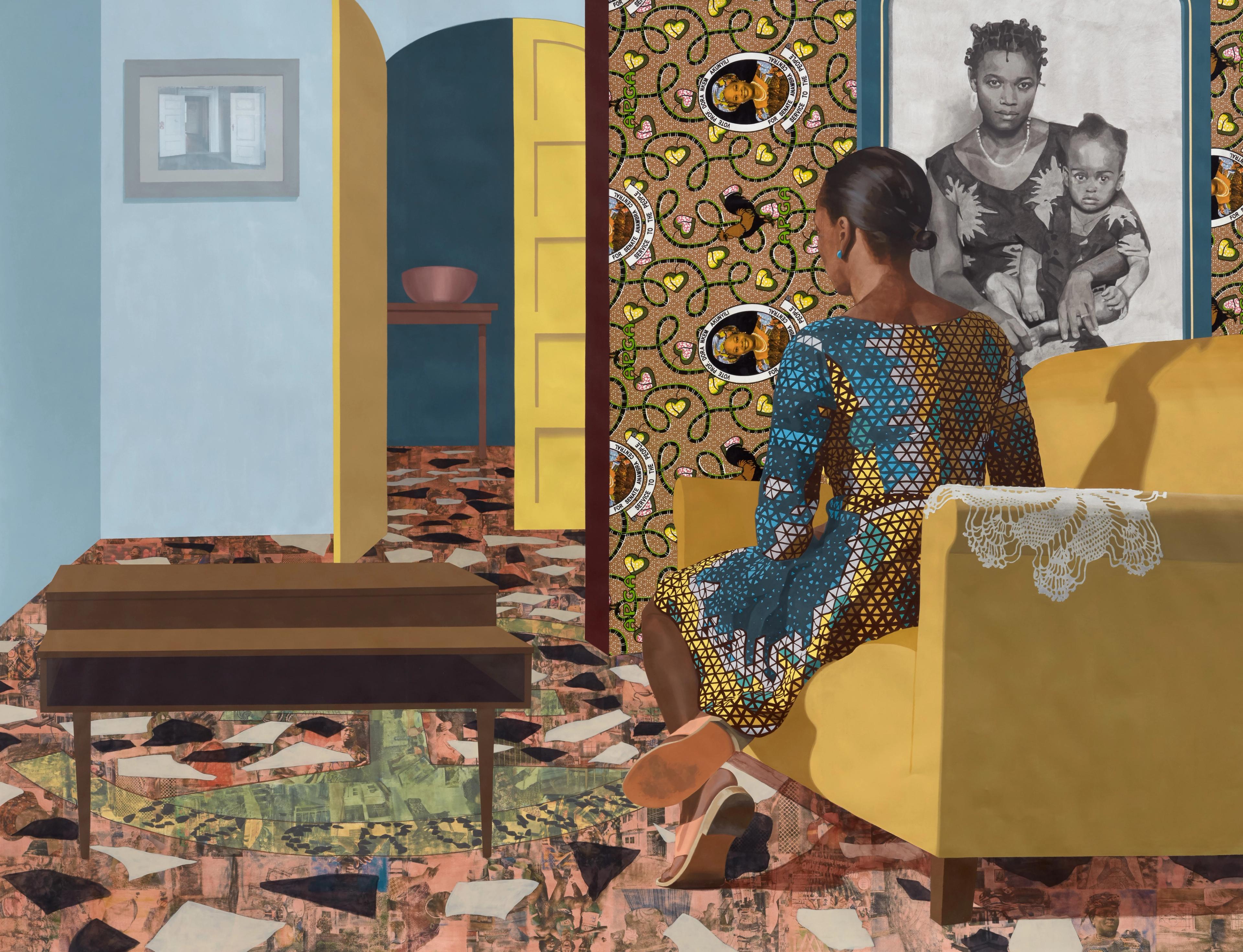
Njideka Akunyili Crosby (Nigerian, 1983). Mother and Child, 2016. Acrylic, transfer printing, colored pencil, cut and pasted paper, and printed fabric on paper, 95 3/4 in. × 10 ft. 4 1/4 in. (243.2 × 315.6 cm). The Metropolitan Museum of Art, New York, Purchase, The Jacques and Natasha Gelman Foundation Gift, 2017 (2017.106). © Njideka Akunyili Crosby
Akunyili Crosby sits in her Los Angeles living room, a space imbued with elements of personal history, facing a large black‑and‑white image of her maternal grandmother and youngest aunt. The terrazzo floor recalls her childhood home in Lagos and is formed from transfers of family photographs. The composition references Vilhelm Hammershøi, whose painting she re-created on the far wall. In his atmospheric domestic interiors, open doors reveal quiet rooms, often haunted by his wife’s solitary presence. Crosby’s scene similarly carries traces of absent others. The wallpaper behind the double portrait is made from fabric commemorating her mother, Dora Akunyili, a Nigerian health official and social advocate who died in 2014. Created while the artist was pregnant, the work is a poignant meditation on memory, motherhood, and loss.
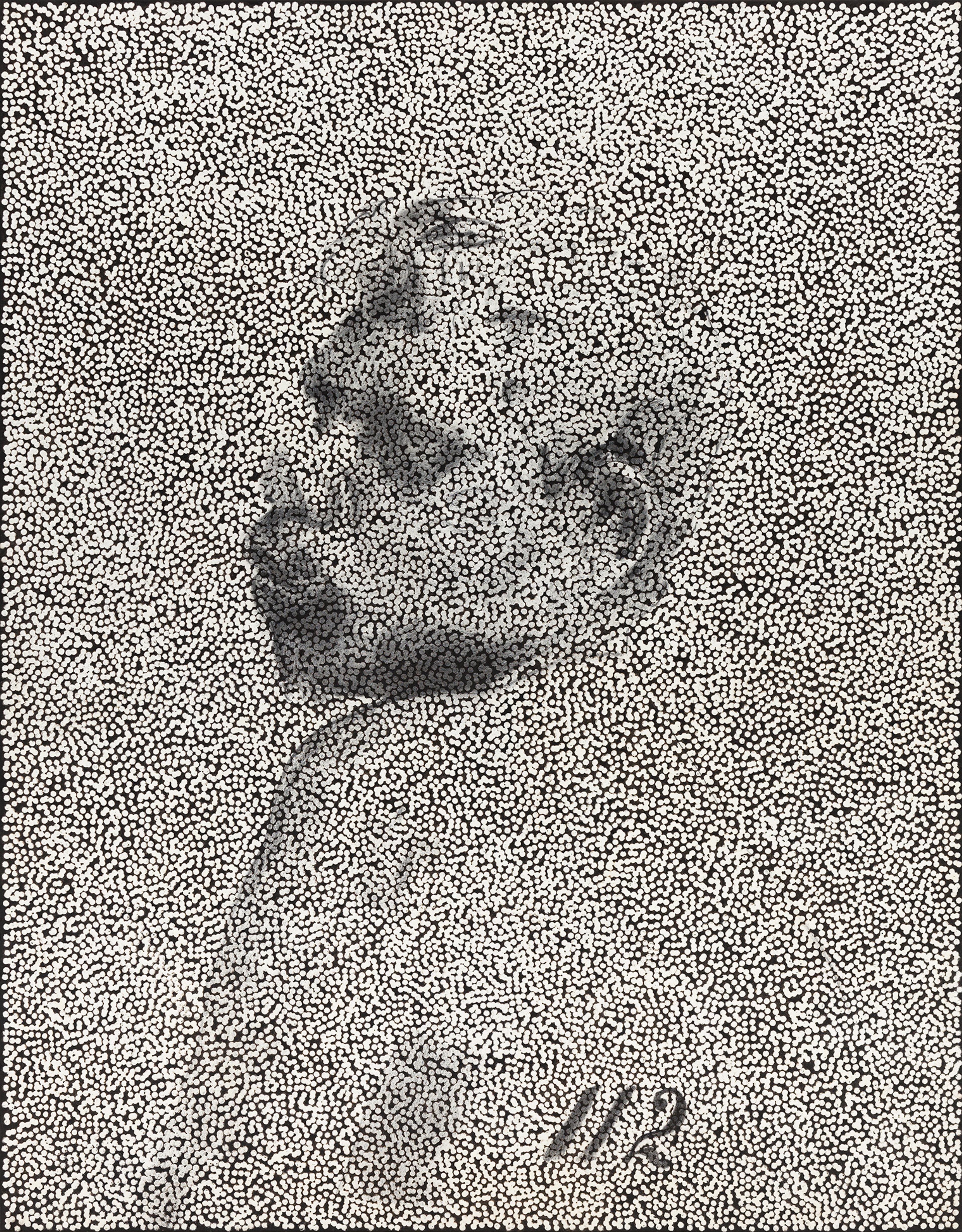
Daniel Boyd (Australian, 1982). Untitled (HBOAIAZ), 2023. Oil, charcoal and archival glue on canvas, 55 1/4 × 43 1/2 × 1 1/8 in. (140.3 × 110.5 × 2.9 cm). The Metropolitan Museum of Art, New York, Purchase, Lila Acheson Wallace Gift, 2024 (2024.484). © 2023 Daniel Boyd
Boyd’s practice melds Western-style portraiture with the traditions of Aboriginal and Torres Strait Islander peoples, investigating histories of representation and cultural survival through eras of colonial oppression. In this work, he has repurposed an 1892 photograph by Charles Kerry from a series on Aboriginal and Torres Strait Islander performers, creating a charcoal portrait of a young Aboriginal man. In the manner of nineteenth-century ethnographic photography, Kerry identified the subject as “Figure 112 Coongardi, warrior, Gilbert River tribe, Queensland.” Boyd’s image retains the number but obscures the sitter’s contours beneath raised dots covering the surface. Reminiscent of Aboriginal painting, the dots—made from archival glue and paint—are conceived by Boyd as lenses or viewfinders through which history’s subjects can be reviewed, reclaimed, and reimagined.
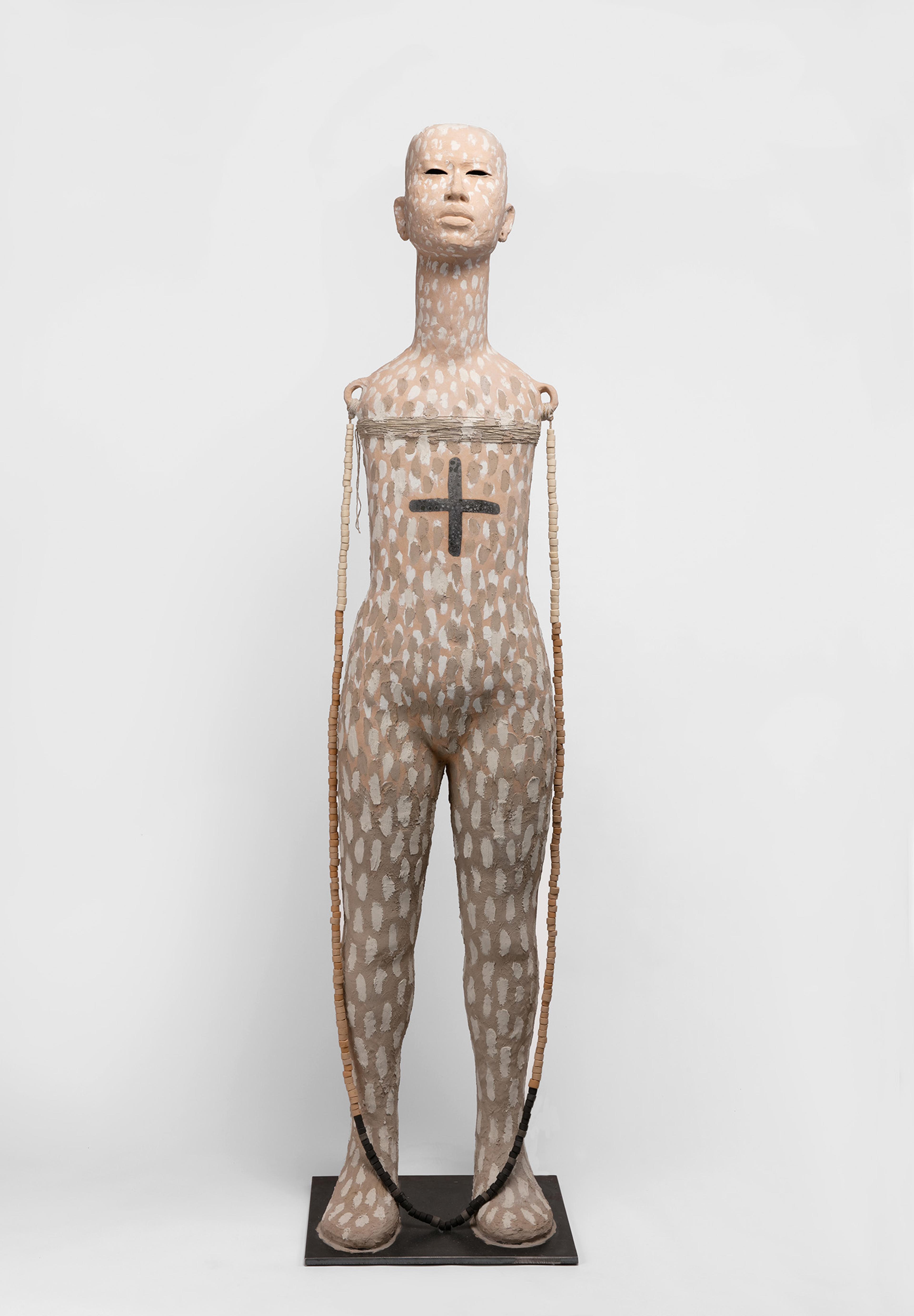
Rose B. Simpson (American, Enrolled member of the Santa Clara Pueblo (Kha’po Owingeh), Santa Fe, New Mexico, 1983). Release, 2022. Clay, steel, twine and grout, 84 × 20 × 18 in. (213.4 × 50.8 × 45.7 cm). The Metropolitan Museum of Art, New York, Purchase, Oscar L. Tang and H.M. Agnes Hsu-Tang Gift, 2023 (2023.359). © Rose B. Simpson. Courtesy of the artist, Jack Shainman Gallery, New York, and Jessica Silverman, San Francisco
Simpson is a mixed-media artist who explores what it means to exist in a postcolonial world, making work imbued with her sustained and personal interest in Indigenous tradition. This sculpture, Release, seems to imply a condition of being rather than of doing. “If I stay in a state of faith,” the artist has said of this piece, “I can let go of a lot of fear.” The figure appears almost as a vessel: instead of arms, two handles appear at the shoulders. Like many of Simpson’s sculptures, the clay here is adorned with distinctive marks and symbols, including two black lines that create a cross on the midsection. The artist defines this shape as a star that indicates the cardinal directions, a source of orientation and guidance.
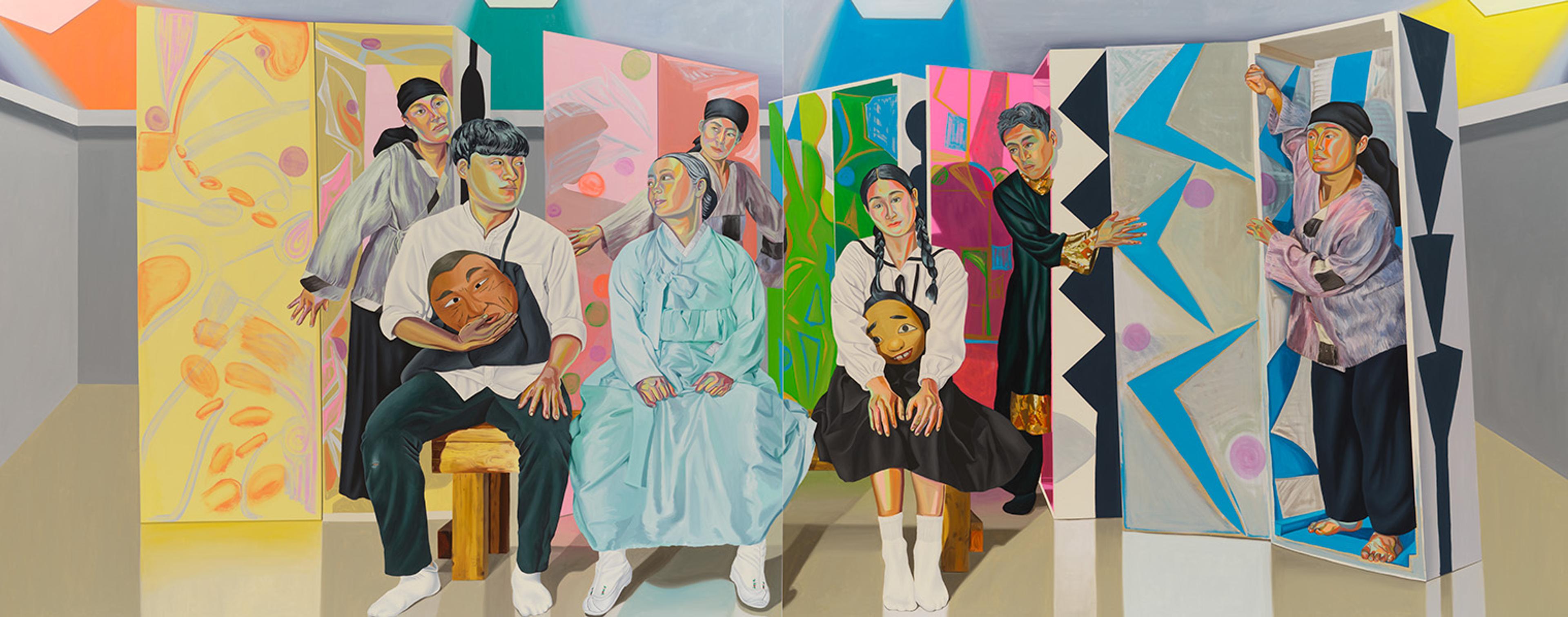
Aliza Nisenbaum (Mexican, 1977). Shin-Myong, Someday in Spring, Dress Rehearsal, 2022. Oil on linen, 75 1/8 in. × 15 ft. 10 1/2 in. × 1 1/2 in. (190.8 × 483.9 × 3.8 cm); each: 75 1/8 × 95 1/4 × 1 1/2 in. (190.8 × 241.9 × 3.8 cm). The Metropolitan Museum of Art, New York, Purchase, Anonymous Gift, 2025 (2026.170a, b). Copyright the artist; Courtesy Anton Kern Gallery, New York and Regen Projects, Los Angeles
Nisenbaum is deeply invested in using her ongoing practice of portrait painting to connect directly with communities. This work was made for the 2022 Gwangju Biennale in South Korea and depicts the Shin-Myong theater troupe during a dress rehearsal for their play Someday in Spring. The performance addresses the trauma and loss experienced due to the Gwangju Uprising in 1980. Nisenbaum depicted the actors rehearsing without their masks to reveal the individuals behind the performance, placing an emphasis on their personal narratives and humanity. The painting illustrates how our understanding of history is shaped by the perspectives of those who present it. A key aspect of Nisenbaum’s practice is a sustained engagement with her sitters, during which she spends considerable time getting to know them, their communities, and their work.
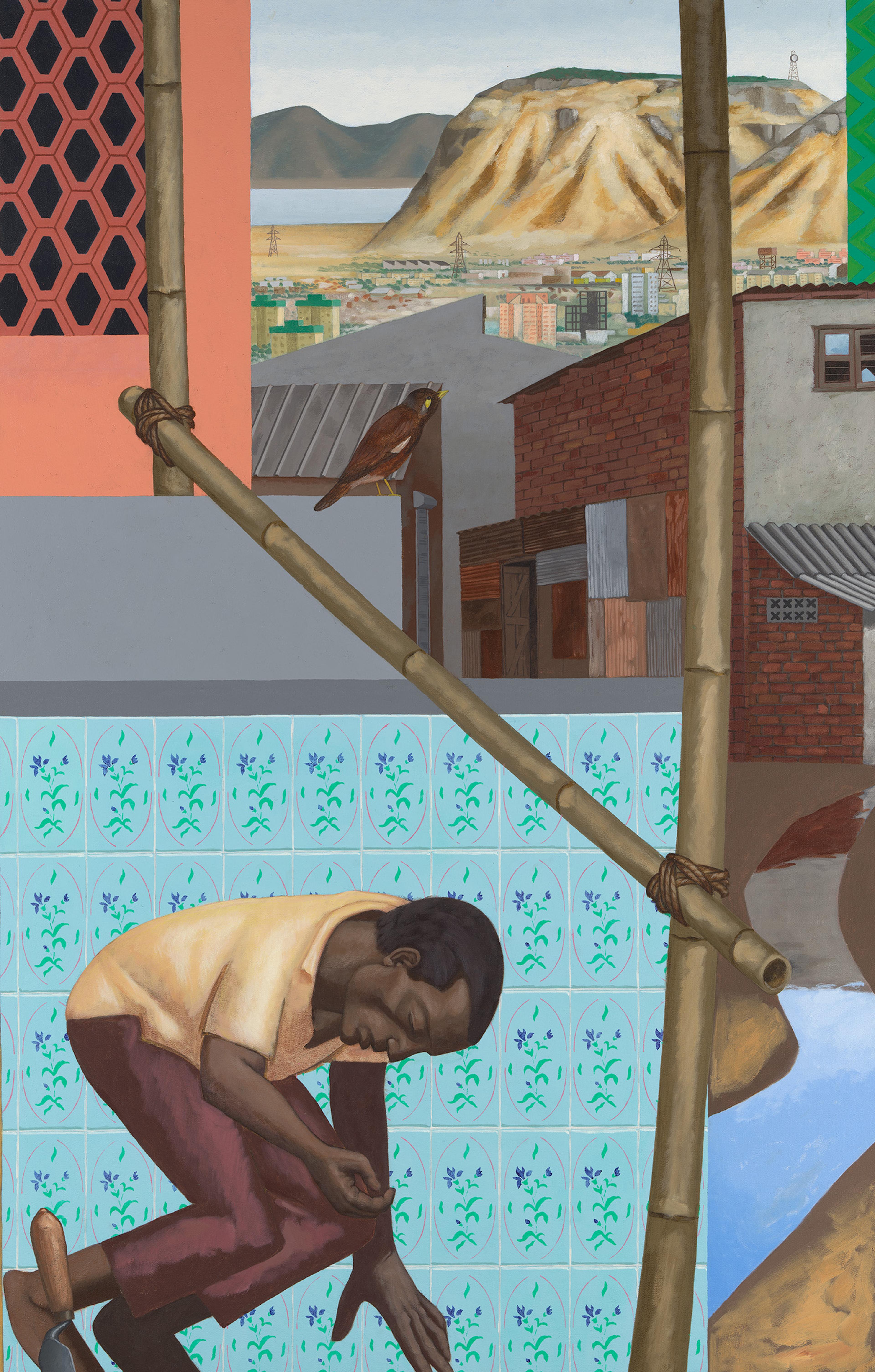
Sudhir Patwardhan (Indian, 1949). Fall, 1998. Acrylic on canvas, 60 × 42 in. (152.4 × 106.7 cm). The Metropolitan Museum of Art, New York, Gift of Virginia and Ravi Akhoury, 2023 (2023.369.3). © Sudhir Patwardhan
Fall depicts a construction worker who has either jumped or fallen from bamboo scaffolding. Behind him rises an unfinished building clad in patterned tiles, their design borrowed from a Mughal painting. Like many works Patwardhan has made since the 1980s, Fall is marked by a representational objectivity that reconstructs from memory a site he observed in Mumbai. He painted it as large tracts of the city were being redeveloped, with cloth mills—the foundation of Mumbai’s industrial power—shutting down and displacing scores of laborers. The painting’s fragmentary narrative heightens the worker’s isolation and loneliness. For Patwardhan, it suggests “a kind of fall from grace” of the unprotected working class, an unraveling social fabric set against the backdrop of a seemingly attractive growing industrial suburb.
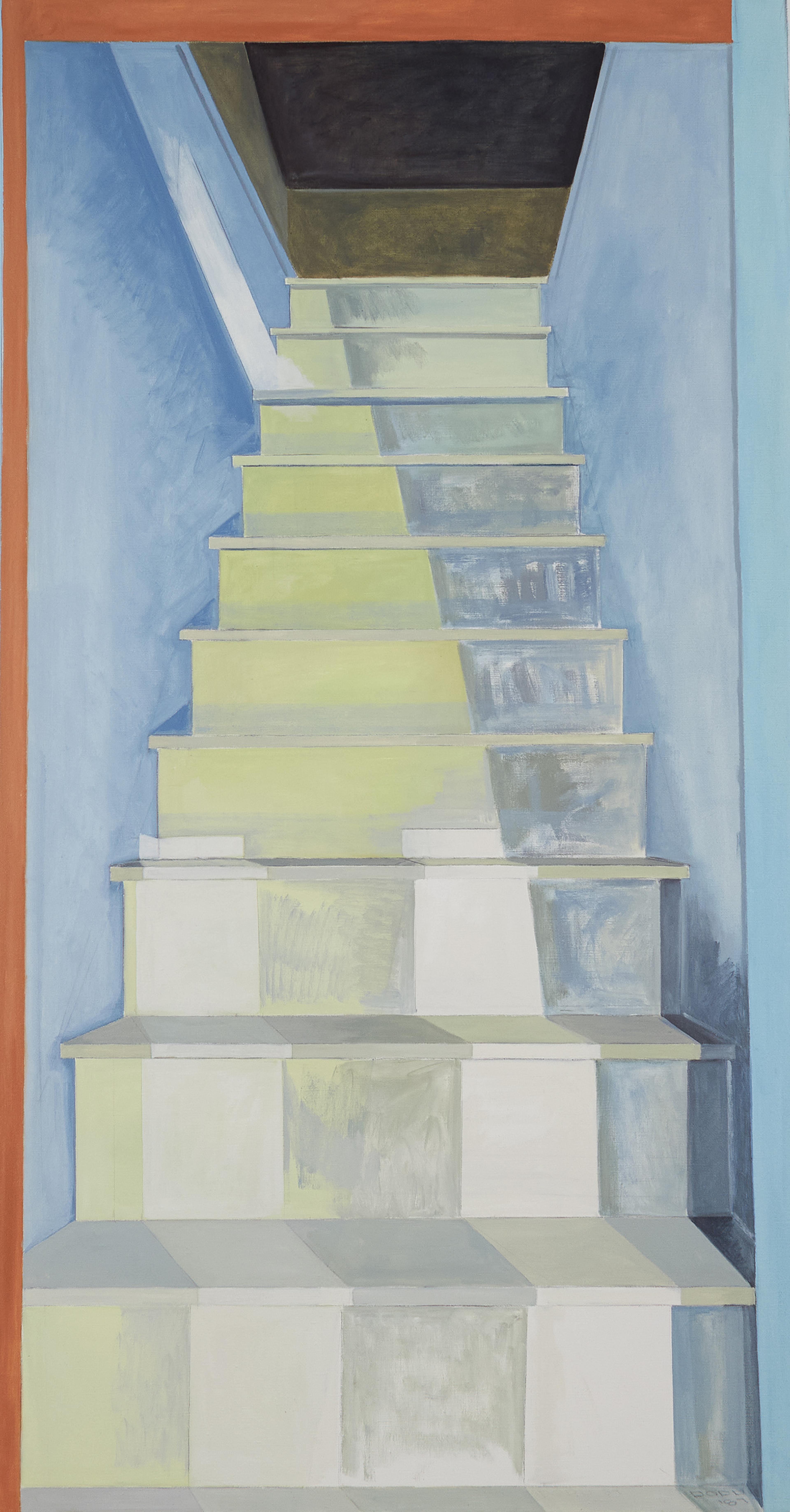
Lois Dodd (American, 1927). Attic Staircase with Sunlight, 1987–88. Oil on linen, 60 × 38 in. (152.4 × 96.5 cm). The Metropolitan Museum of Art, New York, Gift of the Alex Katz Foundation, 2025 (2025.520)
Attic Staircase with Sunlight is a strong example of Dodd’s interest in depicting doorways, staircases, and other portals in her familiar domestic spaces in New Jersey, Maine, and New York City across seasons, weather conditions, and times of day. This work presents a frontal take on a frequent, almost mundane subject for Dodd, focusing the viewer’s attention on the nearly triangular washes of sunlight on the attic steps. The work’s intense structure connects to Dodd’s longstanding interest in geometry—in both the natural and built world—and serves as a powerful means to resist the pull of gravity. Like many of Dodd’s interior scenes, the work is devoid of human figures. It instead constructs a domestic space full of possibility for human presence and daily experience, past or future.
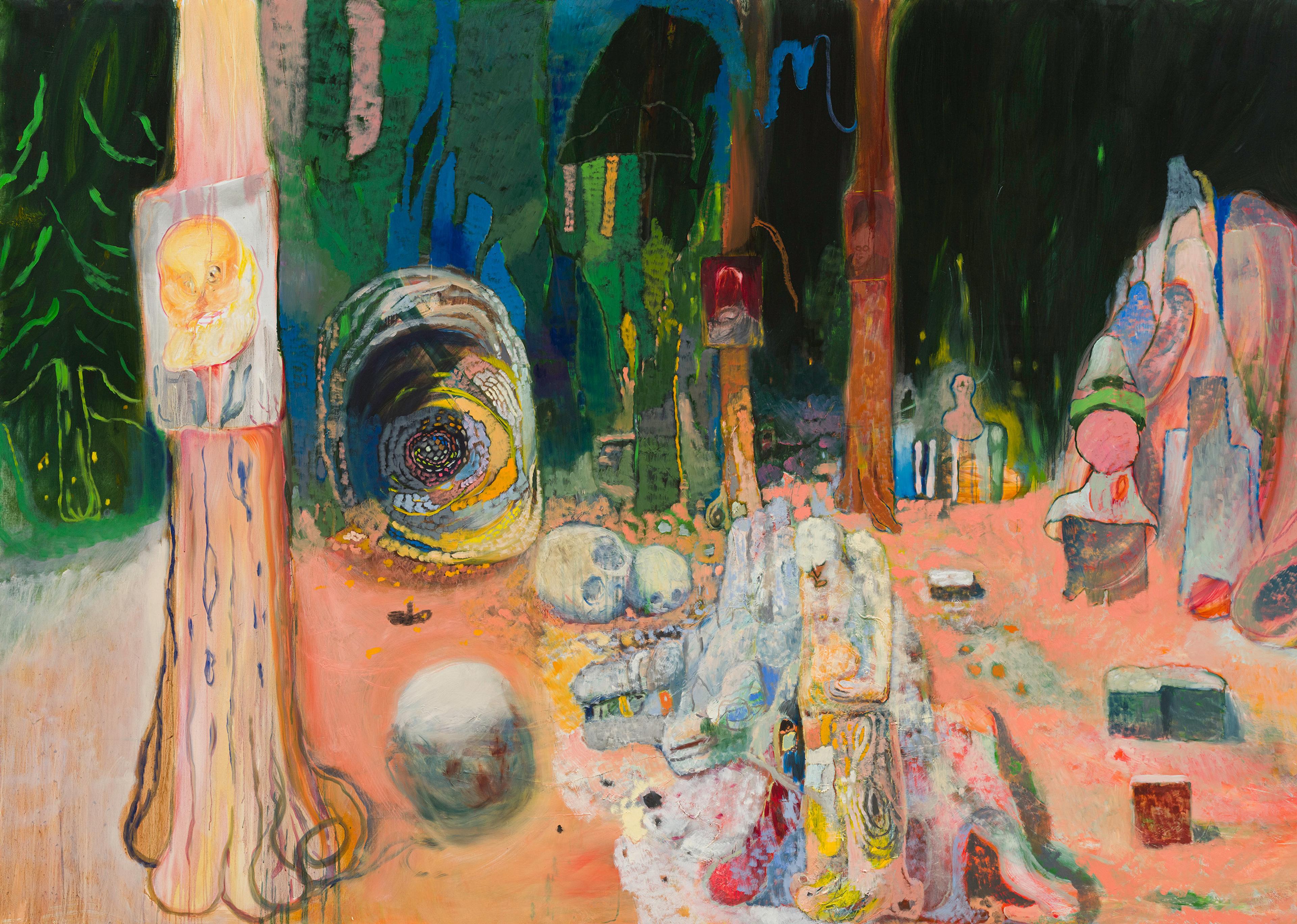
Qiu Xiaofei (Chinese, 1977). Belovezhskaya Forest, 2019–21. Oil on linen, 78 3/4 in. × 9 ft. 2 3/8 in. × 1 3/4 in. (200 × 280.4 × 4.4 cm). The Metropolitan Museum of Art, New York, Purchase, Lila Acheson Wallace Gift, 2025 (2025.308). © Qiu Xiaofei, Courtesy of Pace Gallery
Belovezhskaya Forest unites personal and political history, drawing on European and Chinese painting traditions, architectural forms, and magical realism to create a powerful metaphor for the present. A fantastical psychological drama unfolds across the canvas, anchored in the story of Qiu’s grandfather—a former Trotskyist whose career suffered for that association. The titular site, on the Poland-Belarus border, witnessed Nazi occupation and the Soviet Union’s end. In Qiu’s painting, obscured portraits of Nazi and Communist figures merge with his grandfather’s visage on anthropomorphic trees. They encircle an arhat-like being, a figure drawn from Buddhist art, who is poised toward enlightenment yet surrounded by monsters and skulls that recall the forest’s sinister past. Concentric wormholes evoke spiraling time and memory, while fading forms recall Russian Orthodox churches and socialist dormitories from Qiu’s childhood home in Harbin.
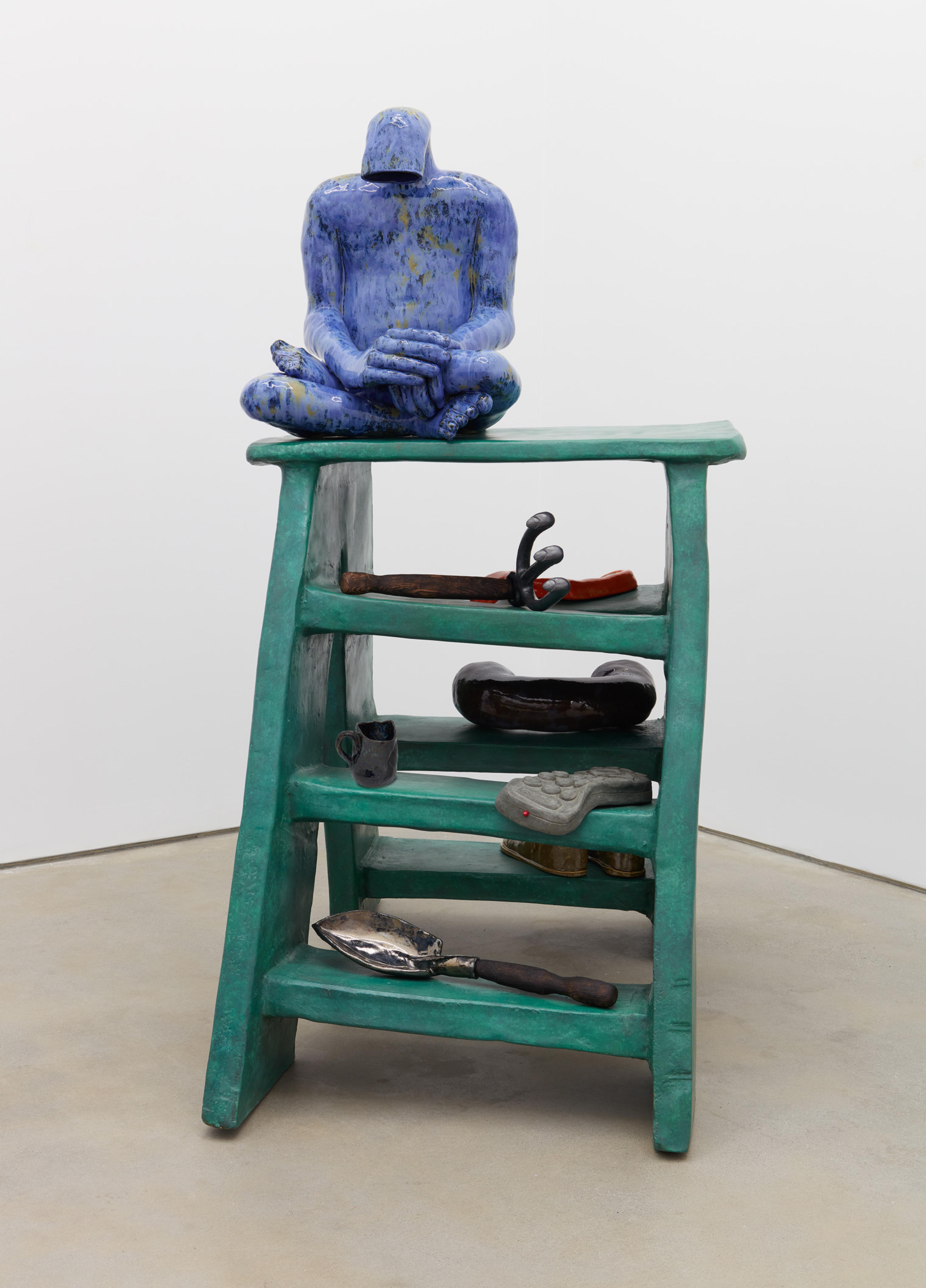
Woody De Othello (American, 1991). Tools, 2022. Bronze, glazed ceramic and wood, 61 × 32 1/2 × 48 in. (154.9 × 82.6 × 121.9 cm). The Metropolitan Museum of Art, New York, Purchase, Camilo Miguel Jr., Mike Mauzé, Jeff Yabuki and Alvaro Leal Gifts, 2023 (2023.394a–j). © Woody De Othello
De Othello creates intriguing, and often humorous, loosely figurative sculptures that represent both the everyday and the metaphysical. An abstracted, headless figure made of clay sits atop an irregularly shaped ladder. On the six rungs are depictions of common items, rendered larger than life with the same cartoonish sensibility as the ladder. By exaggerating each component’s form and expressive quality, the artist expands the emotional and psychological impact of the work. De Othello is also inspired by the cultural traditions of western Africa and the African diaspora, including those of the Yoruba, Bantu, and Kongo peoples. He has embraced certain aspects of their practices, particularly by endowing the objects and sculptures he makes with spiritual power and significance.
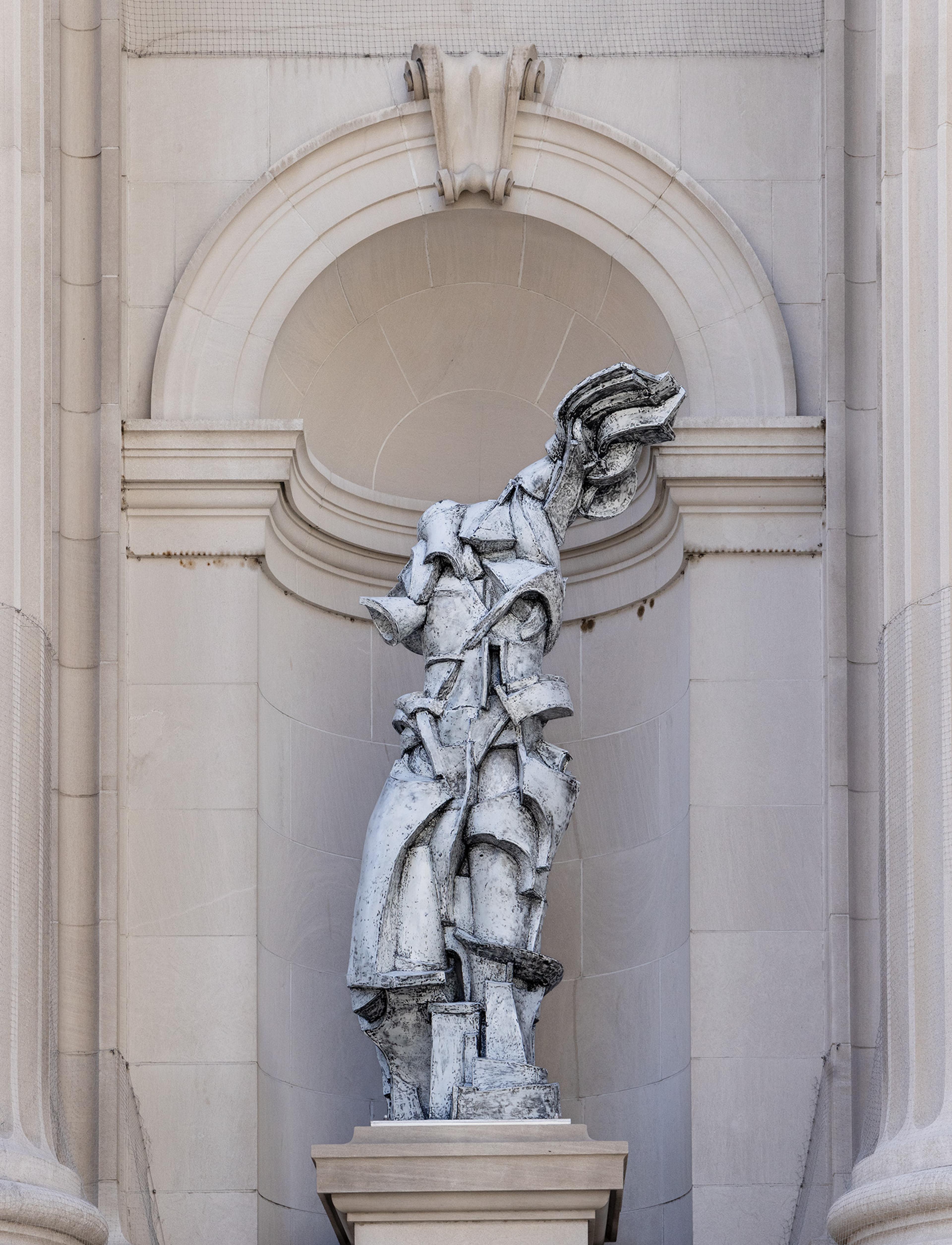
Lee Bul (South Korean, born 1964). Long Tail Halo: CTCS #2, 2024. Stainless steel, ethylene-vinyl acetate, carbon fiber, paint, polyurethane, 8 ft. 9 1/2 in. × 50 in. × 43 11/16 in. (268 × 127 × 111 cm). The Metropolitan Museum of Art, New York, Purchase, The Korean Art and Artist Fund, 2025 (2025.629). © Lee Bul
Responding to sculptural forms across The Met—from ancient Greek and Roman statuary, medieval armor, and Chinese scholar’s rocks to Cubist and Futurist works—Lee created Long Tail Halo: CTCS #2 for the Museum’s 2024 facade commission. Recalling art-historical archetypes, the monumental humanoid stands headless and armless in a contrapposto pose, arrested mid-stride with a broken wing and heavy cladding. It also inherits the aesthetic language of Cyborg, Lee’s hybrid sculpture series from the late 1990s to early 2010s that was influenced by science fiction and anime. Constructed from industrial materials and coatings, meticulously assembled and hand finished, this work evokes patinated metal or porcelain. With its distressed surface and dynamic stance, the figure embodies Lee’s signature ambiguity—it is at once hopeful and defiant, classical and futuristic, forthcoming and elusive.
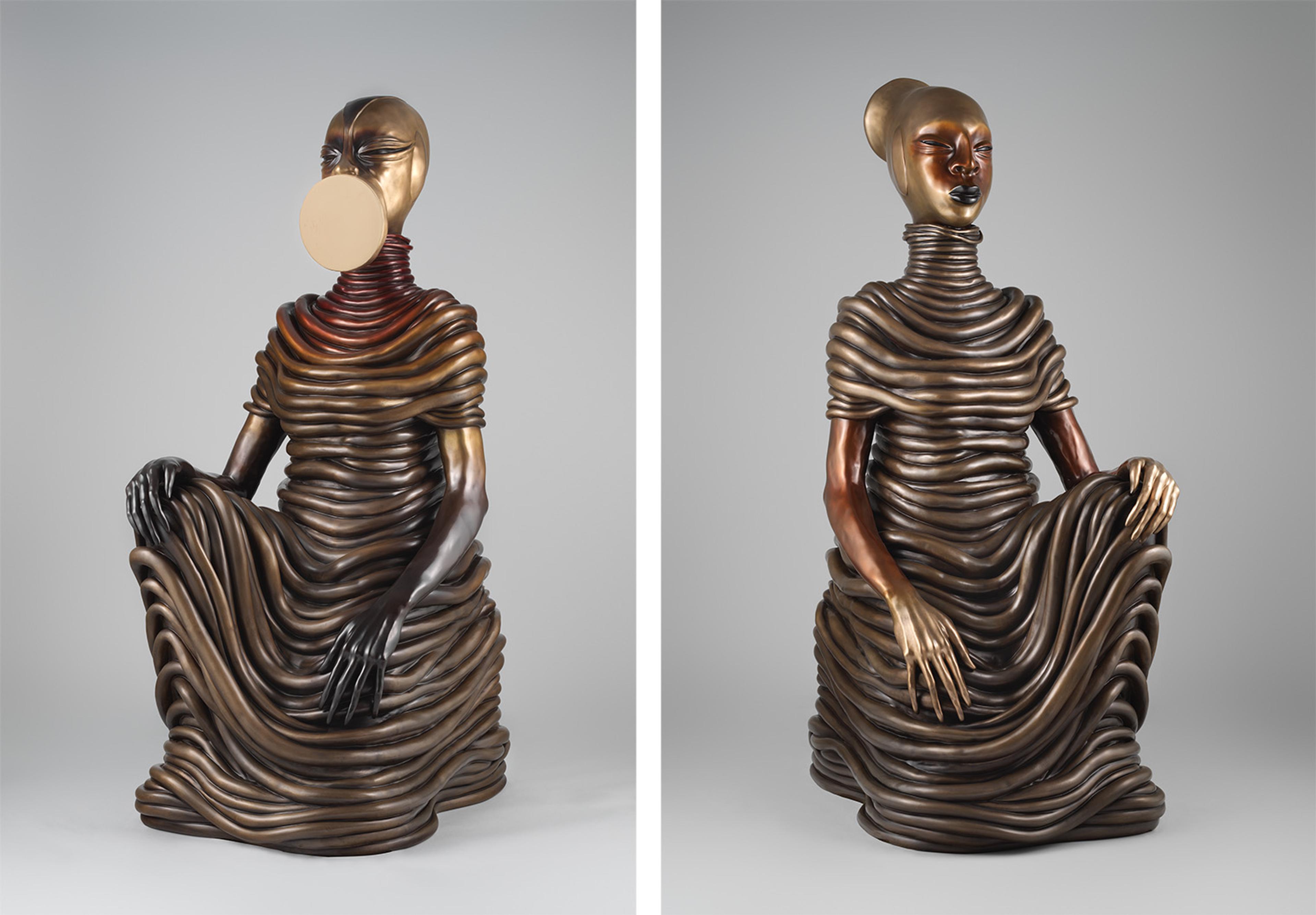
Wangechi Mutu (Kenyan-American, 1972). Left: The Seated I, 2019. Bronze, 79 1/8 × 33 1/2 × 44 1/2 in., 842 lb. (201 × 85.1 × 113 cm). The Metropolitan Museum of Art, New York, Purchase, Hazen Polsky Foundation Fund and Cynthia Hazen Polsky Gift, in celebration of the Museum’s 150th Anniversary, 2020 (2020.119). © Wangechi Mutu. Courtesy of the Artist and Gladstone Gallery, New York and Brussels. Right: The Seated III, 2019. Bronze, 82 1/2 × 33 1/2 × 44 in., 855 lb. (209.6 × 85.1 × 111.8 cm). The Metropolitan Museum of Art, New York, Purchase, Women and the Critical Eye Gifts and Janet Lee Kadesky Ruttenberg Fund, in memory of William S. Lieberman, and in celebration of the Museum’s 150th Anniversary, 2020 (2020.128). © Wangechi Mutu. Courtesy of the Artist and Gladstone Gallery, New York and Brussels
These bronze statues are from a group created by Mutu for The Met’s 2019 facade commission, titled TheNewOnes, will free Us. The kneeling and seated figures are simultaneously spiritual and humanoid. They draw on the tradition of caryatids, or female load-bearers. Carved into columns, these sculptures support buildings physically, and male rulers symbolically. Mutu has reimagined this historical form to create highly stylized figures that exude autonomy and personal agency distinct from the traditional caryatid. Her inspirations for the series include a range of customs and adornments embraced by high-ranking African women, such as beaded bodices, circular necklaces, lip plates, crowns, and skull elongation. The works offer new possibilities for the historical legacies of sculpture while engaging with Mutu’s sustained interest in power, race, gender, and representation.