By his own account, Man Ray's early photography presented an opportunity to be useful. When cofounding the Société Anonyme with Katherine Dreier and Marcel Duchamp in early 1920, he presented himself to Dreier as “a painter” who “used photography to reproduce my paintings.” In her mind, this utilitarian function was “perfect,” as it opened the possibility of producing postcards of exhibited works, adding income to the fledgling venture. After he arrived in Paris in the summer of 1921, Man Ray found in photography a platform for expanding his network: he began with a commission from Francis Picabia to reproduce paintings, transitioned to a role as “recorder of events and personalities,” and ultimately resolved to get “organized as a professional photographer.”[1]
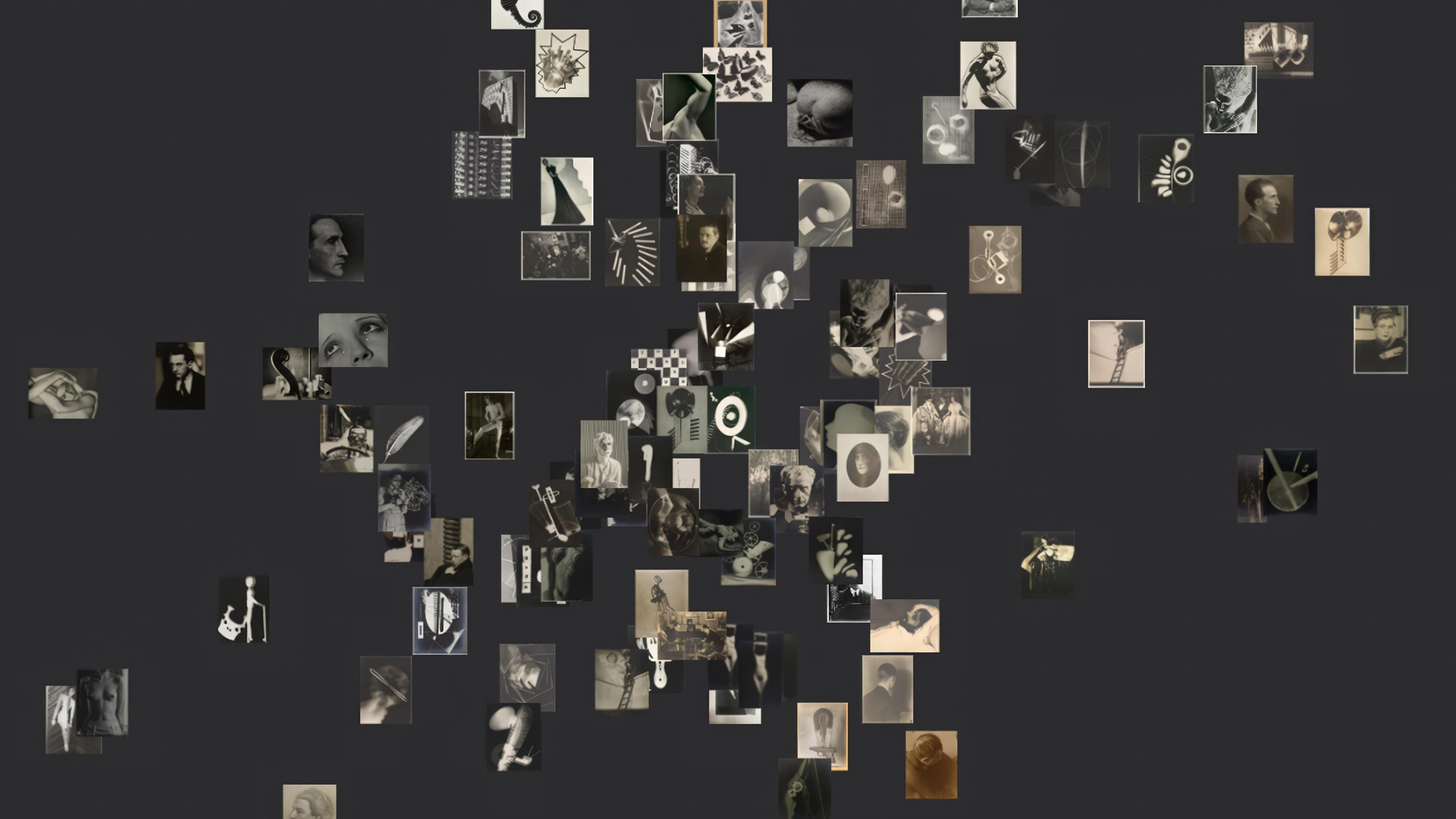
The arc of Man Ray’s career from New York to Paris, with its deepening commitment to photography, required significant shifts in practice. If his work in New York was principally to record things, an adaptation would be required to record people. Man Ray's material record embeds the adaptations and ambitions. Over its ten-year history (2015–25), the Lens Media Lab at Yale University was dedicated to surfacing such histories, providing material evidence to interpret and amplify the practice of photographers. Grounded in metrics made from prints and reference papers, the Lens Media Lab combined traditional art-historical and darkroom practices with methodologies from data science, data visualization, machine vision, and artificial intelligence.[2] In preparation for The Met’s exhibition Man Ray: When Objects Dream (2025), we were invited by The Bluff Collaborative for Research on Dada and Surrealism to work with curators and conservators at The Metropolitan Museum of Art, the Museum of Modern Art, the Yale University Art Gallery, and the J. Paul Getty Museum to measure the fundamental visual properties of rayographs in their collections, adding these data sets to existing information on prints from The Bluff Collection.[3] The result is an interactive app we produced for the project comprised of 124 prints that define Man Ray’s material “feature space” (fig. 1).[4] In addition to documenting his approach to making rayographs, the information gleaned from the study provides an object-based foundation for understanding Man Ray's methods, techniques, and conceptual priorities.
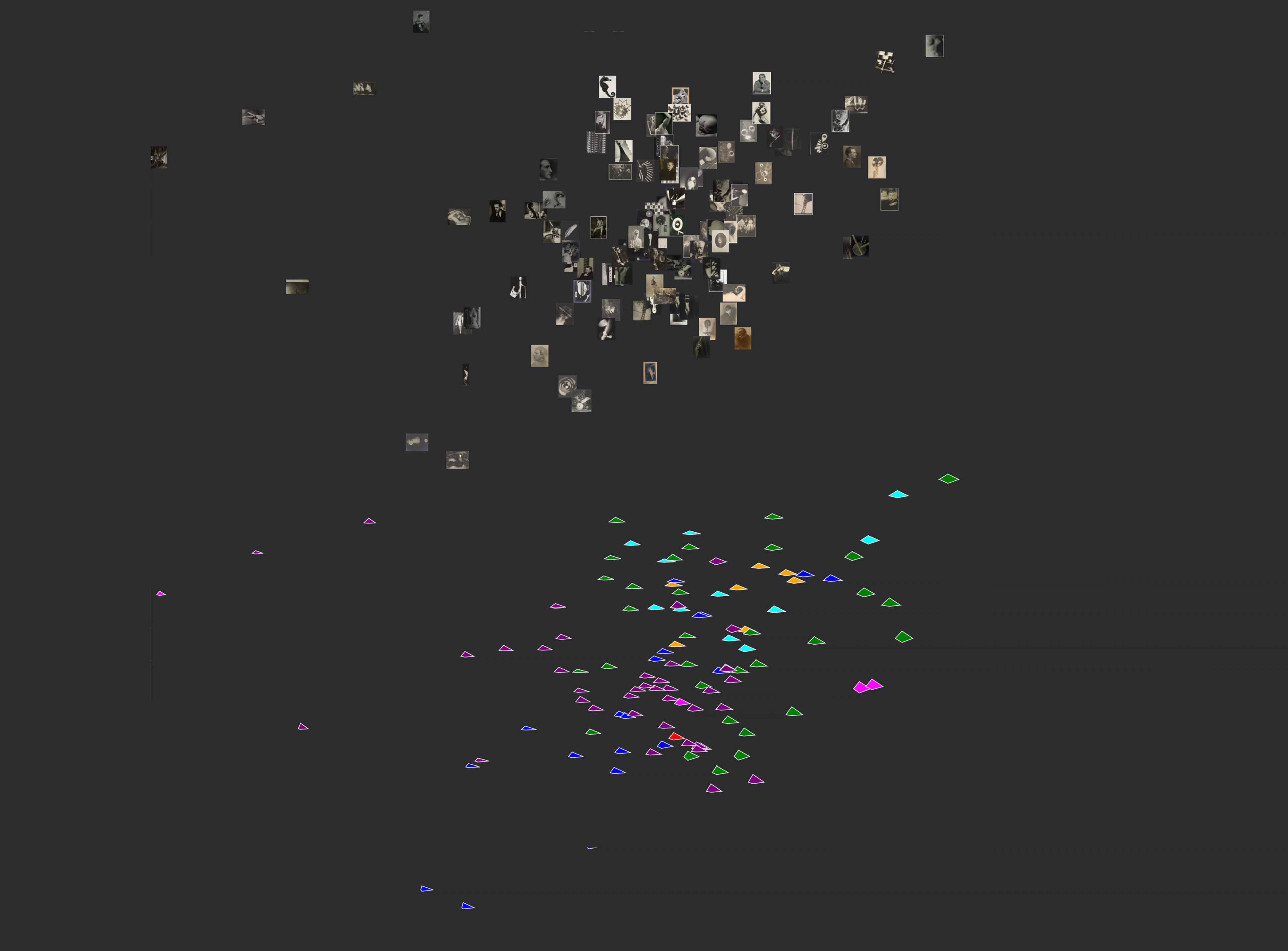
Fig. 1. An image from the Lens Media Lab interactive app showing 124 Man Ray prints organized by paper properties, with image thumbnails (top) and paper-type clusters (bottom) plotted in the same spatial layout.
Within the data set, prints were classified, according to their recorded dates of production, as New York, 1917–20 (seven prints); Portraits, 1921–36 (seventeen prints); and Rayographs, 1921–28 (fifty-nine prints). Exemplar prints from each group were selected based on firm provenance and dating: Élevage de poussière (Dust Breeding) (fig. 2), made with Duchamp in New York; Tristan Tzara (fig. 3), among Man Ray’s first Paris portraits; and an early rayograph of a hand and egg (fig. 4).[5]
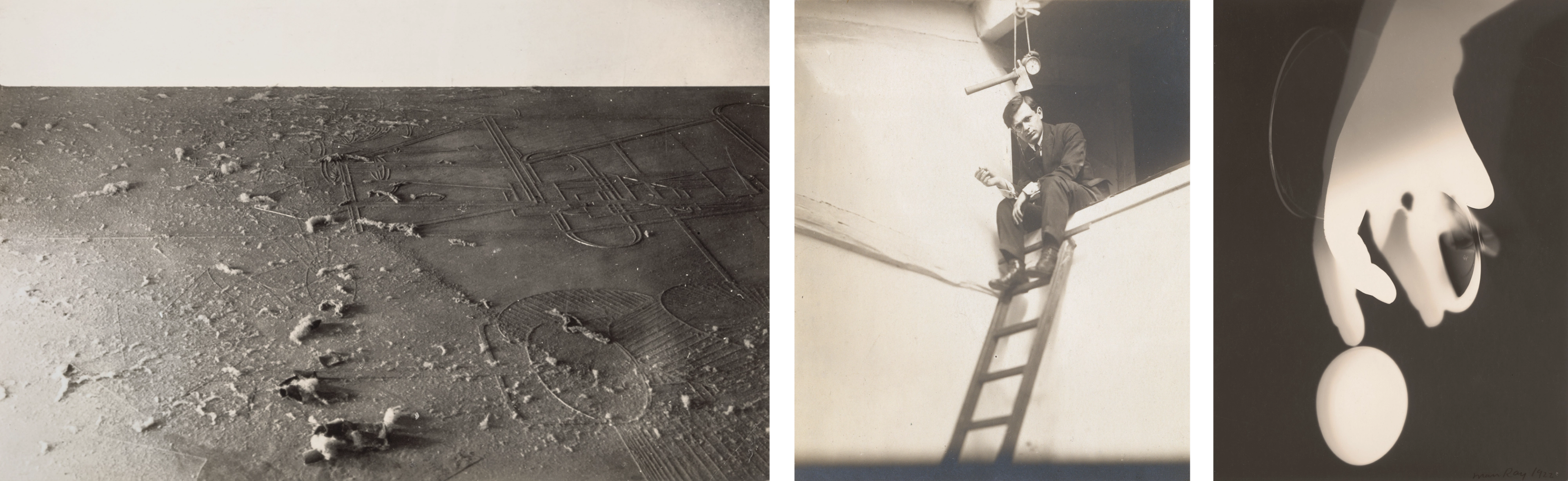
Fig. 2. Man Ray, Élevage de poussière (Dust Breeding), 1920. Gelatin silver print, 2 13/16 x 4 5/16 in. (7.1 x 11 cm). The Metropolitan Museum of Art, New York, The Bluff Collection, Promised Gift of John A. Pritzker. © Man Ray Trust / 2026 Artists Rights Society (ARS), New York. Fig. 3. Man Ray, Tristan Tzara, 1921. Gelatin silver print, 4 1/8 x 3 7/16 in. (10.5 x 8.7 cm). The Metropolitan Museum of Art, New York, Stewart S. MacDermott Fund, 1997 (1997.53). © Man Ray Trust / 2026 Artists Rights Society (ARS), New York. Fig. 4. Man Ray, Rayograph, 1922. Gelatin silver print, 9 1/2 x 7 in. (24.1 x 17.8 cm). The Metropolitan Museum of Art, New York, The Bluff Collection, Promised Gift of John A. Pritzker. © Man Ray Trust / 2026 Artists Rights Society (ARS), New York
The radar charts (the diamond shapes in fig. 5) map these essential properties of the papers used to create the objects in our study: base color from cool to warm, reflectance from glossy to matte, texture from smooth to rough, and thickness from thin to thick. These attributes were commonly used to classify photographic papers throughout the twentieth century, and working photographers were attuned to how the interrelated qualities affected the appearance of a finished print. Metrics for Dust Breeding produce a small diamond hugging the center of the field, which represents a sheet that is smooth, glossy, and thin. This commercial paper was designed to render specificity, making it a window through which a subject could be clearly recorded. In comparison, the diamond for the portrait of Tzara opens out on every side, most prominently to the right and upward, representing a substantially more matte paper, with a slightly warmer highlight tone, greater thickness, and more pronounced roughness. Increased thickness makes for a more assertive object, while the other qualities serve to generalize detail; these attributes of the paper are useful for portraits, in which photographic likeness requires tempering and idealization. The rayograph paper traces nearly the same matte, somewhat rough outline as the Tzara portrait but is slightly thicker and cooler in base tone.
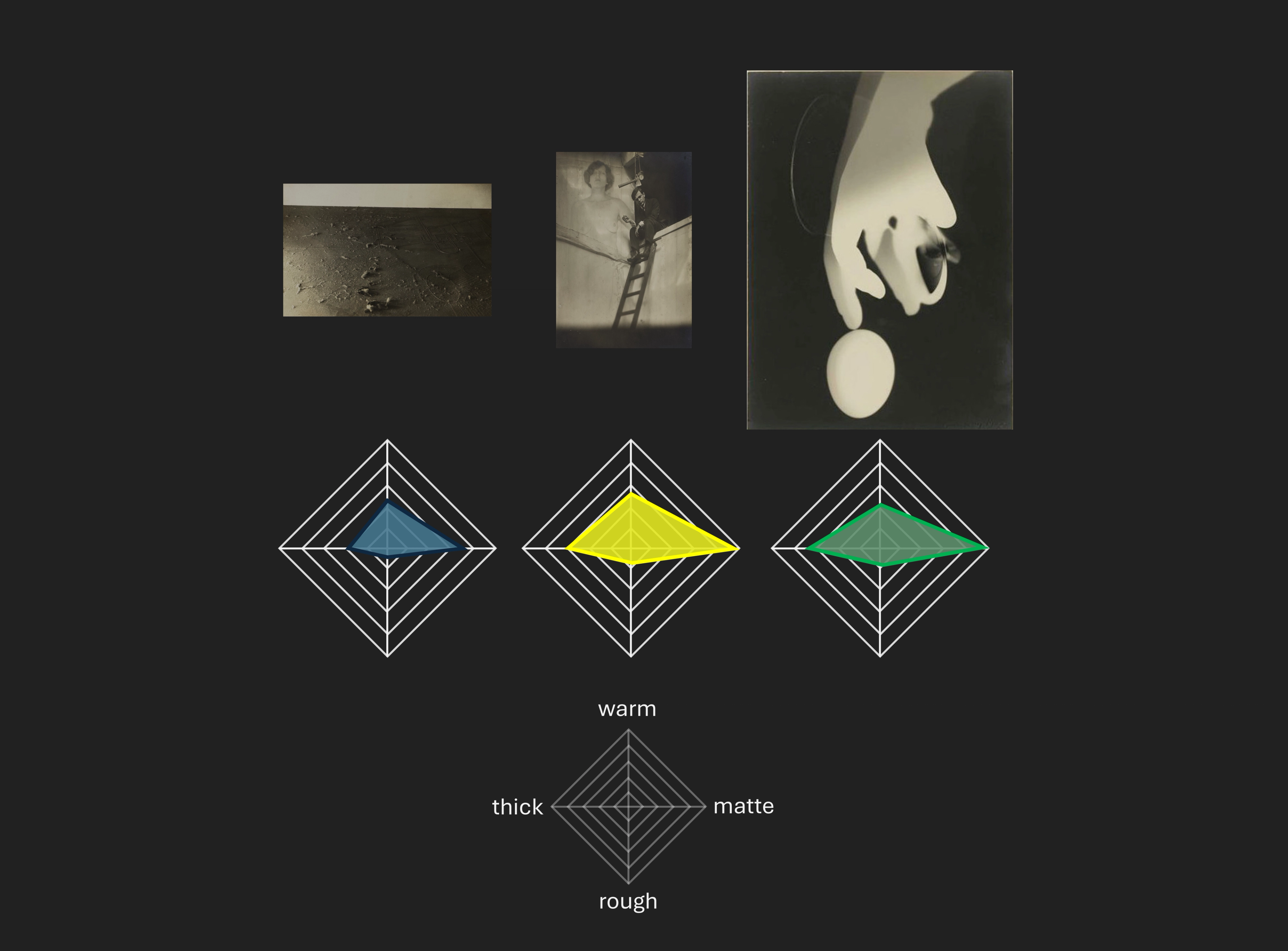
Fig. 5. Paper properties of three exemplar prints, illustrated to scale, left to right: Élevage de poussière (Dust Breeding), 1920 (New York); Tristan Tzara, 1921 (Portrait); an early rayograph, 1922. Chart axes plot base color (cool to warm), reflectance (glossy to matte), texture (smooth to rough), and thickness (thin to thick), each running from the center outward.
Extending this analysis to the three groups in our study allows us to formulate a single metric for specificity and generalization in Man Ray's choice of paper. Figure 6 shows the full data set on this axis: the horizontal coordinate is a weighted combination of all four measured properties (each first placed on a common scale), with the weights chosen that best discriminate between the New York and Portrait groups. The rayographs were not used in fitting the weights, but we project those onto the resulting scale to show where these papers fall relative to the two training groups.[6] The outcome is a substantial overlap between the Portrait and Rayograph groups, with the hand-and-egg rayograph falling very close to the Portrait centroid. Beyond the area of substantial overlap, the rayographs move deeper into generalization territory.
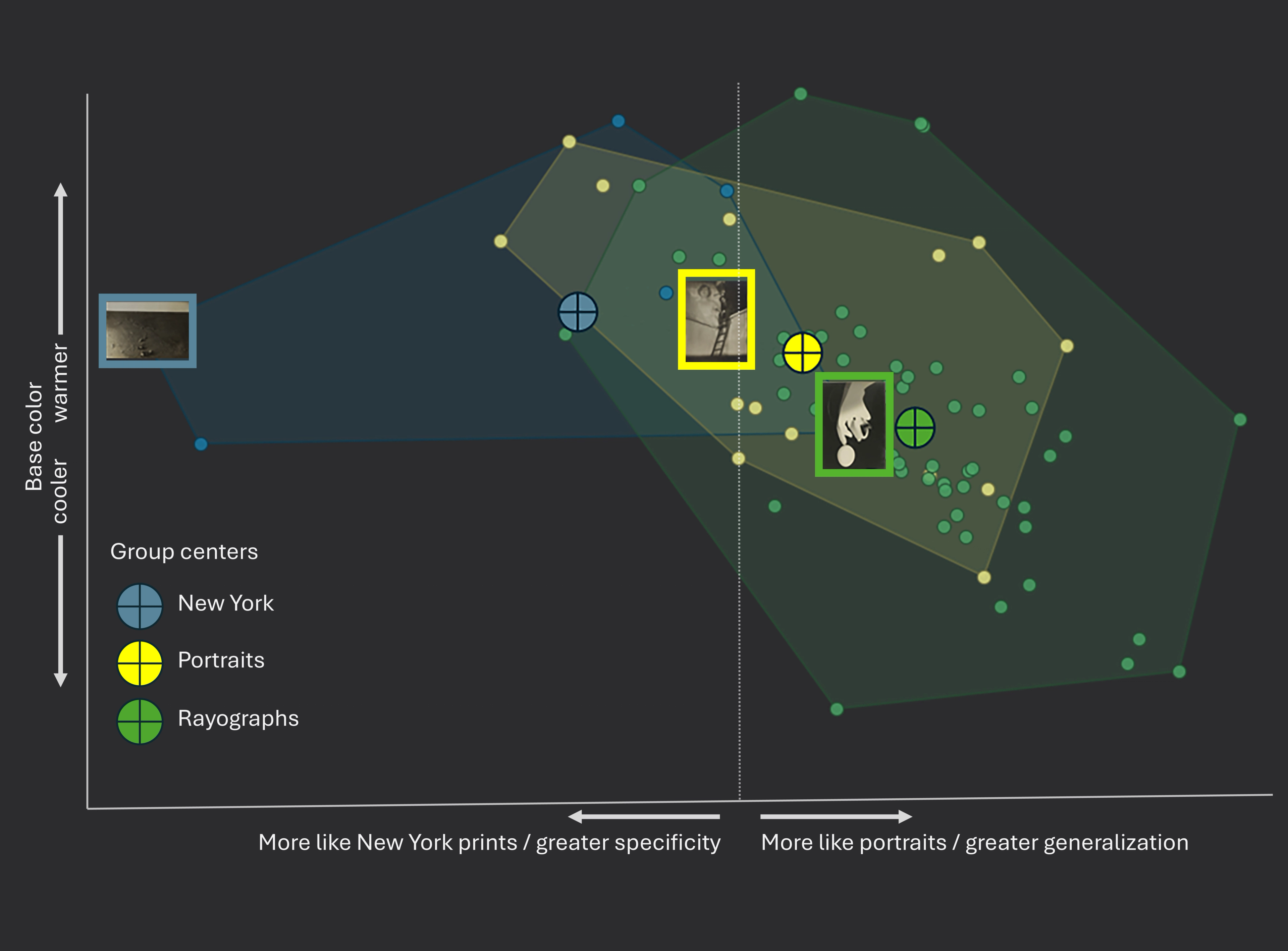
Fig. 6. The full data set plotted along the specificity–generalization axis (horizontal) and base color (vertical). Exemplar prints from Figure 5 are shown as thumbnails.
This tight narrative has one complication. The trend toward generalization—driven mostly by increased texture, matte reflectance, and somewhat thicker papers—is coupled, in Man Ray’s hands, with the use of cooler, more neutral base papers. Plotting warmth, the vertical axis in Figure 6, shows this tendency clearly: rayograph papers carry the most neutral, or “whitest” highlights of the three groups. This finding contradicts an observation from the Lens Media Lab's survey of more than 7,500 historic photographic papers, in which warm highlight tones are typically associated with the other characteristics that govern generalization, and cool or neutral highlights line up with specificity.[7]
A tidy story, in any case, is a poor fit for an artistic practice—especially one like Man Ray’s, built on innovation, experimentation, advancement, and regression. The substantial overlap among the groups in Figure 6 makes that plain: no measured property cleanly separates one period or genre from the next. What this evidence offers is not a boundary but a tendency, useful precisely because it tracks the broad direction of the artist's material choices without flattening their variability.
Through this lens, Man Ray’s papers relay an effort first to record things and then to produce portraits of both people and things. The lightweight, smooth, glossy papers of the New York period are characteristic of a new generation of mass-marketed silver-gelatin papers manufactured for amateurs. Their documentary purpose, well suited for capturing family birthday parties and trips to the beach, also made these papers a perfect choice for a learning photographer with a Dadaist, anti-art bias. However, they were not a good option for portraiture, in which a degree of idealization is required. Man Ray adapted, leaning on the picture-making norms of the early twentieth-century Pictorialists to subordinate detail and suggest timelessness in his portraits. When he worked on his rayographs, Man Ray drew on his experience with materials. He carried portrait norms forward with matte surfaces, open textures, and heavy papers that lend standing to the commonplace objects depicted while prizing the cooler, more neutral highlights inherited from his New York practice. The result is a portrait of a thing: a striking animism suggested by surface and substance yet rendered with neutrality that refuses sentiment.
Notes
Man Ray, Self Portrait (1963; repr., Little, Brown, 1988), 78 (Dreier), 95 (Picabia), 100 (resolve to be a photographer).
Katherine Mintie, Paul Messier, and Damon Crockett, “Closer Looking: Computer Vision in Material Studies of Art,” Art Bulletin 106 (August 2024): 29–32.
The full list of collaborators includes: Joitree Alam, Damon Crockett, Paul Messier, Katherine Mintie, Cynthia Yue, Lens Media Lab, Yale University, New Haven; Micayla Bransfield, Stephanie D'Alessandro, Tess Hamilton, Nora Kennedy, Natasha Kung, Stephen C. Pinson, Katherine Sanderson, The Met; Victoria Binder, Sarah Freeman, James A. Ganz, Virginia Heckert, J. Paul Getty Museum, Los Angeles; Lee Ann Daffner, Museum of Modern Art, New York; and Judy Ditner, Theresa Fairbanks-Harris, Gabriella Svenningsen, Yale University Art Museum, New Haven.
Derived from artificial intelligence, pattern recognition, and early machine learning, a “feature space” is a conceptual, mathematical environment in which complex objects are described by measurable attributes, allowing patterns or relationships among them to be compared.
Dating Man Ray's prints can be perilous, given his tendency to return to negatives over the course of his lifetime, combined with third-party access to those negatives in his later years and posthumously. For these three prints, however, fiber content (principally the amount of rag in the paper) points to paper-manufacturing practices in the 1910s and 1920s that were becoming obsolete by 1930. Dust Breeding carries an inscription on the verso in what appears to be Duchamp's hand, reading “Man Ray / 1947 B'way / NYC.” The Tzara portrait, whose negative likely dates from 1921, is dedicated and signed on the mount “Man Ray 1922” (see Man Ray, Self Portrait, 107). The rayograph of the hand and egg lacks equivalent inscriptions; the print date of 1922 is generally accepted and appears in Stephanie D’Alessandro and Stephen C. Pinson, Man Ray: When Objects Dream, exh. cat. (The Metropolitan Museum of Art, 2025).
The horizontal axis in Figure 6 is the single discriminant produced by a Fisher Linear Discriminant Analysis (Fisher 1936) of the four measured properties. The features were standardized (z‑scored) across the 83‑print working subset (New York + Portrait + Rayograph), and the LDA was fit using only the New York and portrait prints as training groups; the rayographs played no role in determining the axis; they were projected onto it post hoc.
Damon Crockett, Paul Messier, and Katherine Mintie, Paperbase (Lens Media Lab, Yale University, 2024), https://paperbase.xyz.
