Mantle
The garment was sewn from rectangular panels and had sleeves that were seldom, if ever, used. [3] Instead, it was draped over one or both shoulders and fastened across the chest with ties or straps. The sleeves were often sewn shut so that they could be used as pockets for small tools. In some places, the sleeves became shorter or disappeared altogether. [4]
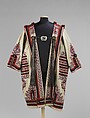
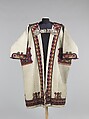
Szürs played an important role in Hungarian society. They were worn mostly by shepherds or other men who spent most of their lives outdoors, as the thick wool felt provided protection from the elements. The large rectangular collar on the back of a szür has two roundels at the bottom that could be knotted together to form a hood. Versatile and weatherproof, a szür could be used to sleep under outdoors or as a horse blanket in winter. Herdsmen, most of whom worked under estates, typically received a szür as payment for their first year of service.
The richly embroidered type, called the cifraszür, was characteristic of the nineteenth century. Given the care that went into making them, cifraszürs were prized luxury possessions and self-conscious statements of regional association and pride. The szür also played a key role in courtship. A young man going to propose would arrive at the home of the woman he hoped to marry in his cifraszür and leave it there. If his szür was hung in front of the house the next morning, his proposal had been refused; if not, he could go inside and ask for her hand. This custom is reflected in the Hungarian idiom kitették a szürét ("his szür was put out"), meaning to throw someone out. A cifraszür remained its owner’s festive attire throughout his life and, at his death, was draped over his coffin. [5]
Stewart Culin (1858–1929) was the Brooklyn Museum’s first Curator of Ethnology from 1903 to 1929. He built the collection of its new department by conducting expeditions across the Americas, Asia, and Europe. Between 1920 and 1923, he collected Central and Eastern European costumes in what are now Czech Republic, Slovakia, Hungary, Romania, Croatia, among other neighboring countries.
Culin collected folk art objects with particular interest in their socio-cultural and historic significance. Through meticulous record keeping of field notes, correspondence, chapbooks, and clippings, he sought to document the cultural life of the region and the circumstances of each acquisition. These materials are now held in the Culin Archival Collection at the Brooklyn Museum Archives.
Culin was traveling in Central Europe in 1921 as the Treaty of Trianon, the peace treaty that divided the territory of the former Austro-Hungarian Empire in the aftermath of the World War I, came into effect. The question of who and what was considered Hungarian was thus especially urgent at the moment of his collecting. Culin’s interest in Hungary was twofold. He wanted to assist in the country’s economic recovery, especially by supporting its decorative arts industry, and he wanted to inspire American designers and educate the public. Today, his collection and his archive remain important resources for the study of cultural anthropology, art and cultural history, and costume and textile design. [6]
[Sojeong Lim 2026]
[1] Iván Balassa and Gyula Ortutay. Hungarian Ethnography and Folklore. Budapest: Corvina Kiadó, 1979, p. 332.
[2] Veronika Gervers-Molnár. The Hungarian Szür: An Archaic Mantle of Eurasian Origin. Toronto: Royal Ontario Museum, 1973, p. 42.
[3] Gervers-Molnár, The Hungarian Szür, p. 3.
[4] Balassa and Ortutay, Hungarian Ethnography and Folklore, p. 325.
[5] Gervers-Molnár, The Hungarian Szür, pp. 3–4.
[6] Deirdre E. Lawrence and Deborah Wythe. "Guide to the Culin Archival Collection." Brooklyn Museum Archives. https://opencollection.brooklynmuseum.org/research/culin/
Artwork Details
- Title: Mantle
- Date: 1840–70
- Culture: Hungarian
- Medium: wool, leather, cotton
- Dimensions: Length at CB: 49 1/2 in. (125.7 cm)
- Classification: Outerwear-Menswear
- Credit Line: Brooklyn Museum Costume Collection at The Metropolitan Museum of Art, Gift of the Brooklyn Museum, 2009; Museum Expedition 1922, Robert B. Woodward Memorial Fund, 1922
- Object Number: 2009.300.56
- Curatorial Department: European Sculpture and Decorative Arts
More Artwork
Research Resources
The Met provides unparalleled resources for research and welcomes an international community of students and scholars. The Met's Open Access API is where creators and researchers can connect to the The Met collection. Open Access data and public domain images are available for unrestricted commercial and noncommercial use without permission or fee.
To request images under copyright and other restrictions, please use this Image Request form.
Feedback
We continue to research and examine historical and cultural context for objects in The Met collection. If you have comments or questions about this object record, please contact us using the form below. The Museum looks forward to receiving your comments.
Content Notice
The Metropolitan Museum of Art presents over 5,000 years of art from around the world, and our online collection reflects ongoing work conducted over the course of our more than 150-year history. You may encounter objects or images that may be inappropriate for some viewers or information that may be outdated.