English
DonateMembershipTickets

Snuffbox in the form of a slipper

Factory Mennecy
ca. 1750–60
On view at The Met Fifth Avenue in Gallery 538
In eighteenth-century Europe, Paris led the production of high-quality luxury goods. Parisian goldsmiths made a wide range of small, personal articles such as snuffboxes; étuis to hold sealing wax, tweezers, or utensils for sewing; souvenirs, which contained thin ivory tablets for note taking; and shuttles for knotting lace. Gold snuffboxes and boxes decorated with portrait miniatures were prized and frequently given as royal gifts, often to ambassadors or members of the court in lieu of cash payments for their services. Coveted and admired, these boxes were produced from a variety of materials. The best were skillfully made of gold and embellished with diamonds, enameled decoration, lacquer, and other luxurious materials. By the middle of the century, the taking of snuff had become an entrenched social ritual, and the snuffbox, too, had become an important social prop. Snuffboxes were considered highly fashionable accessories, with some merchants advertising new boxes with each change of season. The popularity of snuffboxes extended to all levels of society, and for those who could not afford gold, boxes were produced in less expensive materials such as silver, tortoiseshell, porcelain, or domestically produced lacquer.

Artwork Details

Object Information
  • Title: Snuffbox in the form of a slipper
  • Factory: Mennecy
  • Date: ca. 1750–60
  • Culture: French, Mennecy
  • Medium: Soft-paste porcelain, gold
  • Dimensions: Length: 3 9/16 in. (9 cm)
  • Classification: Ceramics-Porcelain
  • Credit Line: The Jack and Belle Linsky Collection, 1982
  • Object Number: 1982.60.363
  • Curatorial Department: European Sculpture and Decorative Arts
More Artwork
Seated Chinese, Mennecy or, Soft-paste porcelain, French, possibly Mennecy or Sceaux
Factory Possibly Mennecy
Factory Sceaux
ca. 1755–65
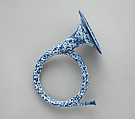
Ceramic Horn, Glazed pottery, French
French
late 18th or early 19th century
Snuffbox or patchbox, Saint James's Factory  British, Soft-paste porcelain, agate, gold, British, London
Saint James's Factory
ca. 1751–54
Dancing Woman, Meissen Manufactory  German, Hard-paste porcelain, gilt-bronze, German, Meissen
Manufactory Meissen Manufactory
Modeler Possibly by Johann Joachim Kändler
Modeler Possibly by Friedrich Elias Meyer
ca. 1748
Couple Dressed as Persians, Mennecy, Soft-paste porcelain, French, Mennecy
Factory Mennecy
Modeler Attributed to Mathieu Simon
ca. 1760

Research Resources

The Met provides unparalleled resources for research and welcomes an international community of students and scholars. The Met's Open Access API is where creators and researchers can connect to the The Met collection. Open Access data and public domain images are available for unrestricted commercial and noncommercial use without permission or fee.

To request images under copyright and other restrictions, please use this Image Request form.

Feedback

We continue to research and examine historical and cultural context for objects in The Met collection. If you have comments or questions about this object record, please contact us using the form below. The Museum looks forward to receiving your comments.

Send feedback

Content Notice

The Metropolitan Museum of Art presents over 5,000 years of art from around the world, and our online collection reflects ongoing work conducted over the course of our more than 150-year history. You may encounter objects or images that may be inappropriate for some viewers or information that may be outdated.