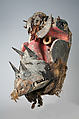
Gegon face mask
The defining activity of this mask is speech. The hinged lower jaw, with a tongue carved in relief on its inner surface, let the mask appear to speak as it addressed an audience. In the past, such masks spoke in sounds rather than words—twittering, croaking, and growling—while an attendant translated for the listeners (Fischer 1978, 19). In the Man region today, a guégon addresses audiences directly in local languages to perform libations, bless, and judge conflicts.
Scholars have read the projecting nose in different ways. The art anthropologist Hans Himmelheber and his son, the ethnologist Eberhard Fischer, worked among the Dan in the mid-twentieth century. They classified the nose as a beak and the masquerade as a bird. Because the name gegon makes no reference to birds, they argued that the genre had been borrowed from a neighboring people (Fischer and Himmelheber 1984, 81). The ethnomusicologist Daniel Reed, working near Man in the 1990s, found no such association (Reed 2003, 89). The metal around the eyes offers a rough guide to date. In the 1960s, the carver Jean Don Gba of Petit-Gbapleu told Himmelheber that masks in his area once had round eyes ringed with white lizard droppings. Imported metal replaced that white during the years when colonial pacification allowed carvers to travel and see Guro, Baule, and Senufo sculpture, which inspired slit eyes (Himmelheber 2016, 359–60). Jean spoke of white metal rather than the copper alloy used here. His account still suggests that this mask postdates that shift, and it shows that Dan carvers tracked the history of their own style.
Masks of masculine types are adorned with materials from the forest, such as fur, feathers, leaves, and cord (Fischer 1978, 19). The circular holes around the edge of this one once secured the crest and raffia that completed the figure. Each of these elements told those who knew the mask which spirit had come. Most Dan masks also carry individual proper names (Fischer and Himmelheber 1984, 23, 67). The name of this one was not recorded when it left the region, and neither were the names of the initiated men who fitted its fur and nails. It is unfortunately impossible to know when it was produced solely based on its physical attributes especially as this genre is still being danced and celebrated today.
Yann Petit, 2026
Jane and Morgan Whitney Fellow
Artwork Details
- Title: Gegon face mask
- Artist: Dan artist
- Date: 19th– mid-20th century
- Geography: Côte d'Ivoire, western region; Liberia, northeastern region
- Culture: Dan peoples
- Medium: Wood, fur, sacrificial material, copper alloy, iron, string, pigment
- Dimensions: H. 12 1/2 x W. 5 3/4 in. (31.8 x 14.6 cm)
- Classification: Wood-Sculpture
- Credit Line: Gift of Mrs. Ruth Trunzo, 1976
- Object Number: 1976.410.3
- Curatorial Department: The Michael C. Rockefeller Wing
More Artwork

Research Resources
The Met provides unparalleled resources for research and welcomes an international community of students and scholars. The Met's Open Access API is where creators and researchers can connect to the The Met collection. Open Access data and public domain images are available for unrestricted commercial and noncommercial use without permission or fee.
To request images under copyright and other restrictions, please use this Image Request form.
Feedback
We continue to research and examine historical and cultural context for objects in The Met collection. If you have comments or questions about this object record, please contact us using the form below. The Museum looks forward to receiving your comments.
Content Notice
The Metropolitan Museum of Art presents over 5,000 years of art from around the world, and our online collection reflects ongoing work conducted over the course of our more than 150-year history. You may encounter objects or images that may be inappropriate for some viewers or information that may be outdated.