Kilonda (ceremonial axe)
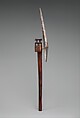
The axe's massive handle matches the blade's solidity and scale. Its flared base and bulbous apex echo the blade's spreading curves, while the striking opulence of the copper sheeting counterbalances the visual complexity of the iron blade. A precious metal originating far to the south at the headwaters of the Zambezi River, copper was an expensive and rare material. Its extensive use in this piece not only beautifies it, but also indicates the ruler's participation in and mastery over long-distance commerce.
Axes were employed as symbols of royal power throughout present-day southeastern Democratic Republic of Congo and northern Angola. Elaborate versions of this functional tool were created as royal scepters that were potent symbols of civilization and cultural achievement. They represented the body of esoteric skills and knowledge associated with ironworking, an activity rich in practical as well as supernatural significance. Indigenous rulers often traced their ancestry back to culture heroes credited with the discovery of ironworking, and these metal implements reinforced those dynastic connections and suggested the leaders' control over potent processes of creation and transformation. The wooden handles of royal axes were often highly decorated, covered with exquisitely carved motifs or encased in precious metals or animal hides.
Artwork Details
- Title: Kilonda (ceremonial axe)
- Artist: Songye artist
- Date: 19th–first half of 20th century
- Geography: Democratic Republic of the Congo, Kasai River region (?)
- Culture: Songye peoples
- Medium: Iron, copper, wood
- Dimensions: W. 8 3/4 × D. 2 × L. 14 1/2 in. (22.2 × 5.1 × 36.8 cm)
- Classification: Metal-Implements
- Credit Line: The Michael C. Rockefeller Memorial Collection, Gift of Dr. and Mrs. Werner Muensterberger, 1959
- Object Number: 1978.412.370
- Curatorial Department: The Michael C. Rockefeller Wing
More Artwork
Research Resources
The Met provides unparalleled resources for research and welcomes an international community of students and scholars. The Met's Open Access API is where creators and researchers can connect to the The Met collection. Open Access data and public domain images are available for unrestricted commercial and noncommercial use without permission or fee.
To request images under copyright and other restrictions, please use this Image Request form.
Feedback
We continue to research and examine historical and cultural context for objects in The Met collection. If you have comments or questions about this object record, please contact us using the form below. The Museum looks forward to receiving your comments.
Content Notice
The Metropolitan Museum of Art presents over 5,000 years of art from around the world, and our online collection reflects ongoing work conducted over the course of our more than 150-year history. You may encounter objects or images that may be inappropriate for some viewers or information that may be outdated.