Hand with beaker
The significance of the subject of this vessel is unknown. Although at times the ritual amputation of limbs was known to have been practiced in ancient Peru, particularly among the Moche of the North Coast (Bourget, 2016; Toyne, 2015), this object seems unrelated to such practices. The ceramic balances best when the blunt end of the arm is on a surface and the hand sticks up. In this position, liquid would rest in the forearm, and when a drink was to be taken, the piece would be move to a horizontal position so that liquid fill the kero. This suggests that the object references drinking in itself.
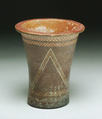
Drinking was an essential component of Inca agricultural rituals, diplomatic exchanges, and other events. Beakers, usually made and used in pairs, could range in size from just a few inches to over a foot high. The Incas called wood beakers keros (see, for example, accession number 2004.212, one of several in the Met’s collection), and those made of silver or gold, aquillas. Others, such as accession number 2003.272, and the present example, were made of ceramic. Filled with a maize beer known as chicha, these vessels were prominent visual features of any gathering of significance in the Inca Empire. Keros continued to be made into the colonial period, albeit in different ceremonies and with different imagery (see, for example accession numbers 1994.35.15, .16).
Elaborate toasts were a key part of Inca rituals (Cummins, 2002; Urton and von Hagen, 2015: 171), and such exchanges were occasionally depicted by Inca artists, such as one shown on a copper tumi (a type of knife with a curved blade) illustrated by Emmerich and Lapiner (1969: pl. 56). On this tumi, two men, each with different clothing and hairstyles, face each other holding out a kero. Objects such as this tumi, and the many finely worked vessels that have survived to the present day, speak to the centrality of drinking rituals in Inca life. Indeed, art historian Tom Cummins (2002: 39) has pointed out that in Andean feasts drinking was more important than eating. This enigmatic vessel may have been used in a specific ritual, and later served as a reminder of a memorable event.
Further Reading and References
Bourget, Steve. Sacrifice, Violence, and Ideology Among the Moche: The Rise of social Complexity in Ancient Peru. Austin: University of Texas Press, 2016.
Cummins, Thomas B. F. Toasts with the Inca: Andean Abstraction and Colonial Images on Quero Vessels. Ann Arbor: University of Michigan Press, 2002.
Emmerich, André, and Alan Lapiner. Sun Gods and Saints: Art of Pre-Columbian and Colonial Peru. Exh. cat. New York: Andre Emmerich Gallery, 1969.
Lapiner, Alan. Pre-Columbian Art of South America. New York: Harry N. Abrams, 1976. See especially p. 319.
Ochoa, Jorge F., Elizabeth K. Arce, and Roberto S. Argumedo. Queros: Arte Inka en Vasos Ceremoniales. Lima: Banco de Crédito, 1998.
Toyne, J. Marla. “The Body Sacrificed: A Bioarchaeological Analysis of Ritual Violence in Ancient Túcume, Peru.” Journal of Religion and Violence 3, no. 10 (2015), pp. 137-171.
Urton, Gary, and Adriana von Hagen. Encyclopedia of the Incas. Lanham: Rowman & Littlefield, 2015.
Artwork Details
- Title: Hand with beaker
- Artist: Inca artist(s)
- Date: 1400–1535 CE
- Geography: Peru
- Culture: Inca
- Medium: Ceramic, slip
- Dimensions: H. 10 5/16 x W. 3 1/2 x D. 5 1/2 in. (26.2 x 8.9 x 14 cm)
- Classification: Ceramics-Containers
- Credit Line: The Michael C. Rockefeller Memorial Collection, Bequest of Nelson A. Rockefeller, 1979
- Object Number: 1979.206.1096
- Curatorial Department: The Michael C. Rockefeller Wing
More Artwork
Research Resources
The Met provides unparalleled resources for research and welcomes an international community of students and scholars. The Met's Open Access API is where creators and researchers can connect to the The Met collection. Open Access data and public domain images are available for unrestricted commercial and noncommercial use without permission or fee.
To request images under copyright and other restrictions, please use this Image Request form.
Feedback
We continue to research and examine historical and cultural context for objects in The Met collection. If you have comments or questions about this object record, please contact us using the form below. The Museum looks forward to receiving your comments.
Content Notice
The Metropolitan Museum of Art presents over 5,000 years of art from around the world, and our online collection reflects ongoing work conducted over the course of our more than 150-year history. You may encounter objects or images that may be inappropriate for some viewers or information that may be outdated.