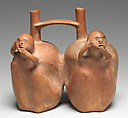
Bottle in the shape of a monkey
Nasca ceramics share many characteristics with the traditions of the preceding Paracas culture in the same region. Nasca potters, however, made a significant technological advancement with the use of colored slips (solutions of fine particles of clay plus mineral dyes) that permitted the application of as many as 13 different colors to their compositions. Nasca ceramics were also burnished, adding a durable sheen to the surfaces. Many Nasca ceramics have a double spout connected by a ceramic strap; hence the name double spout and bridge handle. In this example, the potter has modified one spout to form the monkey’s head with the bridge strap connecting directly to the back of the head. The tiny hole in the top of the head may be the exit for a whistle placed inside of the opening. As liquid was poured in through the spout, air would be forced out, producing a whistle.
References and Further Reading
Aquino, Rolando et al. Monkeys of Peru. Washington DC: Conservation International, U.S., 2015.
Carmichael, Patrick H. "Nasca Origins and Paracas Progenitors." Ñawpa Pacha, Journal of Andean Archaeology, vol. 36, no 2 (2016), pp. 53-94.
Ikehara-Tsukayama Hugo C., Dawn Kriss, and Joanne Pillsbury. “Containing the Divine: Ancient Peruvian Pots.” The Metropolitan Museum of Art Bulletin Vol. 80, Number 4 (Spring 2023). “Containing the Divine: Ancient Peruvian Pots.” Metropolitan Museum of Art Bulletin vol. 80, no 4 (Spring 2023).
Lapiner, Alan C. Pre-Columbian Art of South America. New York: H. N. Abrams, 1976.
Lasaponara, Rosa, Nicola Masini, and Giuseppe Orefici, eds. The Ancient Nasca World: New Insights from Science and Archaeology. New York: Springer Publishing Company, 2016.
Pardo, Cecilia, and Peter Fux. Nasca. Lima: Museo de Arte Lima, 2017.
Proulx, Donald A. "Paracas and Nasca: Regional Cultures on the South Coast of Peru" In Handbook of South American Archaeology, edited by Helaine Silverman and William Isbell, pp. 563-84. New York: Springer, 2008.
Proulx, Donald A. A Sourcebook of Nasca Ceramic Iconography: Reading a Culture Through its Art. Iowa City: University of Iowa Press, 2006.
Sawyer, Alan Reed. Ancient Peruvian Ceramics: The Nathan Cummings Collection. New York: The Metropolitan Museum of Art, 1966.
Vaughn, Kevin J. "Craft and the Materialization of Chiefly Power in Nasca," in Foundations of Power in the Prehispanic Andes, edited by Kevin J. Vaughn, Dennis Ogburn, and Christina A. Conlee. Archaeological Papers of the American Anthropological Association, No. 14, pp. 113-30. American Anthropological Association, 2005.
Artwork Details
- Title: Bottle in the shape of a monkey
- Artist: Nasca artist(s)
- Date: 1–600 CE
- Geography: Peru, South Coast
- Culture: Nasca
- Medium: Ceramic, slip
- Dimensions: H. 5 × W. 3 1/4 × D. 3 3/4 in. (12.7 × 8.3 × 9.5 cm)
- Classification: Ceramics-Containers
- Credit Line: Rogers Fund, 1988
- Object Number: 1988.281.1
- Curatorial Department: The Michael C. Rockefeller Wing
More Artwork
Research Resources
The Met provides unparalleled resources for research and welcomes an international community of students and scholars. The Met's Open Access API is where creators and researchers can connect to the The Met collection. Open Access data and public domain images are available for unrestricted commercial and noncommercial use without permission or fee.
To request images under copyright and other restrictions, please use this Image Request form.
Feedback
We continue to research and examine historical and cultural context for objects in The Met collection. If you have comments or questions about this object record, please contact us using the form below. The Museum looks forward to receiving your comments.
Content Notice
The Metropolitan Museum of Art presents over 5,000 years of art from around the world, and our online collection reflects ongoing work conducted over the course of our more than 150-year history. You may encounter objects or images that may be inappropriate for some viewers or information that may be outdated.