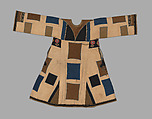
Jibba (tunic)
Such tunics were worn by officers of the Islamic Mahdist army during the 1881–98 struggle against the British presence in the Sudan region. The high visibility of the tunics served a practical purpose in that leaders could easily be distinguished on the battlefield. The uprising was led by Muhammad Ahmad, a devout Muslim and faqir, or holy man. Muhammad Ahmad adopted the title of al-Mahdi ("the Divinely Inspired One") following the revelation that he had been chosen to lead a holy war against Sudan's Egyptian ruling class and their British supporters. The Mahdi and his followers advocated a return to a more Islamic state. In the four years before the Mahdi died of typhus in 1885, he led his people to reclaim nearly all the territory formerly occupied by the Egyptians. By 1898, under his successor, the Sudan had been liberated from foreign rule.
Artwork Details
- Title: Jibba (tunic)
- Artist: Mahdist artist
- Date: 1881–98
- Geography: Sudan
- Culture: Mahdist peoples
- Medium: Cotton, wool, dye
- Dimensions: W. 56 x L. 41 1/4 in. (142.2 x 104.8 cm)
- Classification: Textiles-Woven
- Credit Line: Rogers Fund, 1993
- Object Number: 1993.370
- Curatorial Department: The Michael C. Rockefeller Wing
More Artwork
Related Content
 Free to download
Research Resources
The Met provides unparalleled resources for research and welcomes an international community of students and scholars. The Met's Open Access API is where creators and researchers can connect to the The Met collection. Open Access data and public domain images are available for unrestricted commercial and noncommercial use without permission or fee.
To request images under copyright and other restrictions, please use this Image Request form.
Feedback
We continue to research and examine historical and cultural context for objects in The Met collection. If you have comments or questions about this object record, please contact us using the form below. The Museum looks forward to receiving your comments.
Content Notice
The Metropolitan Museum of Art presents over 5,000 years of art from around the world, and our online collection reflects ongoing work conducted over the course of our more than 150-year history. You may encounter objects or images that may be inappropriate for some viewers or information that may be outdated.