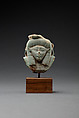
Part of a sistrum
These two heads are so called Hathor emblems and they form the center part of a sistrum, a musical instrument that was used in rituals. Above the heads is a sound box that was shaped like an arch. Only the bottom part of the arch is preserved. It features two additional cobras, one each in the center of the front and back side. At the very bottom of the piece, below the collar, is the onset of a circular shaft, which is the sistrum’s handle that broke off and is lost today.
Altogether the piece is rather small; this is not an actual sistrum but a miniature one that was used as a donation in a temple.
Artwork Details
- Title: Part of a sistrum
- Period: Late Period–Ptolemaic Period
- Date: 664–30 BCE
- Geography: From Egypt
- Medium: Faience
- Dimensions: H. 4.2 × W. 2.5 × D. 1.6 cm (1 5/8 × 1 × 5/8 in.)
- Credit Line: Bequest of Nanette B. Kelekian, 2020
- Object Number: 2021.41.104
- Curatorial Department: Egyptian Art
More Artwork

Research Resources
The Met provides unparalleled resources for research and welcomes an international community of students and scholars. The Met's Open Access API is where creators and researchers can connect to the The Met collection. Open Access data and public domain images are available for unrestricted commercial and noncommercial use without permission or fee.
To request images under copyright and other restrictions, please use this Image Request form.
Feedback
We continue to research and examine historical and cultural context for objects in The Met collection. If you have comments or questions about this object record, please contact us using the form below. The Museum looks forward to receiving your comments.
Content Notice
The Metropolitan Museum of Art presents over 5,000 years of art from around the world, and our online collection reflects ongoing work conducted over the course of our more than 150-year history. You may encounter objects or images that may be inappropriate for some viewers or information that may be outdated.