Zukra
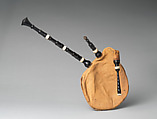
This instrument was part of Victor Charles Mahillon’s musical instrument collection in Brussels. It was exchanged, along with four other instruments, for some of Mary Elizabeth Brown’s instruments in September 1894. It was labelled as a ‘Souqqarah’ by Mahillon, and later simply labelled as a ‘bagpipe’ from Turkey in the 1902 Musical Instrument Catalogue. The ‘Turkish’ origin of the instrument is probably linked to the Ottoman Empire territories, which extended into Northern Africa. .
This specific type of Northern African bagpipe is most commonly found in Tunisia, where the local bagpipe (mizwid), documented since at least the late 19th century, features five fingerholes. Libyan zukras generally feature four fingerholes on the parallel chanters, while the Algerian chekwa has six fingerholes. In Tunisia, the wide popularity of the instrument led it to become a central feature of an eponymous musical genre, mizwid. An urban musical genre emerging from rural migration to Tunis throughout the 20th century, mizwid has bagpipes at its center, along with a singer and a percussion section (Stapley 2006). From the late 20th century onwards, the bagpipe was often replaced by a synthesizer that maintained the melodies, ornamentation, rhythms, and tone of the original instrument. Maligned and rejected for a long time but the middle and upper classes in Tunisia, mizwid music became the highest selling musical genre in Tunisia: in 1999, 70% of Phonie’s sales - one of the two major recording companies of Tunisia, Phonie – was mizwid (Stapley 2006:254).
(Cassandre Balosso-Bardin, 2023)
Technical description:
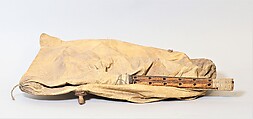
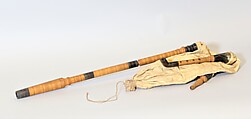
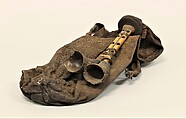
2 cane chanters with double horn bell;
cylindrical bores, protruding 9.6 cm (15 cm including bell);
set in 1 flat, disk-shaped stock of reddish wood;
fingerholes: R 5/0, W 5/0, with 1 venthole in underside of each bell;
reeds inaccessible (typically single, upcut cane reed);
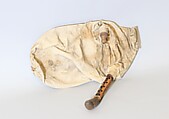
bird-bone blowpipe set in sloping cylindrical wooden stock between forelegs, protruding 12.8 cm, no evidence of valve;
goatskin bag, with chanter bells tied together with green cord terminating in tassels, wooden stocks and foreleg plugs have turned grooving and fluting.
References
Stapley, Kathryn, 2006. ‘An Urban Music with Rural Roots’, Journal of Ethnic and Migration Studies, 32(2): 243-256.
Artwork Details
- Title: Zukra
- Date: 19th century
- Culture: Northern African
- Medium: Cane, horn, bone, kidskin, wood
- Dimensions: Cylindrical bores: protruding - L. 9.6 cm (3-3/4 in.), including bell - L.15 cm (6 in.); Cylindrical wooden stock: protruding - L. 12.8 cm (5-1/8 in.)
- Classification: Aerophone-Reed Vibrated-bagpipe
- Credit Line: The Crosby Brown Collection of Musical Instruments, 1889
- Object Number: 89.4.343
- Curatorial Department: Musical Instruments
More Artwork
Research Resources
The Met provides unparalleled resources for research and welcomes an international community of students and scholars. The Met's Open Access API is where creators and researchers can connect to the The Met collection. Open Access data and public domain images are available for unrestricted commercial and noncommercial use without permission or fee.
To request images under copyright and other restrictions, please use this Image Request form.
Feedback
We continue to research and examine historical and cultural context for objects in The Met collection. If you have comments or questions about this object record, please contact us using the form below. The Museum looks forward to receiving your comments.
Content Notice
The Metropolitan Museum of Art presents over 5,000 years of art from around the world, and our online collection reflects ongoing work conducted over the course of our more than 150-year history. You may encounter objects or images that may be inappropriate for some viewers or information that may be outdated.