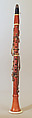
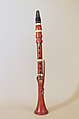
Clarinet in C
Because of its ability to play chromatically before brass instruments gained this capability through the adoption of the valve, the clarinet was the melodic mainstay of the early nineteenth-century band, where instruments like this example were commonly heard.
Maker notes:
Edward Riley (1768-1829) was born in England and emigrated in 1805 from London to New York. Between 1819 and 1831 his address was 29 Chattam Street (Waterhouse, NLI, 328-329).
Technical description:
Clarinet in C, five keys. Boxwood with ivory ferrules and brass keywork. Six pieces: mouthpiece, barrel, upper section, middle section for the fingers of the right hand, lower section with keys, bell. Blackwood mouthpiece grooved for cord and with English style long tenon probably original. English socket-type flask-shaped barrel. Throat keys in rudiments of turned wooden rings. Speaker liner projects almost into the middle of the bore. Levers for L4, tone-hole and key for R4 mounted in a bell-shaped swelling. Guidance for F♯3/C♯5 lever.
Fingerings:
L0: T; speaker.
L1: T; throat A♮.
L2: T.
L3: T.
L4: E3/B♮4; F♯3/C♯5.
R1: T.
R2: T.
R3: T.
R4: T; G♯3/E♭5.
Keyhead type: flat square
Keymount type: blocks, swelling
(Heike Fricke, 2014)
Artwork Details
- Title: Clarinet in C
- Maker: Edward Riley (American (born England) 1769–1829 New York)
- Date: ca. 1825
- Geography: New York, New York, United States
- Culture: American
- Medium: Boxwood, ebony, ivory, brass
- Dimensions: Overall length: 580 mm with mouthpiece
Bore measured at c-hole 13.6 mm; at f-hole 13.6mm
Length of the instrument that has a conical bore : 105 mm - Classification: Aerophone-Reed Vibrated-single reed cylindrical
- Credit Line: Rogers Fund, The Crosby Brown Collection of Musical Instruments, by exchange, and funds from various donors, 1982
- Object Number: 1982.42
- Curatorial Department: Musical Instruments
More Artwork
Related Content
 Free to download
Research Resources
The Met provides unparalleled resources for research and welcomes an international community of students and scholars. The Met's Open Access API is where creators and researchers can connect to the The Met collection. Open Access data and public domain images are available for unrestricted commercial and noncommercial use without permission or fee.
To request images under copyright and other restrictions, please use this Image Request form.
Feedback
We continue to research and examine historical and cultural context for objects in The Met collection. If you have comments or questions about this object record, please contact us using the form below. The Museum looks forward to receiving your comments.
Content Notice
The Metropolitan Museum of Art presents over 5,000 years of art from around the world, and our online collection reflects ongoing work conducted over the course of our more than 150-year history. You may encounter objects or images that may be inappropriate for some viewers or information that may be outdated.