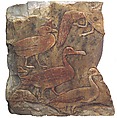
Relief with Birds in the Papyrus Thicket
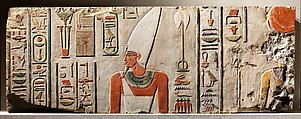
Almost all the relief decorated walls of the Mentuhotep II temple were pulled down during quarrying by late Rameside construction crews searching for reusable stone material. Many blocks, however, got smashed during these activities and thus thousands of fragments survived to be found by the excavators: first Lord Dufferin in 1859-1860, then Edouard Naville working for the British Egypt Exploration Fund in 1903-1907. This fragment must have been part of a large relief depicting the king on a hunt in the marshes (for a complete scene of this type see 30.4.48). The scene was probably placed in one of the upper colonnades of the temple.
Artwork Details
- Title: Relief with Birds in the Papyrus Thicket
- Period: Middle Kingdom
- Dynasty: Dynasty 11
- Reign: late reign of Mentuhotep II
- Date: ca. 2030–2000 B.C.
- Geography: From Egypt, Upper Egypt, Thebes, Deir el-Bahri, Temple of Mentuhotep II, Egypt Exploration Fund excavations, 1907
- Medium: Limestone, paint
- Dimensions: H. 49 cm (19 5/16 in.); W. 107 cm (42 1/8 in.); D. 11.5 cm (4 1/2 in.)
- Credit Line: Gift of Egypt Exploration Fund, 1906
- Object Number: 06.1231.3a, b
- Curatorial Department: Egyptian Art
More Artwork
Related Content
 Free to download
Research Resources
The Met provides unparalleled resources for research and welcomes an international community of students and scholars. The Met's Open Access API is where creators and researchers can connect to the The Met collection. Open Access data and public domain images are available for unrestricted commercial and noncommercial use without permission or fee.
To request images under copyright and other restrictions, please use this Image Request form.
Feedback
We continue to research and examine historical and cultural context for objects in The Met collection. If you have comments or questions about this object record, please contact us using the form below. The Museum looks forward to receiving your comments.
Content Notice
The Metropolitan Museum of Art presents over 5,000 years of art from around the world, and our online collection reflects ongoing work conducted over the course of our more than 150-year history. You may encounter objects or images that may be inappropriate for some viewers or information that may be outdated.