Clutha vase
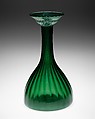
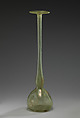
However, "quaint" hardly applies to this example, which shows Dresser’s taste for the techniques and properties of the medium in a different, very particular way: its elongated form and clean, uninterrupted outline is attainable thanks to the lack of any necessary joins in the blown, drawn glass; the graceful patterning in opaque green glass accentuates this quality, being not applied to the vase’s surface but rather fused within it and developed as the glassblower gave the vase its form. The vase is flawlessly executed, showcasing the great skill and craftsmanship of its maker at James Couper & Sons’ glassworks. The vase's regularity, which is quite unlike most other Clutha vases, finds its closest parallel in the crisp contour and ribbed decoration of the second, smaller, blown and molded Clutha vase in the Met's own holdings: 1991.20.2. More akin in outline to Dresser’s designs for metalwork of the 1880s, it is likely that this object, and less distinctively 1991.20.2, are early examples of Clutha designs, before Dresser developed the more popular, organic, consciously archaic and more art nouveau-like forms most typically associated with his Clutha glassware, characterized by the museum's other example, 1998.160.
Artwork Details
- Title: Clutha vase
- Designer: Christopher Dresser (British, Glasgow, Scotland 1834–1904 Mulhouse)
- Manufacturer: James Couper and Sons, Glasgow (1850–1922)
- Retailer: Liberty & Co. (British, founded London, 1875)
- Date: ca. 1888
- Culture: British, Glasgow
- Medium: Glass
- Dimensions: confirmed: 15 7/16 × 6 13/16 × 6 13/16 in., 3.3 lb. (39.2 × 17.3 × 17.3 cm, 1.5 kg)
- Classification: Glass
- Credit Line: Purchase, Friends of European Sculpture and Decorative Arts Gifts, 2015
- Object Number: 2015.250
- Curatorial Department: European Sculpture and Decorative Arts
More Artwork

Research Resources
The Met provides unparalleled resources for research and welcomes an international community of students and scholars. The Met's Open Access API is where creators and researchers can connect to the The Met collection. Open Access data and public domain images are available for unrestricted commercial and noncommercial use without permission or fee.
To request images under copyright and other restrictions, please use this Image Request form.
Feedback
We continue to research and examine historical and cultural context for objects in The Met collection. If you have comments or questions about this object record, please contact us using the form below. The Museum looks forward to receiving your comments.
Content Notice
The Metropolitan Museum of Art presents over 5,000 years of art from around the world, and our online collection reflects ongoing work conducted over the course of our more than 150-year history. You may encounter objects or images that may be inappropriate for some viewers or information that may be outdated.