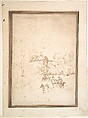
Saint Francis Kneeling in a Grotto, holding a Book and a Skull
The image was also reproduced in another engraving, signed “C. Galle,” in the same orientation as the drawing and bearing, in place of the title of Puget de la Serre’s book, a phrase in Latin derived from Galatians 6: “absit mihi gloriari nihi in crvce domini nostril iesv Christi.” There is an impression in the Graphic Art Collection of Göttweig Abbey in Austria.
(JSS, 8/23/2018)
[1] Jean Puget de la Serre, Les douces pensées de la mort (Brussels: 1627). A copy of this original edition with the intact half-title is in the library of Ghent University (https://lib.ugent.be/catalog/bkt01:000403207).
[2] Véronique Meyer, “Un auteur du XVIIe siècle et l’illustration de ses livres: Jean Puget de la Serre (1595-1665),” in Bibliothèque de l'École des chartes 158, no. 1 (Jan-June 2000), pp. 35-38.
Artwork Details
- Title: Saint Francis Kneeling in a Grotto, holding a Book and a Skull
- Artist: Nicolaas van der Horst (Flemish, Antwerp 1587/98–1646 Brussels)
- Date: 1627 or before
- Medium: Pen and brown ink, brown washes; incised for transfer
- Dimensions: 4 15/16 × 3 7/16 in. (12.5 × 8.8 cm)
- Classification: Drawings
- Credit Line: Gift of J. William Middendorf II, in memory of Walter Liedtke, 2015
- Object Number: 2015.781
- Curatorial Department: Drawings and Prints
More Artwork
Research Resources
The Met provides unparalleled resources for research and welcomes an international community of students and scholars. The Met's Open Access API is where creators and researchers can connect to the The Met collection. Open Access data and public domain images are available for unrestricted commercial and noncommercial use without permission or fee.
To request images under copyright and other restrictions, please use this Image Request form.
Feedback
We continue to research and examine historical and cultural context for objects in The Met collection. If you have comments or questions about this object record, please contact us using the form below. The Museum looks forward to receiving your comments.
Content Notice
The Metropolitan Museum of Art presents over 5,000 years of art from around the world, and our online collection reflects ongoing work conducted over the course of our more than 150-year history. You may encounter objects or images that may be inappropriate for some viewers or information that may be outdated.