English
DonateMembershipTickets

“ANAESTHESIA I” desk

Samuel Ross British
2022
Not on view
The "ANAESTHESIA I" desk is a contemporary interpretation of traditional European writing desks and working tables from the eighteenth and nineteenth centuries. It reflects Samuel Ross’s ongoing interests in Brutalism and early twentieth century modern design and his conceptually rigorous approach to industrial materials. This desk evolved from Ross’s research into the historic visual languages of West African furniture and post-industrialized Western design culture. His work asserts itself in space through mass, weight, and a raw, primal approach to materiality. Industrially processed materials, such as OSB (Oriented Strand Board) engineered wood, concrete, and steel, are infused with organic materials such as turmeric, clay, and honey before being fired and re-processed with, for example, the application of layers of acrylic lacquer. For Ross, the infusion of these organic materials speaks to past hands, processes, and gestures. They "carry memory, intentions and philosophies from the heartland in which they originate"[1]–thus underlining process as a form of ritual, and ritual as a form of making. "ANAESTHESIA I" explores the intimate relationship between the desk’s constituent materials and the human body, while Ross’s combination of erosion and accretion, and the celebration of mineral residue, results in an artifact with its own layered history. The object is emphasized as a vessel of memory, expanding the meaning of each piece while also preserving its functionality.

[1] The artist quoted in "Samuel Ross: Coarse," May 10, 2023–June 17, 2023, Friedman Benda, New York, NY, friedmanbenda.com.

Artwork Details

Object Information
  • Title: “ANAESTHESIA I” desk
  • Artist: Samuel Ross (British, born London 1991)
  • Date: 2022
  • Medium: Glass fiber reinforced concrete, aluminum, stainless steel, OSB (Oriented Strand Board, engineered wood), Abidjan clay, turmeric, acrylic, acrylic lacquer, polyurethane
  • Edition: Edition of 8 with 4 artist's proofs
  • Dimensions: 30 × 68 × 22 in. (76.2 × 172.7 × 55.9 cm)
  • Classification: Furniture
  • Credit Line: Purchase, Milly Mayer Trust Gift, 2024
  • Object Number: 2024.284a–c
  • Rights and Reproduction: Courtesy of Friedman Benda and Samuel Ross
  • Curatorial Department: Modern and Contemporary Art
More Artwork
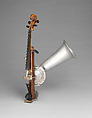
Stroh Violin, George Evans & Co.  English, Mahogany and aluminum, British
George Evans & Co.
first quarter 20th century
"Pipistrello" Lamp, Gae (Gaetana) Aulenti  Italian, Lacquered aluminum, stainless steel, poly(methyl methacrylate) (PMMA)
Designer Gae (Gaetana) Aulenti
Manufacturer Martinelli Luce S.p.A.
1965
Sopranino Bugle in C, brass, British
British
19th century
As Long as the Sun Lasts (commissioned for The Met's Iris and B. Gerald Cantor Roof Garden, 2021), Alex Da Corte  American, Aluminum, fiber reinforced plastic, PA12 nylon, stainless Steel, powder coating, cementitious grout, bronze, polyurethane paint
Alex Da Corte
2021
Chalumeau in C, J.C. Denner  British, Wood, brass, British
Original by J.C. Denner
This copy possibly by Francis W. Galpin
copy late 19th century

Research Resources

The Met provides unparalleled resources for research and welcomes an international community of students and scholars. The Met's Open Access API is where creators and researchers can connect to the The Met collection. Open Access data and public domain images are available for unrestricted commercial and noncommercial use without permission or fee.

To request images under copyright and other restrictions, please use this Image Request form.

Feedback

We continue to research and examine historical and cultural context for objects in The Met collection. If you have comments or questions about this object record, please contact us using the form below. The Museum looks forward to receiving your comments.

Send feedback

Content Notice

The Metropolitan Museum of Art presents over 5,000 years of art from around the world, and our online collection reflects ongoing work conducted over the course of our more than 150-year history. You may encounter objects or images that may be inappropriate for some viewers or information that may be outdated.