Dining room from Kirtlington Park
Artwork Details
- Title: Dining room from Kirtlington Park
- Designer: John Sanderson (active from ca. 1730–died 1774)
- Maker: Chimneypiece possibly by Sir Henry Cheere (British, London 1703–1781 London)
- Maker: Chimneypiece possibly by John Cheere (British, London 1709–1787 London)
- Maker: Plasterwork attributed to Thomas Roberts (active 1685–1714)
- Date: 1748
- Culture: British, Oxfordshire
- Medium: Wood, plaster, marble
- Dimensions: confirmed: 20 ft. 2 in. × 35 ft. 5 in. × 23 ft. 5 in. (614.7 × 1079.5 × 713.7 cm); width extending into window niches 24 ft. 8 in. (751.8 cm).
- Classification: Woodwork
- Credit Line: Fletcher Fund, 1931
- Object Number: 32.53.1
- Curatorial Department: European Sculpture and Decorative Arts
Audio
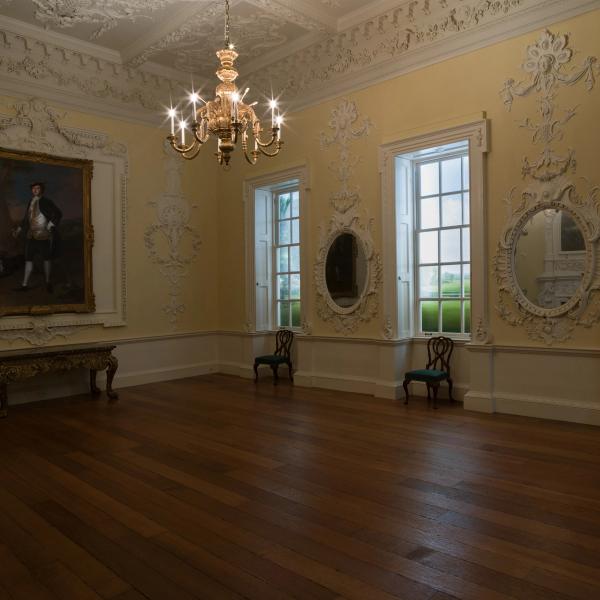
408. Dining Room from Kirtlington Park
Gallery 511
NARRATOR: In 18th century England, a dining room wasn’t just a place where people ate, it could be a forum to convince others of your politics.
IVAN DAY: There’s always hidden agendas when you invite local politicians around, and that’s what you’ve got around this table
[SFX: DINNER PARTY]
NARRATOR: That’s food historian Ivan Day, and you’re standing in the dining room from Kirtlington Park, an imposing English country house built by the well-to-do politician, Sir James Dashwood. The idea for someone like Dashwood was to give his dinner guests lots to drink and eat to butter them up…
IVAN DAY: And then talk to them afterwards and say, “Well, you know, I’m putting myself up for the next election. I’d be happy if you voted for me.”
NARRATOR: What kind of meal was delectable enough to sway peoples’ political opinions? Well, there’s a record of a dinner at Kirtlington from 1761. And what Sir James Dashwood served might seem a bit…surprising.
IVAN DAY: Something called a calf’s head turtle. How could a calf’s head be a turtle? Well, turtle dinner was the ultimate. So if you couldn’t get one, you made a fake one and they made a fake one – this is a bit gruesome – from the head of a calf, which has got a very similar rather gelatinous flesh.
NARRATOR: As Ivan researched, for dessert, there was a vessel called an “epergne” filled with sweet treats, like the one you see at the center of the table here. If you look closely, you’ll see period accurate chocolates, little biscuits, and something called sugar toys.
IVAN DAY: These are little novelties that were made out of a sugar paste.
NARRATOR: These sugary replicas are meant to give a small taste of what it might have been like to dine here in the 18th century.
Now, take a moment to look beyond the dinner table, at the space that surrounds it. The bold and highly imaginative plaster decoration lining the ceiling and walls was carried out by artist Thomas Roberts. Up close, you can admire the naturalism of the details, like the plumes of feathers and the large eagles. Every element was carefully considered, so that Dashwood could impress his dinner guests.
IVAN DAY: It was quite an exciting occasion for diners that would sometimes last for hours.
More Artwork
Related Content
 Free to download
Research Resources
The Met provides unparalleled resources for research and welcomes an international community of students and scholars. The Met's Open Access API is where creators and researchers can connect to the The Met collection. Open Access data and public domain images are available for unrestricted commercial and noncommercial use without permission or fee.
To request images under copyright and other restrictions, please use this Image Request form.
Feedback
We continue to research and examine historical and cultural context for objects in The Met collection. If you have comments or questions about this object record, please contact us using the form below. The Museum looks forward to receiving your comments.
Content Notice
The Metropolitan Museum of Art presents over 5,000 years of art from around the world, and our online collection reflects ongoing work conducted over the course of our more than 150-year history. You may encounter objects or images that may be inappropriate for some viewers or information that may be outdated.