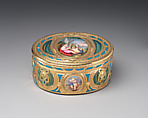
Snuffbox with miniature depicting the return of Theseus
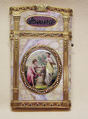
The cover of this ornate and colorful snuffbox has a polychrome enameled plaque ostensibly depicting a scene from Phaedra showing the return of her husband King Theseus. Based on a subject from Greek mythology, Jean Racine wrote the French tragedy Phèdre which was first performed in Paris in 1677. New and illustrated editions of Racine's collected plays were published during the eighteenth century making the subject fashionable again. A snuffbox in the Louvre, made by Charles Ouizille in 1777–1778, has a similar miniature, indicating a common engraved source and as yet unidentified engraved source. Neither miniature is signed.
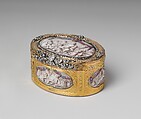
Surrounding the miniature on The Met’s snuffbox are panels of translucent opalescent enamel veined to simulate moss or dendritic agate. Beginning with small panels in the mid-1750’s, the use of this motif developed in the 1770’s to cover the surfaces of certain boxes. Here, it is used sparingly over engine turning and on small enameled ovals and bands encircling the central image.
Surrounding the enameled miniature are panels of translucent opalescent enamel veined to simulate moss or dendritic agate. Beginning with small panels in the mid-1750s, the use of this motif developed in the 1770s to cover the surfaces of certain boxes. Here, it is used sparingly over engine turning and on small, enameled ovals and bands encircling the central image. The marchand mercier (dealer in luxury goods) Granchez advertised in 1775 snuffboxes “ornées de médaillons, d’agates arborisées, plus belles que les naturelles” (adorned with medallions of dendritic/moss agate more beautiful than that found in nature).
Daughter of one of the founders of the Weyerhaeuser Timber Company, Catherine D. Wentworth (1865–1948) was an art student and painter who lived in France for thirty years. She became one of the most important American collectors of eighteenth-century French silver and on her death in 1948 bequeathed part of her significant collection of silver, gold boxes, French furniture and textiles to the Metropolitan Museum.
Artwork Details
- Title: Snuffbox with miniature depicting the return of Theseus
- Maker: Probably by Barthélemy Pillieux (apprenticed 1764, master 1774, active 1790)
- Date: 1781
- Culture: French, Paris
- Medium: Gold, enamel
- Dimensions: 1 × 2 1/2 in. (2.5 × 6.4 cm)
- Classifications: Metalwork-Gold and Platinum, Miniatures
- Credit Line: Bequest of Catherine D. Wentworth, 1948
- Object Number: 48.187.474
- Curatorial Department: European Sculpture and Decorative Arts
More Artwork
Research Resources
The Met provides unparalleled resources for research and welcomes an international community of students and scholars. The Met's Open Access API is where creators and researchers can connect to the The Met collection. Open Access data and public domain images are available for unrestricted commercial and noncommercial use without permission or fee.
To request images under copyright and other restrictions, please use this Image Request form.
Feedback
We continue to research and examine historical and cultural context for objects in The Met collection. If you have comments or questions about this object record, please contact us using the form below. The Museum looks forward to receiving your comments.
Content Notice
The Metropolitan Museum of Art presents over 5,000 years of art from around the world, and our online collection reflects ongoing work conducted over the course of our more than 150-year history. You may encounter objects or images that may be inappropriate for some viewers or information that may be outdated.