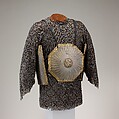
Cuirass (Char-aina)
As a group, char-a'ina are frequently inscribed with mystical verses and also carry the longest Qur'anic inscriptions found on Islamic armor. The reason for this is that such armors, in addition to providing straightforward physical protection, were thought to have a special talismanic quality, as mirrors that could repel evil. Michael Gorelik noted that this idea persisted in Sino-Manchurian armor until the nineteenth century (see Gorelik, Michael. "Oriental Armour of the Near and Middle East from the Eighth to the Fifteenth Centuries as Shown in Works of Art." in Elgood, Robert, ed. Islamic Arms and Armour. London: Scolar Press, 1979, pp. 30–63.).
The image of the mirror is used in Sufi thought to describe the way man arrives at self-knowledge and knowledge of God. In such analogies the mirror is likened to the soul, through which man becomes aware of something inexpressibly greater than himself. For the Iranians, especially, armor of this kind evoked associations with the solar imagery of Zoroastrianism, which had been Islamicized in the Shahnama of the Persian poet Firdausi (about A.D. 1000). A char-a'ina in the Historisches Museum, Bern, for example, is inscribed with a Persian poem that begins, "When the King is dressed with the four mirrors, he appears as the rising sun."
Such solar imagery reflects the Zoroastrian concept of the "light of glory" that surrounds the hero. The ruler appearing as the rising sun can therefore be seen in an Islamic context as embodying the heavenly light on earth, and he becomes the "shadow of God" or "pole or axis of the age," qutb al-zaman. This concept holds that at all times there exists an individual intimately connected with the divine who is consequently the best, indeed the only, route by which others can approach God.
Artwork Details
- Title: Cuirass (Char-aina)
- Date: 17th–early 18th century
- Culture: Persian, Safavid
- Medium: Steel, iron, gold, leather, textile (wool)
- Dimensions: Breast- and backplates: 11 x 11 in. (28 x 28 cm); side plates: 11 5/8 x 6 1/8 in. (29.5 x 15.5 cm); Wt. 6 lb. 8 oz. (2948 g)
- Classification: Armor Parts-Cuirasses
- Credit Line: Bequest of George C. Stone, 1935
- Object Number: 36.25.18a–d
- Curatorial Department: Arms and Armor
More Artwork
Related Content
 Free to download
Research Resources
The Met provides unparalleled resources for research and welcomes an international community of students and scholars. The Met's Open Access API is where creators and researchers can connect to the The Met collection. Open Access data and public domain images are available for unrestricted commercial and noncommercial use without permission or fee.
To request images under copyright and other restrictions, please use this Image Request form.
Feedback
We continue to research and examine historical and cultural context for objects in The Met collection. If you have comments or questions about this object record, please contact us using the form below. The Museum looks forward to receiving your comments.
Content Notice
The Metropolitan Museum of Art presents over 5,000 years of art from around the world, and our online collection reflects ongoing work conducted over the course of our more than 150-year history. You may encounter objects or images that may be inappropriate for some viewers or information that may be outdated.