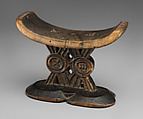
Headrest
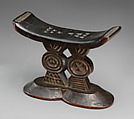
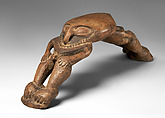
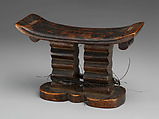
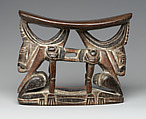
The designs of such works, created to protect elaborate coiffures, reflect a range of regional styles. Tsonga sculptors have been credited with the most varied formal solutions to the support element.
In Zulu society, women commissioned male carvers to produce a headrest for the bride and groom as part of the dowry. Among the Shona, headrests were exclusively carved and used by men. Since they also functioned as vehicles of communication with the ancestral realm, headrests and other personal articles were frequently buried with their owners, evidencing the intimate connection between the object and its owner. In other cases, they were passed along to male descendants.
Artwork Details
- Title: Headrest
- Date: 19th–20th century
- Geography: Zimbabwe
- Culture: Shona peoples
- Medium: Wood
- Dimensions: H. 5 5/8 x W. 6 1/4 x D. 2 1/2 in. (14.3 x 15.9 x 6.4 cm)
- Classification: Wood-Furniture
- Credit Line: Anonymous Gift, 1986
- Object Number: 1986.484.1
- Curatorial Department: The Michael C. Rockefeller Wing
More Artwork
Research Resources
The Met provides unparalleled resources for research and welcomes an international community of students and scholars. The Met's Open Access API is where creators and researchers can connect to the The Met collection. Open Access data and public domain images are available for unrestricted commercial and noncommercial use without permission or fee.
To request images under copyright and other restrictions, please use this Image Request form.
Feedback
We continue to research and examine historical and cultural context for objects in The Met collection. If you have comments or questions about this object record, please contact us using the form below. The Museum looks forward to receiving your comments.
Content Notice
The Metropolitan Museum of Art presents over 5,000 years of art from around the world, and our online collection reflects ongoing work conducted over the course of our more than 150-year history. You may encounter objects or images that may be inappropriate for some viewers or information that may be outdated.