Pellet Crossbow
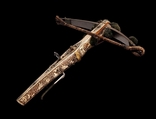
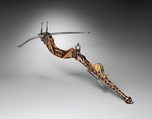
Pellet crossbows shot small stones or molded clay pellets rather than steel-tipped bolts (see acc. nos. 14.25.1591a–l, .1601a–c) and were used solely for killing fowl and small animals such as squirrels, ermine, or marten. Though they lacked the power and range of conventional crossbows, pellet crossbows could be spanned by hand and their missiles stunned or killed the game without piercing the skin and ruining fur or feathers with bloodstains.
Pellet crossbows were used throughout Europe from the second half of the sixteenth century at least to the end of the seventeenth century. Bows of this particular type and design, with simple but beautifully carved sculptural ornament on the stock, recall the carving on similar examples from the Medici armory, now preserved in the Museo Nazionale del Bargello in Florence.
Artwork Details
- Title: Pellet Crossbow
- Date: ca. 1550–1600
- Culture: probably Italian or French
- Medium: Steel, wood (walnut), staghorn, hemp
- Dimensions: L. 40 3/16 in. (102.1 cm); W. 25 9/16 in. (64.9 cm); Wt. 7 lb. 8 oz. (3,388 g)
- Classification: Archery Equipment-Crossbows
- Credit Line: Gift of William H. Riggs, 1913
- Object Number: 14.25.1581
- Curatorial Department: Arms and Armor
More Artwork


Related Content

Research Resources
The Met provides unparalleled resources for research and welcomes an international community of students and scholars. The Met's Open Access API is where creators and researchers can connect to the The Met collection. Open Access data and public domain images are available for unrestricted commercial and noncommercial use without permission or fee.
To request images under copyright and other restrictions, please use this Image Request form.
Feedback
We continue to research and examine historical and cultural context for objects in The Met collection. If you have comments or questions about this object record, please contact us using the form below. The Museum looks forward to receiving your comments.
Content Notice
The Metropolitan Museum of Art presents over 5,000 years of art from around the world, and our online collection reflects ongoing work conducted over the course of our more than 150-year history. You may encounter objects or images that may be inappropriate for some viewers or information that may be outdated.