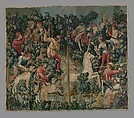
Ritrovamento dell'unicorno
Artwork Details
- Titolo: Ritrovamento dell'unicorno
- Data: 1495-1505
- Cultura: Paesi Bassi meridionali
- Materiale e tecnica: Ordito di lana con trama di filati di lana, seta, argento, oro
- Dimensioni: 3,7 x 3,8 m
- Crediti: Dono di John D. Rockefeller Jr., 1937
- Numero d'inventario: 37.80.2
- Curatorial Department: Medieval Art and The Cloisters
Audio
64. The Unicorn Is Found (from the Unicorn Tapestries)
Gallery 17
NARRATOR: Surrounding a tall white fountain is a company of twelve hunters and their dogs who have found the unicorn. The mystical beast, shown here kneeling on the ground, is dipping his horn into a stream. Other animals are also present. A pair of goldfinches perches on the fountain, not far from a pair of pheasants. Rabbits, lions, and other animals – some more realistic-looking than others -- flank both sides of the stream. According to legend, the unicorn cannot be disturbed when performing a magical act. Scholars have suggested that the unicorn is in the process of purifying a poisoned stream, a hypothesis supported by the presence of such plants as pot marigold—which you’ll see under the hyena’s chin; sage—the plant with the blue flowers in front of the fountain; and an orange tree in the lower right corner of the tapestry. All of them stand in close proximity to the stream and are known to have been used as antidotes against poison in the Middle Ages. The orange tree deserves a second look. It is flowering and bearing fruit at the same time – unusual yet botanically accurate. It has also been identified by botanists as a type of sweet orange introduced in Europe only around 1500. The precision with which the orange tree is represented attests to the designer’s careful observation, which we find not only in the depiction of plants but that of other objects throughout the tapestries. Our next stop is to the right, “The Unicorn Leaps Across A Stream.”
More Artwork
Related Content
Research Resources
The Met provides unparalleled resources for research and welcomes an international community of students and scholars. The Met's Open Access API is where creators and researchers can connect to the The Met collection. Open Access data and public domain images are available for unrestricted commercial and noncommercial use without permission or fee.
To request images under copyright and other restrictions, please use this Image Request form.
Feedback
We continue to research and examine historical and cultural context for objects in The Met collection. If you have comments or questions about this object record, please contact us using the form below. The Museum looks forward to receiving your comments.
Content Notice
The Metropolitan Museum of Art presents over 5,000 years of art from around the world, and our online collection reflects ongoing work conducted over the course of our more than 150-year history. You may encounter objects or images that may be inappropriate for some viewers or information that may be outdated.