Homage to Georges Braque
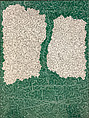
Kolar has created numerous types of collages from the printed matter of books, newspapers, maps, musical scores, and reproductions of works of art. One type, of which Homage to Georges Braque is an example, he named "chiasmage." In Kolar's chiasmages, torn fragments of text are arranged in a random, allover pattern and applied to flat surfaces, to reliefs, or to three-dimensional objects. The disintegration of the text as a whole, through tearing and arbitrary reassembly, renders its words meaningless.
This particular chiasmage is a tribute to the artist Georges Braque (1882–1963), the French painter who, with Picasso, played a leading role in the development of Cubism. Braque produced portraits and still lifes that combined painting and collage, through the application of pieces of pasted paper, newsprint, commercially printed wallpaper, and labels. In Kolar's homage to this pioneer of mixed-media abstraction, the wood support of the work has been covered entirely with small torn fragments of pages printed with French text, pasted into a rhythmic but dizzying chance arrangement. A bottle-shaped form has been coated in more text fragments and affixed to the background, and bits of musical score decorate the applied relief of an elongated rectangle with two circular forms that suggest a wind instrument. The wine bottle and musical instrument are typical Cubist imagery, often included in tabletop still lifes that referred to the free-spirited lifestyle of young artists in Paris.
Artwork Details
- Title: Homage to Georges Braque
- Artist: Jiri Kolar (Czechoslovakian, 1914–2002)
- Date: 1982
- Medium: Cut and torn pasted printed papers on wood panel
- Dimensions: 35 7/16 × 25 9/16 × 5/8 in. (90 × 65 × 1.6 cm)
- Classification: Drawings
- Credit Line: Jacques and Natasha Gelman Collection, 1998
- Object Number: 1999.363.34
- Rights and Reproduction: © 2026 Artists Rights Society (ARS), New York
- Curatorial Department: Modern and Contemporary Art
More Artwork
Research Resources
The Met provides unparalleled resources for research and welcomes an international community of students and scholars. The Met's Open Access API is where creators and researchers can connect to the The Met collection. Open Access data and public domain images are available for unrestricted commercial and noncommercial use without permission or fee.
To request images under copyright and other restrictions, please use this Image Request form.
Feedback
We continue to research and examine historical and cultural context for objects in The Met collection. If you have comments or questions about this object record, please contact us using the form below. The Museum looks forward to receiving your comments.
Content Notice
The Metropolitan Museum of Art presents over 5,000 years of art from around the world, and our online collection reflects ongoing work conducted over the course of our more than 150-year history. You may encounter objects or images that may be inappropriate for some viewers or information that may be outdated.