Ukulele
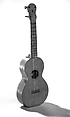
The 'ukulele found favor in the court of the Hawaiian King David Kal?kaua, a champion both of customary Hawaiian music and musical innovation. Under Kal?kaua's patronage, the 'ukulele was adapted to accompany hula dance performances, transforming the more sedate tempo of earlier types of hula into the more lively rhythm characteristic of many hula performances today.
There are several accounts of how the 'ukulele got its name, which means "jumping flea." Edward Purvis, a small, lively musician popular in Kal?kaua's court was reportedly nicknamed " 'uku lele" and the instrument may be named after him. Alternatively, the rapid action of the musician's figures when playing possibly reminded Hawaiians of jumping fleas. The name may also represent a modified version of 'ukeke, the term for the mouth bow, previously the only string instrument in Hawai'i.
Artwork Details
- Title: Ukulele
- Date: ca. 1880
- Geography: Hawaii, United States
- Culture: Hawai'i
- Medium: Mahogany, hardwood, metal
- Dimensions: L. 20 1/2 × W. 5 1/2 × D. 1 3/4 in. (52.1 × 14 × 4.5 cm)
- Classification: Chordophone-Lute-plucked-fretted
- Credit Line: The Crosby Brown Collection of Musical Instruments, 1889
- Object Number: 89.4.727
- Curatorial Department: Musical Instruments
More Artwork


Research Resources
The Met provides unparalleled resources for research and welcomes an international community of students and scholars. The Met's Open Access API is where creators and researchers can connect to the The Met collection. Open Access data and public domain images are available for unrestricted commercial and noncommercial use without permission or fee.
To request images under copyright and other restrictions, please use this Image Request form.
Feedback
We continue to research and examine historical and cultural context for objects in The Met collection. If you have comments or questions about this object record, please contact us using the form below. The Museum looks forward to receiving your comments.
Content Notice
The Metropolitan Museum of Art presents over 5,000 years of art from around the world, and our online collection reflects ongoing work conducted over the course of our more than 150-year history. You may encounter objects or images that may be inappropriate for some viewers or information that may be outdated.