Miniature Zampogna
The zampogna was traditionally played by shepherds and is still used for a variety of cultural practices, devotional and secular. In the Lucania region and parts of Calabria and the Abbruzzi they are often played in a duo formation with a ciaramella/piffero, a double reeded shawm. This duo has become emblematic of the Christmas season, where traditionally dressed pipers walk from village to village playing the ‘novena’, a form of devotional music (Scaldaferri 2022). Zampogna players have secular and religious repertoires. The former is used for the novena and devotional processions, while the latter are used to accompany dancing and singing.
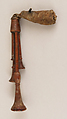
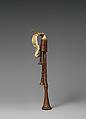
This miniature zampogna would most likely have been part of a crèche, a large nativity scene that was installed in churches and in private homes during the Christmas Period. The practice reached a peak in eighteenth-century Naples, and the Metropolitan Museum owns one of largest and most complete forms of this art. This zampogna would probably have been associated with a shepherd and other peasant musicians. The bagpipe is representative of the large zampogne that were played in the Lazio and Campania regions at the time, and is a relatively accurate reproduction of the instrument, right down to a miniature leather bag.
This instrument is understood to have come from Eugène de Bricqueville’s collection in Versailles, France, although no direct evidence allows us to confirm this provenance. However, its passage through France is plausible, as Southern Italian zampogna players were often found busking on the streets of nineteenth century Paris (Matthews 2011), bringing their music and traditions with them.
(Cassandre Balosso-Bardin and David Marker, 2023)
Technical description
2 conical melodic pipes of wood, R. 55 mm, 3/0 holes; L 176 mm, 3/0 holes;
2 drones both in 1 section, 70 mm, 93 mm;
No blowpipe;
Very thin leather bag;
Single wooden cylindrical stock for all 4 pipes, the pipes and stock with turned grooving.
References
Baines, Anthony, 1960. Bagpipes. Oxford: Oxford University Press
Matthews, Clive, 2011. ‘The invasion of the zampognari’. In Chanter, Winter.
Scaldaferri, Nicola, 2022. ‘The Bagpipes in the Mount Pollino Area (Southern Italy): Morphology and Musical Repertoires.’ In Playing Multipart Music: Solo and Ensemble Traditions in Europe: European Voices IV. Vienna: Böhlau Verlag. pp. 71-93
Vereno, Michael Peter, 2021. The Voice of the Wind: A Linguistic History of Bagpipes. Lincoln: International Bagpipe Ogranisation
Artwork Details
- Title: Miniature Zampogna
- Date: 19th century
- Geography: Italy or France
- Culture: possibly Italian
- Medium: wood, leather
- Classification: Aerophone-Reed Vibrated-bagpipe
- Credit Line: The Crosby Brown Collection of Musical Instruments, 1889
- Object Number: 89.4.862
- Curatorial Department: Musical Instruments
More Artwork



Research Resources
The Met provides unparalleled resources for research and welcomes an international community of students and scholars. The Met's Open Access API is where creators and researchers can connect to the The Met collection. Open Access data and public domain images are available for unrestricted commercial and noncommercial use without permission or fee.
To request images under copyright and other restrictions, please use this Image Request form.
Feedback
We continue to research and examine historical and cultural context for objects in The Met collection. If you have comments or questions about this object record, please contact us using the form below. The Museum looks forward to receiving your comments.
Content Notice
The Metropolitan Museum of Art presents over 5,000 years of art from around the world, and our online collection reflects ongoing work conducted over the course of our more than 150-year history. You may encounter objects or images that may be inappropriate for some viewers or information that may be outdated.