Relief depicting rituals and sacred emblems
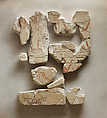
The decoration of the funerary apartments consisted almost exclusively of ritual scenes and depictions of sacred objects deriving from local Upper Egyptian iconography. The carving of Neferu’s surviving reliefs has a captivating otherworldliness, although it is varied in quality. The extenuated proportions of the figures, and the elaborate patterns contrasting with smooth planes, represent the height of the Eleventh Dynasty archaic style. The background was left unpainted, while the figures were either detailed or covered with orange, pink, purple, blue, green, white or black paint.
This goal of the scenes illustrated in this group of fragments was to provide a liturgical listing of items that were essential in the proper procedure of funeral rites, rather than to depict actual ritual performances. This accounts for the striking lack of proportion between objects and human figures in these scenes
The following stages in the funeral rites are alluded to by the presence of sacred objects:
1. The body of the deceased is prepared.
In the top register on the left, four tiny men carry a rectangular object that looks like a canopy but is actually a bracelet (or anklet) that is to be put on the mummy.
2. Entry into the underworld.
Immediately to the right of the bracelet carriers, a kneeling man lifts up a funerary boat. Boats were thought to be the means by which the deceased entered the realm of the dead.
3. The deceased is endowed with supernatural powers.
In the middle register, two kneeling men present scepters, possibly to endow the deceased with divine power.
4. The deceased is purified.
Only the top of the lowest register is preserved. According to parallels (see gallery 107), at right we are seeing the cone-shaped lid of a jar around which flowers have been wrapped, followed by the top of a flail and a mythical double bull. The combination appears to be connected to rites of purification.
5. The deceased follows the journey of the sun from dusk to dawn,
from death to resurrection.
The double bull is a symbol for the setting and rising sun, and the journey through the deep that the sun undergoes between the two points.
For other reliefs from the tomb of Neferu, see 31.3.1 and 26.3.353*.
Artwork Details
- Title: Relief depicting rituals and sacred emblems
- Period: Middle Kingdom
- Dynasty: Dynasty 11
- Reign: reign of Mentuhotep II, early
- Date: ca. 2051–2030 B.C.
- Geography: From Egypt, Upper Egypt, Thebes, Deir el-Bahri, Tomb of Neferu (TT 319, MMA 31), MMA excavations, 1923–25
- Medium: Limestone, paint
- Dimensions: 26.3.353a: H. 67.5 x W. 102 cm (26 9/16 x 40 3/16 in.)
26.3.353b: H. 53.5 x W. 88.5 cm (21 1/16 x 34 13/16 in.) - Credit Line: Rogers Fund, 1926
- Object Number: 26.3.353a, b-related
- Curatorial Department: Egyptian Art
More Artwork
Research Resources
The Met provides unparalleled resources for research and welcomes an international community of students and scholars. The Met's Open Access API is where creators and researchers can connect to the The Met collection. Open Access data and public domain images are available for unrestricted commercial and noncommercial use without permission or fee.
To request images under copyright and other restrictions, please use this Image Request form.
Feedback
We continue to research and examine historical and cultural context for objects in The Met collection. If you have comments or questions about this object record, please contact us using the form below. The Museum looks forward to receiving your comments.
Content Notice
The Metropolitan Museum of Art presents over 5,000 years of art from around the world, and our online collection reflects ongoing work conducted over the course of our more than 150-year history. You may encounter objects or images that may be inappropriate for some viewers or information that may be outdated.