Sickle Insert
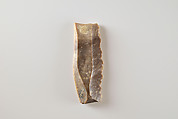
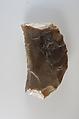
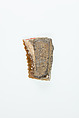
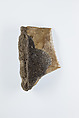
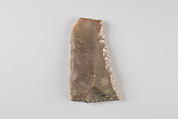
Sickle inserts could be made in a variety of ways. The earliest were fully bifacially retouched, then later they were made on blades (long narrow pieces of flint). Starting in the 2nd millennium BC, some sickle inserts were made on large flakes, such as this one.
Flint, rather than copper alloy, was the primary material used to make sickles in Egypt until the first millennium B.C. when iron became more widely available. The reason for using flint was probably multifaceted and included considerations such as its abundance, its ease of manufacture compared to casting metal tools, flint’s proficiency at cutting grain, and the relationships between the people who made flint tools and the people who used them.
Artwork Details
- Title: Sickle Insert
- Period: Probably New Kingdom, Ramesside–Third Intermediate Period
- Date: ca. 1200–664 BCE
- Geography: From Egypt, Memphite Region, Lisht North, debris, MMA excavations
- Medium: Flint, adhesive (lime plaster ?)
- Dimensions: L. 5.6 × W. 2.3 × Th. 0.7 cm, Wt. 8.6g (2 3/16 × 15/16 × 5/16 in., 0.303oz.)
- Credit Line: Rogers Fund, 1948
- Object Number: 48.105.41t
- Curatorial Department: Egyptian Art
More Artwork
Press the down key to skip to the last item.
Research Resources
The Met provides unparalleled resources for research and welcomes an international community of students and scholars. The Met's Open Access API is where creators and researchers can connect to the The Met collection. Open Access data and public domain images are available for unrestricted commercial and noncommercial use without permission or fee.
To request images under copyright and other restrictions, please use this Image Request form.
Feedback
We continue to research and examine historical and cultural context for objects in The Met collection. If you have comments or questions about this object record, please contact us using the form below. The Museum looks forward to receiving your comments.
Content Notice
The Metropolitan Museum of Art presents over 5,000 years of art from around the world, and our online collection reflects ongoing work conducted over the course of our more than 150-year history. You may encounter objects or images that may be inappropriate for some viewers or information that may be outdated.