Galatea
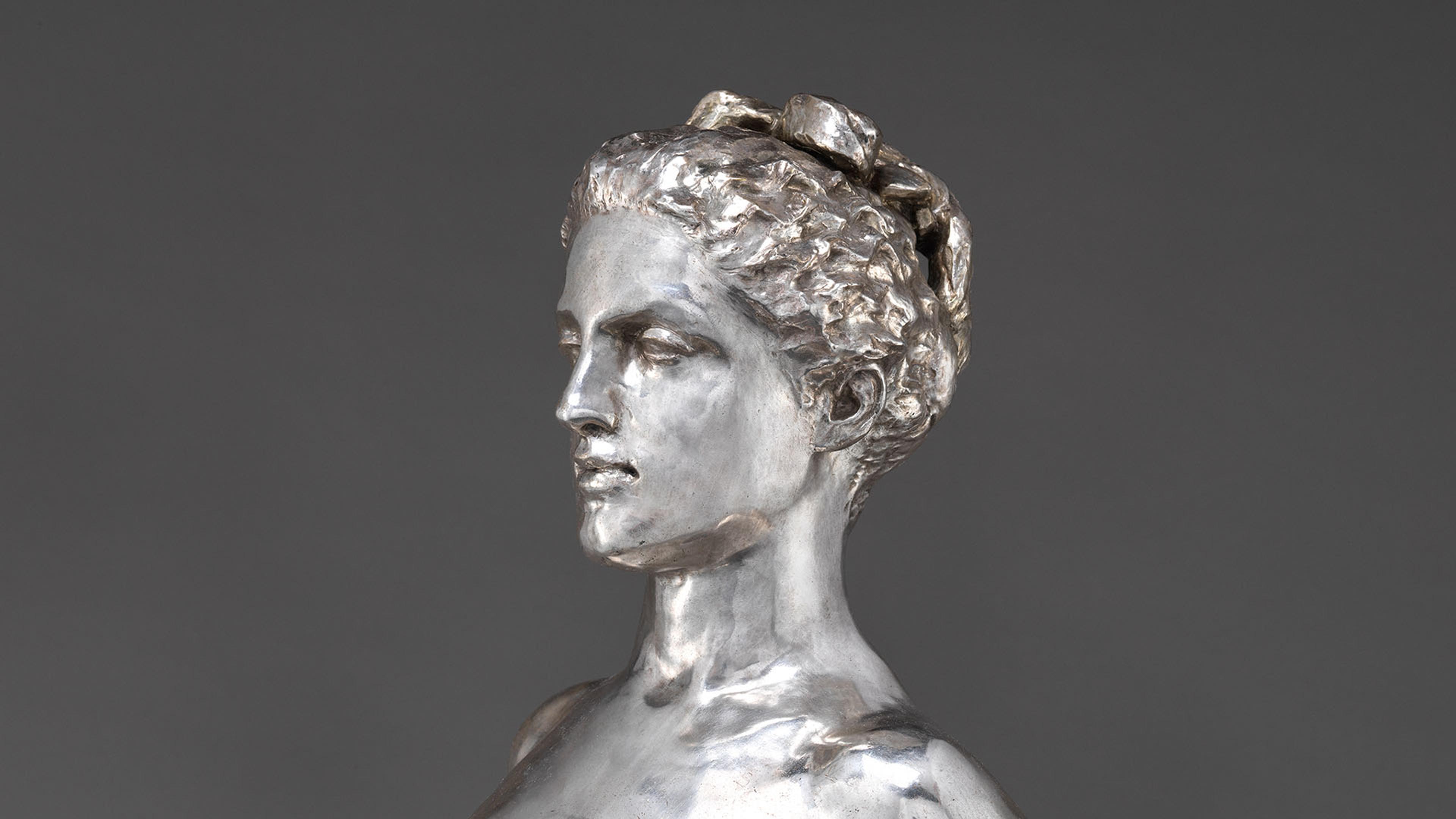
Klinger created Galatea at the height of his artistic fame when he was celebrated in German speaking countries as one of their greatest sculptors. He was best known for his complex polychrome sculptures that were assembled from assorted colored marbles and bronze. The mythical sea-goddess and child seated on a marble throne is Klinger’s only independent figurative sculpture in silver. In 1906 Klinger presented Galatea as his principle work at the prestigious exhibition of German contemporary art in Weimar.
Shown in triumph, Klinger’s figure of the sea-goddess Galatea resonates with the primal aura of an idol. The subject was familiar to Klinger’s contemporaries from Goethe’s famous description of triumphant Galatea, "Grave in aspect like the gods, in dignified immortality…" (Faust II, 8387-90). But Klinger also drew from the contemporary philosophy of Nietzsche and Freudian psychology to create an unprecedented depiction of the goddess enthroned with a male child who together represent the archetypal union between body and mind, female and male, sexuality and the psyche.
Artwork Details
- Title: Galatea
- Artist: Max Klinger (German, Leipzig 1857–1920 Großjena)
- Founder: Cast by Noack and Brückner Foundry (German)
- Date: 1906
- Culture: German
- Medium: Cast silver; marble
- Dimensions: Confirmed field dimensions: 43 3/4 × 12 1/2 × 18 3/4 in. (111.1 × 31.8 × 47.6 cm)
figure, wt. confirmed: 31 1/2 × 12 3/16 × 13 3/8 in., 30 lb. (80 × 31 × 34 cm, 13.6 kg)
base, wt. confirmed: 21 15/16 × 10 5/8 × 13 3/8 in., 208 lb. (55.7 × 27 × 34 cm, 94.3 kg) - Classification: Sculpture
- Credit Line: Purchase, Bequest of Emma A. Sheafer, by exchange, Anonymous and Charles Hack and the Hearn Family Trust Gifts, and Gifts of Irwin Untermyer and Mrs. Robert M. Hillas, by exchange, 2018
- Object Number: 2018.25a, b
- Curatorial Department: European Sculpture and Decorative Arts
More Artwork


Related Content
 Free to download
Research Resources
The Met provides unparalleled resources for research and welcomes an international community of students and scholars. The Met's Open Access API is where creators and researchers can connect to the The Met collection. Open Access data and public domain images are available for unrestricted commercial and noncommercial use without permission or fee.
To request images under copyright and other restrictions, please use this Image Request form.
Feedback
We continue to research and examine historical and cultural context for objects in The Met collection. If you have comments or questions about this object record, please contact us using the form below. The Museum looks forward to receiving your comments.
Content Notice
The Metropolitan Museum of Art presents over 5,000 years of art from around the world, and our online collection reflects ongoing work conducted over the course of our more than 150-year history. You may encounter objects or images that may be inappropriate for some viewers or information that may be outdated.