Evening dress
Poiret's designs from the mid-1920s, however, are invariably refined in their execution. Perhaps by that point in his career Poiret controlled his more theatrical and artisanal impulses and sought to conform to the standards of the métiers of les petits mains, the workshops that provide all the decorative details of the haute couture. Perhaps, also, he was answerable to his backers, the Auber Group, which from 1924, provided financial support to Poiret's flagging business. In any case, in this period his designs both reflected the polished finish typically associated with couture techniques and were also aligned overall with the styles of his contemporaries.
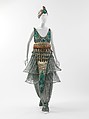
Although the designer continued to advocate a flaring skirt at a time when a stricter chemise shape was the standard, the fullness in this example is mediated by the weight of the embroidered pearl motifs – lotuslike with possible Egyptian Revival or archaic Chinese sources – which cause the paisley-patterned gold lace to collapse in irregular flutes. The lace, the "lotus" pearl embroidery, and the flaring Poiret sleeve (described by one journalist as a "mandarin sleeve," although it is equally Ottoman in style) are subsumed in the effect of prevailing fashion. Poiret's exoticism has not disappeared, but is merely muted by the influence of aesthetic trends that found full expression in the 1925 Exposition Internationale des Arts Décoratifs et Industriels Modernes.
Artwork Details
- Title: Evening dress
- Designer: Paul Poiret (French, Paris 1879–1944 Paris)
- Date: ca. 1925
- Culture: French
- Medium: metallic, simulated pearls
- Credit Line: Gift of Mrs. Robert L. Dodge, 1951
- Object Number: C.I.51.48.4a, b
- Curatorial Department: The Costume Institute
More Artwork
Related Content
 Free to download
Research Resources
The Met provides unparalleled resources for research and welcomes an international community of students and scholars. The Met's Open Access API is where creators and researchers can connect to the The Met collection. Open Access data and public domain images are available for unrestricted commercial and noncommercial use without permission or fee.
To request images under copyright and other restrictions, please use this Image Request form.
Feedback
We continue to research and examine historical and cultural context for objects in The Met collection. If you have comments or questions about this object record, please contact us using the form below. The Museum looks forward to receiving your comments.
Content Notice
The Metropolitan Museum of Art presents over 5,000 years of art from around the world, and our online collection reflects ongoing work conducted over the course of our more than 150-year history. You may encounter objects or images that may be inappropriate for some viewers or information that may be outdated.