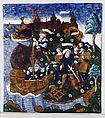
The Fleet of Aeneas Arrives in Sight of Italy (Aeneid, Book III)
The scenes are not, however, the product of the enameler's imagination; rather, they are close copies of the woodcut illustrations for the edition of the Latin poet’s Opera printed by Johann Grüninger in Strasbourg in 1502. The same woodcuts were used again for the edition published in Lyon in 1517. The anonymous painter of the enamels may have used either the Strasbourg of the Lyon edition as his model, but the enamels are somewhat later than either edition. Because of changes made at an early point in the series in the technique employed for counterenameling the plaques (enameling the reverse side), it seems likely that most of them were painted after about 1530 or 1533.
Artwork Details
- Title: The Fleet of Aeneas Arrives in Sight of Italy (Aeneid, Book III)
- Artist: Master of the Aeneid (active ca. 1530–40)
- Date: ca. 1530–35
- Culture: French, Limoges
- Medium: Painted enamel on copper, partly gilt
- Dimensions: 8 3/4 x 7 3/4 in. (22.2 x 19.7 cm)
- Classification: Enamels
- Credit Line: Gift of J. Pierpont Morgan, 1925
- Object Number: 25.40.2
- Curatorial Department: European Sculpture and Decorative Arts
More Artwork




Related Content
 Free to download
Research Resources
The Met provides unparalleled resources for research and welcomes an international community of students and scholars. The Met's Open Access API is where creators and researchers can connect to the The Met collection. Open Access data and public domain images are available for unrestricted commercial and noncommercial use without permission or fee.
To request images under copyright and other restrictions, please use this Image Request form.
Feedback
We continue to research and examine historical and cultural context for objects in The Met collection. If you have comments or questions about this object record, please contact us using the form below. The Museum looks forward to receiving your comments.
Content Notice
The Metropolitan Museum of Art presents over 5,000 years of art from around the world, and our online collection reflects ongoing work conducted over the course of our more than 150-year history. You may encounter objects or images that may be inappropriate for some viewers or information that may be outdated.