Harlequin with Goat as Bagpipes
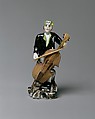
Harlequin's bagpipes are made of a goat's hide complete with hooves, head, and horns. The instrument is clearly inspired by the Bohemian bock, featuring a single cylindrical chanter, small bellows, and a right-angle, extensible drone with two tubes connected by a sliding joint. While intact goatskins frequently served as bags, the head was replaced with a zoomorphically carved wooden stock. In the Meissen model, the exaggerated naturalism of the instrument amplifies the composition's grotesque character; it is difficult to resist the impression that Harlequin makes a live goat blow the chanter by squeezing its voluminous body with his left arm.
Despite their lowly associations, small bagpipes known as musettes became popular in aristocratic circles in the seventeenth and eighteenth centuries. Bock ensembles were attached to the Saxon court, accompanying weddings, hunts, and festival processions, while nobles often disguised themselves as Tyrolean bagpipers at court masquerades. Meissen figures were another expression of that broad cultural vogue.
Artwork Details
- Title: Harlequin with Goat as Bagpipes
- Manufactory: Meissen Manufactory (German, 1710–present)
- Date: ca. 1736
- Culture: German, Meissen
- Medium: Hard-paste porcelain
- Dimensions: Overall (confirmed): 5 9/16 x 3 x 2 1/2 in. (14.1 x 7.6 x 6.4 cm)
- Classification: Ceramics-Porcelain
- Credit Line: The Jack and Belle Linsky Collection, 1982
- Object Number: 1982.60.316
- Curatorial Department: European Sculpture and Decorative Arts
More Artwork
Related Content

 Free to download
Research Resources
The Met provides unparalleled resources for research and welcomes an international community of students and scholars. The Met's Open Access API is where creators and researchers can connect to the The Met collection. Open Access data and public domain images are available for unrestricted commercial and noncommercial use without permission or fee.
To request images under copyright and other restrictions, please use this Image Request form.
Feedback
We continue to research and examine historical and cultural context for objects in The Met collection. If you have comments or questions about this object record, please contact us using the form below. The Museum looks forward to receiving your comments.
Content Notice
The Metropolitan Museum of Art presents over 5,000 years of art from around the world, and our online collection reflects ongoing work conducted over the course of our more than 150-year history. You may encounter objects or images that may be inappropriate for some viewers or information that may be outdated.