Ivory sandaled foot
Artwork Details
- Title: Ivory sandaled foot
- Period: Early Imperial, Augustan
- Date: ca. 31 BCE–14 CE
- Culture: Roman
- Medium: Ivory
- Dimensions: Overall: 2 3/8 x 5 5/8 in. (6 x 14.3 cm)
- Classifications: Miscellaneous-Bone, Ivory
- Credit Line: Fletcher Fund, 1925
- Object Number: 25.78.43
- Curatorial Department: Greek and Roman Art
Audio
1073. Ivory sandaled foot, Part 1
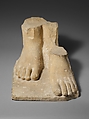
The warm natural color of this ivory sandaled foot bears a resemblance to real flesh. Notice how skillfully the artist has carved the toes to look like skin stretched over jointed bones, and how naturalistically he rendered the tied leather straps. This extraordinary foot was once part of a large statuette. Probably, the hands, arms and head were also made of ivory, but the drapery was in a different material, perhaps gold or silver, or even semi-precious stone. The magnificent figure probably stood in one of the many temples erected during the reign of the Emperor Augustus, between 27 B.C. and A.D. 14.
On the tongue of the sandal is a personification of the Nile River, suggesting that this foot might have belonged to a representation of an Egyptian deity. Then again, it might have been part of a large statuette of the Roman Emperor Augustus. For nearly four hundred years, Egypt had been under the rule of the Ptolemies—the Macedonian kings who inherited the vast territories conquered by Alexander the Great. Egypt was the last of the Hellenistic kingdoms to fall to Rome, and, thus, its last great rival. By conquering Egypt, Augustus secured Rome’s supremacy throughout the Mediterranean, and brought the great wealth and natural resources of the land of the Nile to benefit the people of Rome.
If you would like to hear Philippe de Montebello read a quote from the Roman poet, Horace, about Augustus, and the far reaches of his empire, press the PLAY button now.
Listen to more about this artwork
More Artwork
Related Content


 Free to download
Research Resources
The Met provides unparalleled resources for research and welcomes an international community of students and scholars. The Met's Open Access API is where creators and researchers can connect to the The Met collection. Open Access data and public domain images are available for unrestricted commercial and noncommercial use without permission or fee.
To request images under copyright and other restrictions, please use this Image Request form.
Feedback
We continue to research and examine historical and cultural context for objects in The Met collection. If you have comments or questions about this object record, please contact us using the form below. The Museum looks forward to receiving your comments.
Content Notice
The Metropolitan Museum of Art presents over 5,000 years of art from around the world, and our online collection reflects ongoing work conducted over the course of our more than 150-year history. You may encounter objects or images that may be inappropriate for some viewers or information that may be outdated.