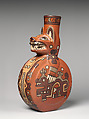
Figure Bottle
The Nasca inhabited the fertile coastal valleys of southern Peru and were great innovators in both ceramic technology and textile fabrication. Nasca potters were early developers of the use of polychrome slips and deployed them to depict animals, plants, deities, and individuals performing different tasks. Textile production, which was advanced in all cultures in ancient Peru, reached a very high level in the Nasca period, particularly the variety of techniques, materials, and overall quality. Although this individual wears a rather simple wrap, other textiles used embroidery, feathers, tie-dye, and other variations. The arid desert environment of the Peruvian south coast has permitted the preservation of many of these weavings (see, for example, works in the Met’s collection, including 28.171.13 and 29.146.23).
References
Lavalle, José Antonio and José Alejandro González García, series directors. Arte textil del Perú. Lima, Peru: Industria Textil Piura, 1988-1989.
Lavalle, José Antonio. Nazca. Culturas Precolombinas. Lima, Peru: Banco de Crédito del Perú, 1989.
Pardo, Cecilia, and Peter Fux, editors. Nasca. Exh. cat. Lima, Peru: Asociación Museo de Arte de Lima; Zürich, Switzerland: Museo Rietberg, 2017. Proulx, Donald A. A Sourcebook of Nasca Ceramic Iconography: Reading a Culture through its Art. Iowa City: University of Iowa Press, 2006.
Rickenbach, Judith. Nasca: Geheimnisvolle Zeichen im alten Peru. Exh. cat. Zürich: Museum Rietberg, 1999.
Artwork Details
- Title: Figure Bottle
- Date: 4th–6th century
- Geography: Peru
- Culture: Nasca
- Medium: Ceramic, pigment
- Dimensions: H. 8 1/2 in. (21.59 cm)
- Classification: Ceramics-Containers
- Credit Line: Gift of Mr. and Mrs. Nathan Cummings, 1964
- Object Number: 64.228.65
- Curatorial Department: The Michael C. Rockefeller Wing
More Artwork
Related Content
 Free to download
Research Resources
The Met provides unparalleled resources for research and welcomes an international community of students and scholars. The Met's Open Access API is where creators and researchers can connect to the The Met collection. Open Access data and public domain images are available for unrestricted commercial and noncommercial use without permission or fee.
To request images under copyright and other restrictions, please use this Image Request form.
Feedback
We continue to research and examine historical and cultural context for objects in The Met collection. If you have comments or questions about this object record, please contact us using the form below. The Museum looks forward to receiving your comments.
Content Notice
The Metropolitan Museum of Art presents over 5,000 years of art from around the world, and our online collection reflects ongoing work conducted over the course of our more than 150-year history. You may encounter objects or images that may be inappropriate for some viewers or information that may be outdated.