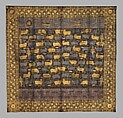
Shield cover
The second, and largest, register is composed of alternating anthropomorphic and zoomorphic forms. The zoomorphic forms appear to be a creature shown in profile and wearing a crescent headdress, thought to be a symbol of rank or divinity. An eel or snake emerges from the creature’s mouth, and a serpent-like form from the crown of the head, although it is possible the creature is simply biting into the body of an undulating, double-headed snake. The lower portion of the creature’s body is tripartite with a single, central, footed leg symmetrically flanked by additional open-mouthed, teeth-baring profile zoomorphic heads that flare out and down from the body. The anthropomorphic figure, also wearing a crescent headdress, holds a staff in either hand. The staves are probably plant forms, complete with roots and what appear to be ears of maize. A bicephalic snake form, perhaps a representation of a type of ornamental regalia, separates the head from the body.
The third band features a stepped-fret pattern, unusual in the corpus of Chimú silver disks. The fret forms are filled with tiny birds, monkeys, and mythological creatures. The innermost band consists of a ring of shore birds wearing crescent headdresses and grasping small unidentified, though somewhat lizard-like, creatures. This band displays greater variation in size between the motifs, as if the silversmith who created it had difficulty spacing the birds in the composition. Similarly, birds wearing crescent headdresses are depicted in the architectural reliefs at Chan Chan, the capital of the Chimú Empire, now an archaeological site near the modern city of Trujillo, Peru.
The rim of this disk was slightly folded over in two places, apparently in ancient times, giving the disk a slightly oval shape. After the edges were thus folded, five pairs of perforations plus a single perforation were made close to the edge of the disk. This thin silver disk was then likely lashed to a cane backing or frame to create a spectacular component of a warrior’s armor.
Joanne Pillsbury, Andrall E. Pearson Curator, Arts of the Ancient Americas, 2018
Published
Art of Oceania, Africa, and the Americas from the Museum of Primitive Art. New York: The Metropolitan Museum of Art, 1969, 471.
King, Heidi, Luis Jaime Castillo Butters, and Paloma Carcedo de Mufarech. Rain of the Moon: Silver in Ancient Peru. New York, New Haven and London: The Metropolitan Museum of Art, 2000, 15d, 44-5.
Further Reading
Boone, Elizabeth Hill, ed., Andean Art at Dumbarton Oaks. Washington, D.C.: Dumbarton Oaks Research Library and Collection, 1996, pp. 218-222.
Donnan, Christopher B., Moche Tombs at Dos Cabezas. Los Angeles, CA: Cotsen Institute of Archaeology at UCLA, 2007.
Pillsbury, Joanne. "Luxury Arts and the Lords of Chimor," in Latin American Collections: Essays in Honor of Ted J.J. Leyenaar, Dorus Kop Jansen and Edward de Bock, eds., pp. 67-81. Leiden: Ed. Tetl, 2003
Artwork Details
- Title: Shield cover
- Artist: Chimú artist(s)
- Date: 1350–1470 CE
- Geography: Peru, North Coast
- Culture: Chimú
- Medium: Silver
- Dimensions: H. 12 1/2 × W. 13 5/8 × D. 1/2 in. (31.8 × 34.7 × 1.3 cm)
- Classification: Metal-Ornaments
- Credit Line: The Michael C. Rockefeller Memorial Collection, Gift of Nelson A. Rockefeller, 1969
- Object Number: 1978.412.144
- Curatorial Department: The Michael C. Rockefeller Wing
More Artwork
Related Content
 Free to download
Research Resources
The Met provides unparalleled resources for research and welcomes an international community of students and scholars. The Met's Open Access API is where creators and researchers can connect to the The Met collection. Open Access data and public domain images are available for unrestricted commercial and noncommercial use without permission or fee.
To request images under copyright and other restrictions, please use this Image Request form.
Feedback
We continue to research and examine historical and cultural context for objects in The Met collection. If you have comments or questions about this object record, please contact us using the form below. The Museum looks forward to receiving your comments.
Content Notice
The Metropolitan Museum of Art presents over 5,000 years of art from around the world, and our online collection reflects ongoing work conducted over the course of our more than 150-year history. You may encounter objects or images that may be inappropriate for some viewers or information that may be outdated.