Set of Sacrificial Weapons
Kālī is said to have sprung fully formed, in the midst of battle, from the forehead of an enraged Durgā. The very image of death, with dark shriveled skin, wild disheveled hair, a wide gaping mouth with bared fangs, clad only in a necklace and skirt made from the body parts of her opponents, and driven by an insatiable lust for their blood, she is the consummate destroyer. She also appears as the personified rage of other, usually benign, goddesses, including Pārvatī, Satī, and Sītā. In some episodes of Kālī's legends her fury reaches such dangerous proportions that it can be quelled only by the death of her husband, Shiva. In effect, he sacrifices himself to Kālī by appearing as a corpse at her feet amid the carnage she has wrought, so that in recognizing him she will realize the impact of the destruction she has caused.
From Kālī's role as the ultimate agent of death there evolved the other fundamental aspect of her persona, that of the universal mother, the ultimate source of life. As such she is the principal deity of Shaktism, the worship of the trancendent female generative forces that are the font of all life and stability in the universe. Although wild and deadly, with a mouth reddened by blood, this Kālī can also be young and beautiful. In her resides the complete life cycle, from the creation of existence out of the void to its inevitable return to nothingness.
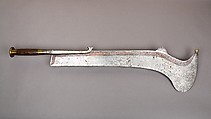
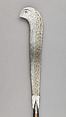
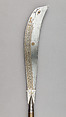
The worship of Kālī, like that of the other Indian goddesses who are revered for their generative powers, regularly includes blood sacrifice, which was once carried out with weapons such as these three examples. The largest of the three (acc. no. 36.25.1284), a top-heavy sword known as a rāmdāo, was used to decapitate sacrificial buffalo in commemoration of the slaying of the buffalo demon, Mahisha, by Kālī's progenitor, Durgā. The two lighter swords, of the type called either kartrī or churī, were intended for smaller animals such as goats (acc. nos. 36.25.1285, .1286). The eye engraved on the blade signifies the presence of the goddess as she watches over the sacrifice. The hump-like projection above the eye on the back edge of the rāmdāo represents the tasseled hat of the defeated buffalo demon. The hat is sometimes also seen in paintings of Durgā, floating above her head as she battles demon armies, as a symbol of her victory over Mahisha. Animals sacrificed during worship are thought to have been liberated instantly from the painful cycle of rebirth to which Hindus believe all living creatures are bound. The sacrifices are intended to nourish the goddess and to secure from her the blessings of life.
Artwork Details
- Title: Set of Sacrificial Weapons
- Date: 19th century
- Culture: Indian, Bengal (?) or Nepalese
- Medium: Steel, wood, brass
- Dimensions: 36.25.1284: L. 35 1/2 in. (90.2 cm)
36.25.1285: L. 18 in. (45.7 cm)
36.25.1286: L. 17 in. (43.2 cm); overall 25 1/2 in. (64.8 cm) - Classification: Shafted Weapons
- Credit Line: Bequest of George C. Stone, 1935
- Object Number: 36.25.1284–.1286
- Curatorial Department: Arms and Armor
More Artwork
Research Resources
The Met provides unparalleled resources for research and welcomes an international community of students and scholars. The Met's Open Access API is where creators and researchers can connect to the The Met collection. Open Access data and public domain images are available for unrestricted commercial and noncommercial use without permission or fee.
To request images under copyright and other restrictions, please use this Image Request form.
Feedback
We continue to research and examine historical and cultural context for objects in The Met collection. If you have comments or questions about this object record, please contact us using the form below. The Museum looks forward to receiving your comments.
Content Notice
The Metropolitan Museum of Art presents over 5,000 years of art from around the world, and our online collection reflects ongoing work conducted over the course of our more than 150-year history. You may encounter objects or images that may be inappropriate for some viewers or information that may be outdated.