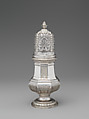
Sugar caster (one of a pair)
Crystallized sugar was shipped in hard, paper-wrapped cones which had to be broken or cut into small pieces. Served in a bowl, small lumps of sugar were offered with tea and coffee, the hot liquids quickly dissolving the lumps of sugar. Alternatively, the imported sugar was refined in France and crushed into a fine powder for use as a condiment during the meal. This required a different type of serving vessel: either a caster with an openwork lid for sprinkling, or a lidded bowl with a pierced spoon for dusting.
Small casters to contain salt, ground pepper, spices, and dry mustard were already used in France by the mid-1600s. With the increasing sugar consumption, taller casters for powdered sugar were added to the table. A dusting of fine grain or powdered sugar enhanced the flavor of fresh fruit served at the time of the dessert.
The early cylindrical form of the sugar caster with a pierced domed lid surmounted by a finial or knob, gave way in the eighteenth century to a more elegant baluster shape. The ornate openwork of the lid allowed the sugar to be sprinkled (saupoudroir) or “cast.” This caster, one of a pair, by the silversmith Nicolas Besnier, dates to 1728-29.
Artwork Details
- Title: Sugar caster (one of a pair)
- Maker: Nicolas Besnier (French, 1686–1754, master 1714)
- Date: 1728–29
- Culture: French, Paris
- Medium: Silver
- Dimensions: Height: 10 in. (25.4 cm)
- Classification: Metalwork-Silver
- Credit Line: Harris Brisbane Dick Fund, 1938
- Object Number: 38.164.2a, b
- Curatorial Department: European Sculpture and Decorative Arts
More Artwork
Research Resources
The Met provides unparalleled resources for research and welcomes an international community of students and scholars. The Met's Open Access API is where creators and researchers can connect to the The Met collection. Open Access data and public domain images are available for unrestricted commercial and noncommercial use without permission or fee.
To request images under copyright and other restrictions, please use this Image Request form.
Feedback
We continue to research and examine historical and cultural context for objects in The Met collection. If you have comments or questions about this object record, please contact us using the form below. The Museum looks forward to receiving your comments.
Content Notice
The Metropolitan Museum of Art presents over 5,000 years of art from around the world, and our online collection reflects ongoing work conducted over the course of our more than 150-year history. You may encounter objects or images that may be inappropriate for some viewers or information that may be outdated.