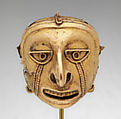
Stamp, Monkey
In Nahuatl, the monkey is called ozomatli and is the eleventh day sign of the ancient Aztec calendar. Unlike our calendar today, which consists of twelve months of approximately thirty days each, the Aztecs and other Mesoamerican peoples used "months" of just twenty days. Each day was given a number and named after a different animal or other natural element—for example, "1 Crocodile," "2 Reed," or "4 Movement (Earthquake)."
Monkeys were closely associated with the wind deity Ehecatl, whose teardrop-shaped earrings (epcololli) and split-conch necklaces are often depicted in sculpted images of primates. Almost invariably, artists in the Postclassic period (ca. 900–1521) showed monkeys with large stomachs, animated facial expressions, and attenuated tails that they often hold in their paws.
Ceramic stamps were made in Central Mexico from the Early Formative period (ca. 1800–1200 B.C.) and continued into the early sixteenth century. It is assumed that the earliest examples of such objects functioned much as they did among the Aztecs three millennia later: as ornamental devices used to decorate clothing, ceramic vessels, and even the body. They typically feature abstract geometric designs or stylized animal imagery, often in repeating patterns. Commonly found interred with human remains, these stamps were apparently valued as highly in death as they were in life.
William T. Gassaway, 2014-15 Sylvan C. Coleman and Pamela Coleman Fellow
-----
Resources and Additional Reading
Bierhorst, John. History and Mythology of the Aztecs: The Codex Chimalpopoca. Tucson: University of Arizona Press, 1992.
Miller, Mary E., and Karl Taube. The Gods and Symbols of Ancient Mexico and the Maya: An Illustrated Dictionary of Mesoamerican Religion. London: Thames & Hudson Ltd, 1993.
Sahagún, Bernardino de. The Florentine Codex: A General History of the Things of New Spain. 12 vols. Translated and edited by Arthur J. O. Anderson and Charles E. Dibble. Santa Fe: School of American Research, 1950–82. For creation myth, see Bk. 11 ("Earthly Things").
Seler, Eduard. Gesammelte Abhandlungen zur Amerikanischen Sprach- und Altertumskunde. 5 vols. Berlin: Ascher, 1902–23. See esp. Vol. 4, pp. 456–59.
Taube, Karl. Olmec Art at Dumbarton Oaks. Washington, D.C.: Dumbarton Oaks Research Library and Collection, 2004.
Artwork Details
- Title: Stamp, Monkey
- Date: 14th–early 16th century
- Geography: Mexico, Mesoamerica
- Culture: Mexica (Aztec)
- Medium: Ceramic
- Dimensions: W. 2 × D. 5/8 × L. 2 1/2 in. (5.1 × 1.6 × 6.4 cm)
- Classification: Ceramics-Implements
- Credit Line: Museum Purchase, 1900
- Object Number: 00.5.1164
- Curatorial Department: The Michael C. Rockefeller Wing
More Artwork
Research Resources
The Met provides unparalleled resources for research and welcomes an international community of students and scholars. The Met's Open Access API is where creators and researchers can connect to the The Met collection. Open Access data and public domain images are available for unrestricted commercial and noncommercial use without permission or fee.
To request images under copyright and other restrictions, please use this Image Request form.
Feedback
We continue to research and examine historical and cultural context for objects in The Met collection. If you have comments or questions about this object record, please contact us using the form below. The Museum looks forward to receiving your comments.
Content Notice
The Metropolitan Museum of Art presents over 5,000 years of art from around the world, and our online collection reflects ongoing work conducted over the course of our more than 150-year history. You may encounter objects or images that may be inappropriate for some viewers or information that may be outdated.