Allegory
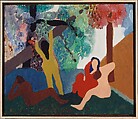
Fantasy and storytelling play a key role in the artist’s work, as seen in Allegory, whose generic title leaves much to the viewer’s imagination.[5] Only the grouping and interaction of figures, which appear mostly in chromatic silhouette, shorn of individualized details, lend insight into the precise nature of Thompson’s cryptic narrative. Although his palette inclines to the bright and cheery, his subject matter tends towards the sinister, mixing hedonism and violence. Allegory’s composition is divided into zones of color brushed over other colors that fit together like pieces of a puzzle. Into this interlocking set of shapes, Thompson inserts creatures as well as male and female figures, all of them among his most common motifs. One of the male figures, identified as such by his hat, is joined with an orange animal with gray hooves.[6] To his right is what appears to be a beach ball, mysteriously out of place and out of context, as well as a floating, possible nude figure floating at upper right. Directly below him is the head of another animal, this one black, possibly a hound. The other male figure, painted brown, lifts a nude female figure, painted a light gray-beige, off the ground. She is the passive victim of his physical and sexual aggression. Former Met curator Lowery Stokes Sims has postulated that Thompson is here reimagining the ancient Greek and Roman myths of either Persephone, Europa, or the sisters Phoebe and Hilaeira (daughters of Leucippus), all of whom were victims of rape, abduction, and kidnapping, a subject represented with great frequency in the very European paintings Thompson so frequently studied.[7] Allegory might even have been inspired, either directly or indirectly, by drawings, paintings, and prints he could have seen at The Met, including The Abduction of the Sabine Women by Nicholas Poussin, a longstanding favorite of Thompson’s.[8] (Other depictions of the Sabine women, likewise those of the protagonists mentioned by Sims, were also represented in considerable numbers in The Met’s collection of 1959–60.)
It is useful to consider the work in relationship to the reading of Crystal N. Feimster, who positions Thompson’s career against the backdrop of Jim Crow America, a charged moment that witnessed the confluence of two contradictory forces: first, the lynching of Black men for real or alleged sexual relations with White women, and second, the assertion by "young radical African Americans, including Thompson" of "a new Black sense of self that linked interracial sex with racial equality and Black freedom."[9] Channeling widespread social anxieties among Whites, the memory of racial trauma and the ongoing threat of racial hatred, and, finally, personal and political desires, Thompson reimagines in paintings such as Allegory "the racial and sexual landscape of Jim Crow America into a vision of interracial sexual freedom that blurred the line between pleasure and violence, man and beast, good and evil."[10]
[1] See John Cohen’s image of the 1960 Grooms’ Happening, "The Burning Building," in which Thompson participated. Thompson himself does not appear in this photograph, though.
[2] Don Fiene, a friend of Thompson's, remembers running into the artist at The Met in 1959, for instance. See Judith Wilson, "Garden of Music: The Art and Life of Bob Thompson," in Bob Thompson, ed. Thelma Golden (New York: Whitney Museum of American Art; Berkeley, CA: University of California Press, 1998), p. 70.
[3] Thelma Golden reads Thompson's tendency to quote in terms of "signifyin'," a term introduced by Henry Louis Gates, Jr., "in which meaning is inscribed through revision, repetition and conscious misappropriation." The "act of copying . . . becomes a surreptitious claim to power and equality, or rather to the power that can be gained through equality" (Golden, "Introduction," in Bob Thompson, p. 23).
[4] Adrienne L. Childs, "Bob Thompson in the Wake of Art History," in Bob Thompson: This House is Mine, ed. Diana Tuite (Waterville, ME: Colby College Museum of Art, 2021), p. 59.
[5] Allegory was painted the same year as Thompson's first one-person exhibition in New York at the Delancey Street Museum, a gallery run by Thompson, Red Grooms, and Jay Milder out of a third-floor studio loft at 148 Delancey Street. Meyer Schapiro purchased a work by Thompson from this exhibition. It is not known if Allegory was included in that show.
[6] The hatted male figure is a persistent motif in Thompson's art, and he introduces it around 1960, the same year he painted Allegory. Golden calls him an "apparition" that also serves as a "coded mark" for Thompson himself (Ibid., p. 18). Bridget R. Cooks speculates that the hatted figured symbolizes jazz musician Lester Young, who often wore a porkpie hat when performing. ("Dark Figures," in Bob Thompson: This House is Mine, pp. 92–93). Usually seen in the company of women and animals, the hatted figure is a curious, disconcerting, mysterious presence in Thompson's work, representing a complex of unresolved anxieties around race, gender, and sexuality.
[7] Lowery Stokes Sims, The Figure in 20th Century American Art: Selections from the Metropolitan Museum of Art (New York: American Federation of Arts, 1984), p. 108.
[8] Thompson mentioned his admiration for Poussin in a 1965 interview. See Childs, ibid, p. 62.
[9] Crystal N. Feimster, "Black Monster and The Hanging," in Bob Thompson: This House is Mine, p. 115. Thompson’s wife, Carol Plenda, was White.
[10] Ibid., p. 117.
Artwork Details
- Title: Allegory
- Artist: Bob Thompson (American, Louisville, Kentucky 1937–1966 Rome, Italy)
- Date: 1960
- Medium: Oil on canvas
- Dimensions: 60 × 71 (152.4 × 180.3)
- Classification: Paintings
- Credit Line: George A. Hearn Fund, 1981
- Object Number: 1981.284
- Rights and Reproduction: © Estate of Bob Thompson
- Curatorial Department: Modern and Contemporary Art
More Artwork
Research Resources
The Met provides unparalleled resources for research and welcomes an international community of students and scholars. The Met's Open Access API is where creators and researchers can connect to the The Met collection. Open Access data and public domain images are available for unrestricted commercial and noncommercial use without permission or fee.
To request images under copyright and other restrictions, please use this Image Request form.
Feedback
We continue to research and examine historical and cultural context for objects in The Met collection. If you have comments or questions about this object record, please contact us using the form below. The Museum looks forward to receiving your comments.
Content Notice
The Metropolitan Museum of Art presents over 5,000 years of art from around the world, and our online collection reflects ongoing work conducted over the course of our more than 150-year history. You may encounter objects or images that may be inappropriate for some viewers or information that may be outdated.