자화상
Artwork Details
- 제목: 자화상
- 아티스트: 레오노라 캐링턴 멕시코, 영국 태생, 19177–2011년
- 연대: 1937– 38년경
- 재료: 캔버스에 유채
- 크기: 65 × 81.3cm
- 크레디트 라인: 피에르와 마리아-개타나 마티스 컬렉션, 2002
- 작품 번호: 2002.456.1
- Curatorial Department: Modern and Contemporary Art
Audio
Leonora Carrington’s Self Portrait | Gallery 901
“I didn’t have time to be anyone’s muse,” the artist and writer Leonora Carrington once said. “I was too busy rebelling against my family and learning to be an artist.”
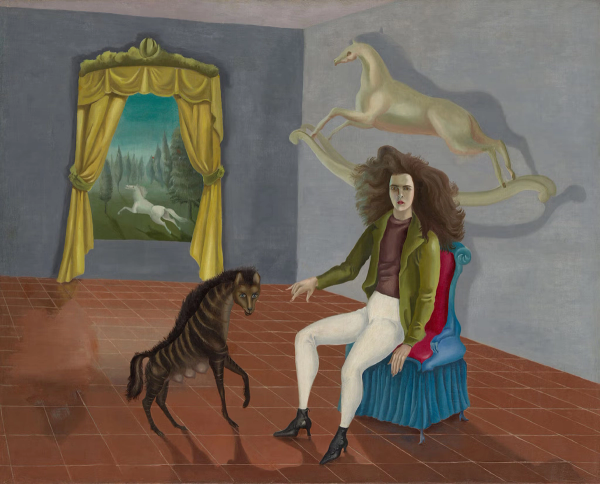
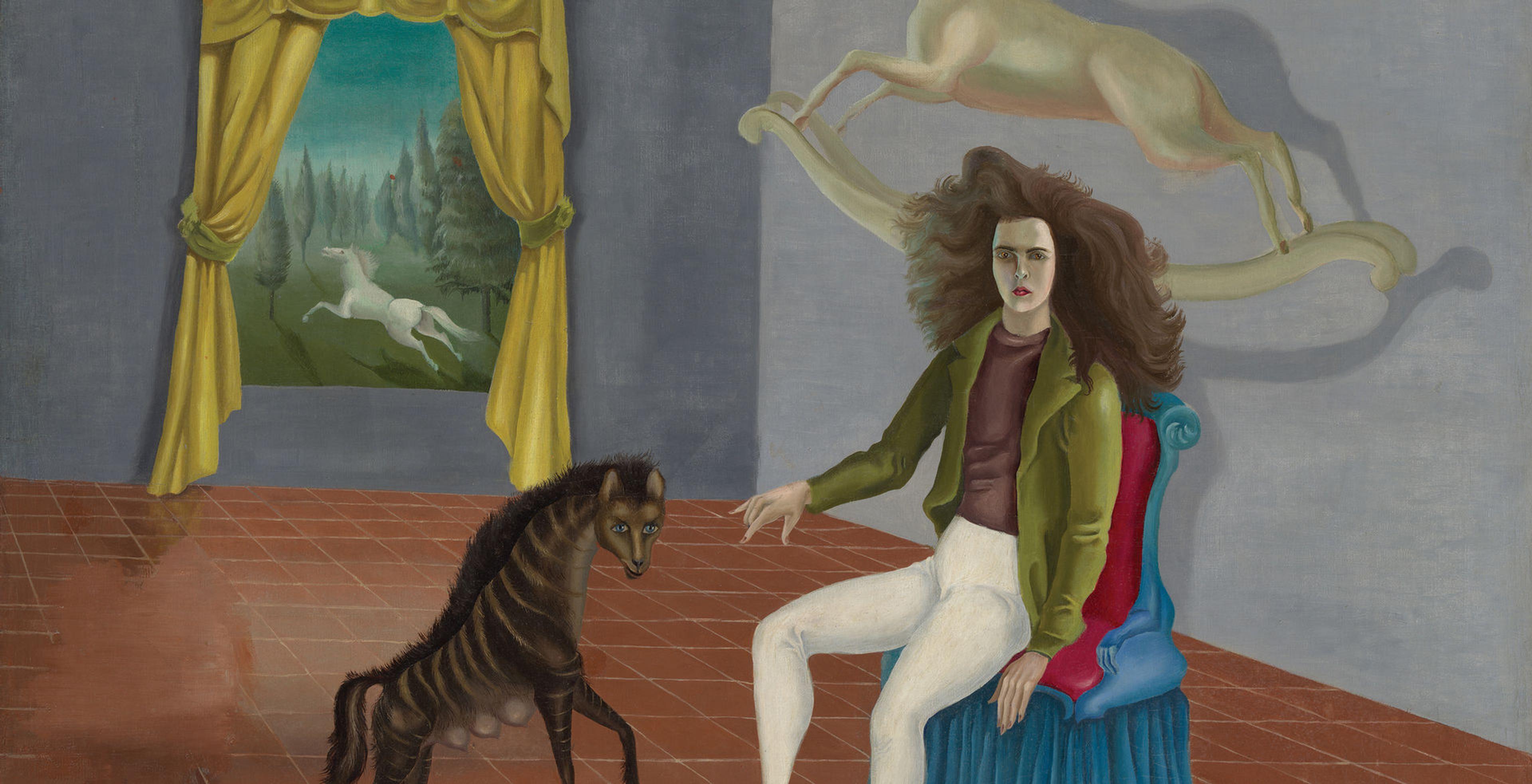
KATY HESSEL (Voiceover): In The Met’s Modern and Contemporary Wing, there’s a small self-portrait of a woman with wild hair. This woman is surrealist artist Leonora Carrington. And when I saw this incredible work in person, I was astonished.
HESSEL: Ah… amazing!
I’ve seen it reproduced so many times. But actually when you see it in The Met Museum, somehow it comes alive more than you’ve ever imagined before.
We see this woman, her hair almost looks like it’s got a sort of electric shock or something. She’s wearing these white jodhpurs. It’s quite preppy. And these two horses, one of which is a flying rocking horse with a shadow—looking quite ominous. And the other is breaking free, it’s alive. It’s not a rocking horse. It’s not wooden. It’s set free into the distance.
Leonora Carrington is just an artist who I’ve always, her work has always resonated with me so much. And it’s because she had this rebellious, free spirit. She had such an extraordinary life. She grew up in this quite strict, sort of upper-middle-class household where she was destined to just be a debutante and essentially be married off to a wealthy man.
But she did the exact opposite of that. She ran away to London, and then to Paris, then she went to Spain and then New York, then Mexico City. And she was young at this time. She was twenty years old when she made her Self-Portrait. And she’d just run away.
HESSEL (Voiceover): For a long time, rather than being known as an artist in her own right, Leonora Carrington was widely known as Max Ernst’s muse. Max Ernst was one of the most well-known artists from the surrealist movement of the early twentieth century.
HESSEL: And I always get so frustrated when I go to exhibitions and I look at the wall text and they say, “Oh, Leonora Carrington, her lover was Max Ernst.” Well, she was also so much more than that. And should women be considered muses? Yes, that might be an element of what they do. They might be a subject, which is an exciting, interesting aspect of their career. But also they were artists first and foremost.
And actually, I love this quote… So when Whitney Chadwick, who’s a formidable, brilliant feminist art historian, asked artist Leonora Carrington for her thoughts on the surrealist muse, she replied, “I thought it was bullshit. I didn’t have time to be anyone’s muse. I was too busy rebelling against my family and learning to be an artist.”
HESSEL (Voiceover): Listen on to hear more incredible stories about women artists at The Met.
More Artwork
Related Content

Research Resources
The Met provides unparalleled resources for research and welcomes an international community of students and scholars. The Met's Open Access API is where creators and researchers can connect to the The Met collection. Open Access data and public domain images are available for unrestricted commercial and noncommercial use without permission or fee.
To request images under copyright and other restrictions, please use this Image Request form.
Feedback
We continue to research and examine historical and cultural context for objects in The Met collection. If you have comments or questions about this object record, please contact us using the form below. The Museum looks forward to receiving your comments.
Content Notice
The Metropolitan Museum of Art presents over 5,000 years of art from around the world, and our online collection reflects ongoing work conducted over the course of our more than 150-year history. You may encounter objects or images that may be inappropriate for some viewers or information that may be outdated.