Seven String Bass Viol
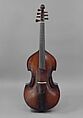
This viol was brought from France to Quebec City in Canada in the middle of the eighteenth century. It was at a boarding school for wealthy girls run at the Convent of the Hospital General along with other instruments, perhaps to accompany a choir. At some point, perhaps in 1759 during the Battle of Quebec, all of the instruments along with other items were hidden behind a hastily constructed wall in the convent. The instruments remained there until the 1830s when masons discovered them when they were brought in to make repairs to the convent. This instrument by Bertrand was later sold in 1864 to a dealer in Montreal, William Snaith. He in turn sold it to Mary Elizabeth Brown in 1899.
This viol retains its original neck, which was reshaped when the viol was converted to a cello, probably in the nineteenth century. Bass viols of French origin feature seven strings, an invention of the French viol player Jean de Sainte-Colombe (fl. 1658–87, died by 1701). Nicolas Bertrand, one of the most celebrated makers of viols, incorporated this feature in his bass viols.
Artwork Details
- Title: Seven String Bass Viol
- Maker: Nicolas Bertrand (1686–1735)
- Date: 1720
- Geography: Paris, France
- Culture: French
- Medium: Maple, spruce
- Dimensions: Height: 51 15/16 in. (132 cm)
Width: 16 1/8 in. (41 cm)
Depth: 9 13/16 in. (25 cm) - Classification: Chordophone-Lute-bowed-fretted
- Credit Line: The Crosby Brown Collection of Musical Instruments, 1889
- Object Number: 89.4.1343
- Curatorial Department: Musical Instruments
More Artwork
Related Content
 Free to download
Research Resources
The Met provides unparalleled resources for research and welcomes an international community of students and scholars. The Met's Open Access API is where creators and researchers can connect to the The Met collection. Open Access data and public domain images are available for unrestricted commercial and noncommercial use without permission or fee.
To request images under copyright and other restrictions, please use this Image Request form.
Feedback
We continue to research and examine historical and cultural context for objects in The Met collection. If you have comments or questions about this object record, please contact us using the form below. The Museum looks forward to receiving your comments.
Content Notice
The Metropolitan Museum of Art presents over 5,000 years of art from around the world, and our online collection reflects ongoing work conducted over the course of our more than 150-year history. You may encounter objects or images that may be inappropriate for some viewers or information that may be outdated.