Gajda
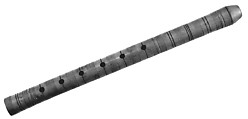
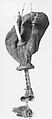
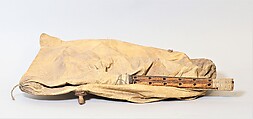
This instrument was made in 1937 by Veljko Janevic in Skopje, Northern Macedonia. At the time, the territory was under the rule of the Kingdom of Serbs, Croats and Slovenes, commonly known as Yougoslavia. It features a single melodic pipe (gajdenica) which is typically made out of boxwood, as well as a final extension (rog) made out of horn. This extremity includes the last two holes of the melodic pipe, and is bent at the end, facing away from the musician. The melodic pipe features 7 fingerholes and one thumbhole, as well as a tuning hole on the lower part of the extension. The uppermost fingerhole is of a very small diameter (2mm) and is called the ‘marmorka’. This is used for ornamentation and to play a chromatic scale. The melodic pipe is fitted into a horn stock, which itself is attached to the neck of a goatskin bag. The bag is made out of an entire animal; the lower extremity of the animal hide is tied into a knot with string. The insufflation pipe is fitted into a dark wooden stock. It has a non-return valve, a leather flap inserted into a thin indent in the wood. The drone is fitted into a dark wooden stock and is in three parts, and adorned with dark wooden rings.
This instrument was formerly owned by Božidar Širola (1889 - 1956). Širola was a specialist of Croatian music in the first half of the twentieth century. He was a composer, the curator and director of the Ethnographic Museum, the dean of the Music Academy of Zagreb, and a high school teacher (Brožek 1957). The instrument was part of the New York Public Library collection until 1976, when it was exchanged along with forty-two other instruments and six accompanying items for a collection of sheet music and music books held at the Metropolitan Museum.
(Cassandre Balosso-Bardin, 2023)
Technical description
Single wooden chanter with cylindrical bore, 301 mm including angled, pronged horn bell;
7/1 holes, venthole in bell, top hole is "flea hole", usually with quill projecting across bore into thumbhole;
Single downcut cane reed: 1 drone in 3 sections (752 mm);
Reed similar to chanters;
Insufflation pipe (125 mm) with leather flapper valve;
Kidskin bag, with forelegs holding drone and blowpipe and neck holding chanter;
Blowpipe and drone stocks of grooved dark wood, conical horn chanter stock;
Pines of light turned wood, grooved and mounted with horn bands.
References
Angelov, Goranco, 2016. ‘Traditional musical instruments used in strengthening the national identity of the Macedonian people since 1989’. In: Music and Dance in Southeastern Europe, Myth, Ritual, Post-1989, Audiovisual Ethnographies. Blagoevgrad, Bulgaria: South-West University "Neofit Rilski", 215-221.
Brožek, Josef, 1957. Božidar Širola. Journal of the International Folk Music Council, 9, 77-77.
Resta, Fabio, 2018. ‘Macedonian Gajda – history, style and techniques’. In: Chanter (Winter).
Artwork Details
- Title: Gajda
- Maker: Veljko Janevic
- Date: 1937
- Geography: Balkan Peninsula, Skopje, Macedonia
- Culture: Macedonian
- Medium: Wood, horn, kidskin
- Classification: Aerophone-Reed Vibrated-bagpipe
- Credit Line: The Crosby Brown Collection of Musical Instruments, by exchange with The New York Public Library, 1976.
- Object Number: 1976.8.21
- Curatorial Department: Musical Instruments
More Artwork


Research Resources
The Met provides unparalleled resources for research and welcomes an international community of students and scholars. The Met's Open Access API is where creators and researchers can connect to the The Met collection. Open Access data and public domain images are available for unrestricted commercial and noncommercial use without permission or fee.
To request images under copyright and other restrictions, please use this Image Request form.
Feedback
We continue to research and examine historical and cultural context for objects in The Met collection. If you have comments or questions about this object record, please contact us using the form below. The Museum looks forward to receiving your comments.
Content Notice
The Metropolitan Museum of Art presents over 5,000 years of art from around the world, and our online collection reflects ongoing work conducted over the course of our more than 150-year history. You may encounter objects or images that may be inappropriate for some viewers or information that may be outdated.