Maa cloth
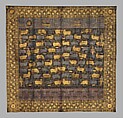
This cloth, depicts a central flowering Tree of Life motif, rendered in a local Toraja vernacular design language – note the mountain from which the tree emerges, and the men on buffaloes - whilst the enclosing floral roundel border designs and the saw-tooth (Indonesian tumpal motifs) of the end borders reflect a wider Indian trade cloth design repertoire (see Guy, 1998).
It was most likely manufactured in the Netherlands or Germany, where in the course of the 19th century a vibrant textile printing industry emerged expressly to serve the needs of “colonial clients”. The Vlisco factory in Helmond, southeast Holland, was particularly famed for supplying both the Indonesian and West Africa markets (the latter market continues today). The precise factory origin of this cloth warrants further research.
Artwork Details
- Title: Maa cloth
- Date: late 19th or early 20th century
- Culture: Indonesia (Toraja, Sulawesi); European for the Indonesian market
- Medium: Printed cotton
- Dimensions: 73 1/4 × 39 5/8 in. (186.1 × 100.6 cm)
- Classification: Textiles
- Credit Line: Funds from various donors, 2015
- Object Number: 2015.479
- Curatorial Department: Asian Art
More Artwork

Research Resources
The Met provides unparalleled resources for research and welcomes an international community of students and scholars. The Met's Open Access API is where creators and researchers can connect to the The Met collection. Open Access data and public domain images are available for unrestricted commercial and noncommercial use without permission or fee.
To request images under copyright and other restrictions, please use this Image Request form.
Feedback
We continue to research and examine historical and cultural context for objects in The Met collection. If you have comments or questions about this object record, please contact us using the form below. The Museum looks forward to receiving your comments.
Content Notice
The Metropolitan Museum of Art presents over 5,000 years of art from around the world, and our online collection reflects ongoing work conducted over the course of our more than 150-year history. You may encounter objects or images that may be inappropriate for some viewers or information that may be outdated.