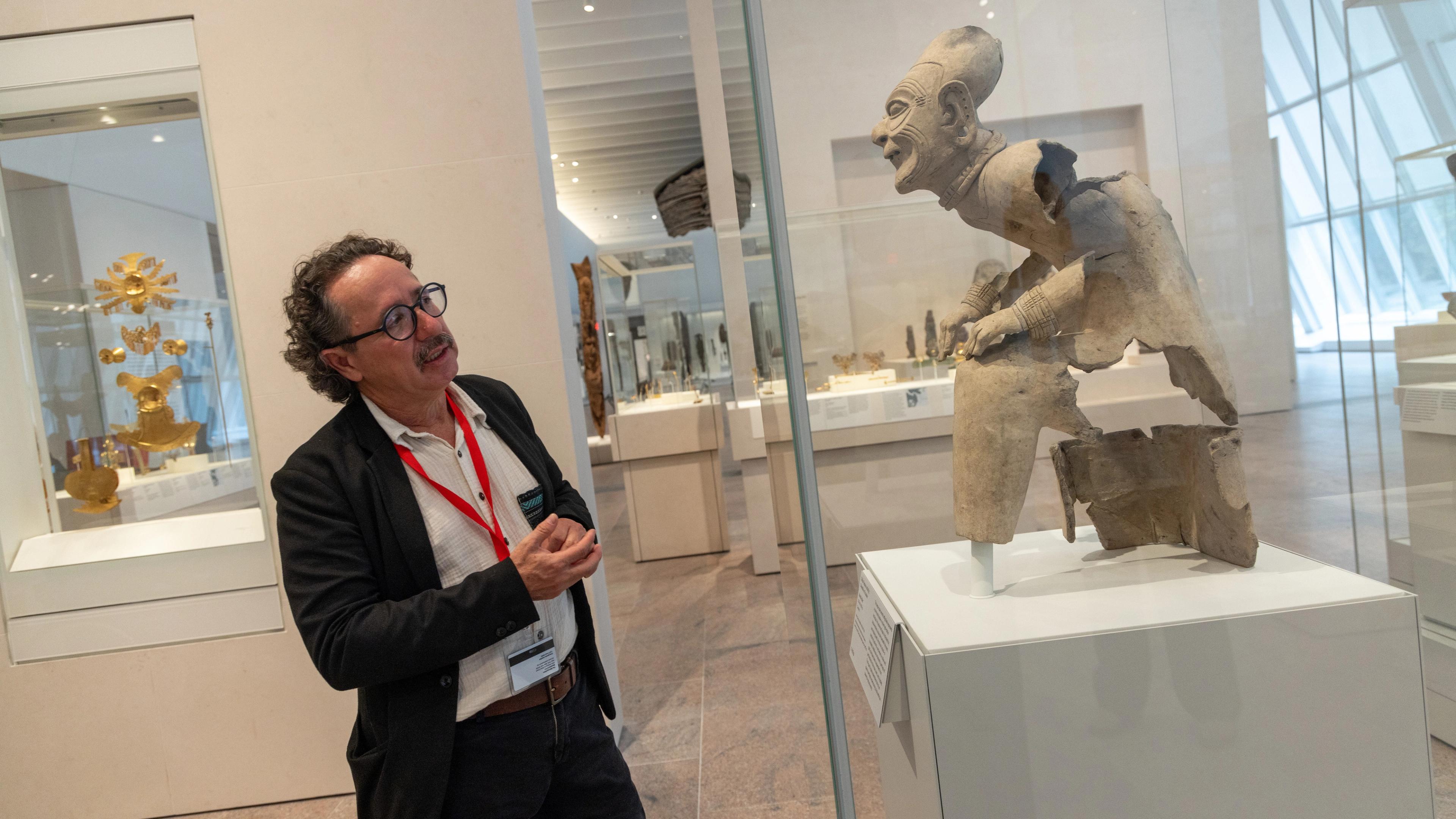
Florencio Delgado Espinoza is an Ecuadorian anthropologist and archaeologist who teaches at San Francisco University in Quito, Ecuador.
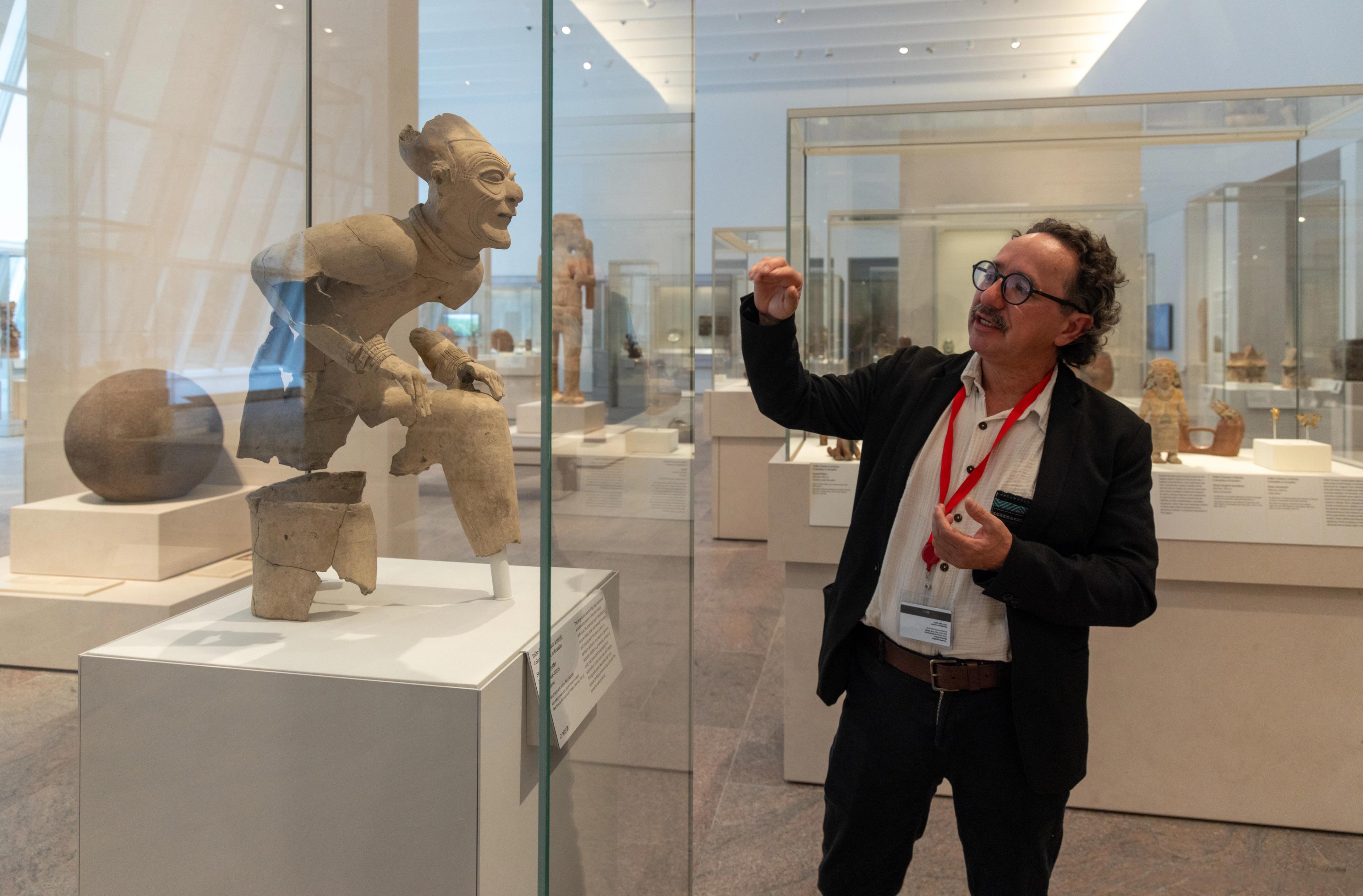
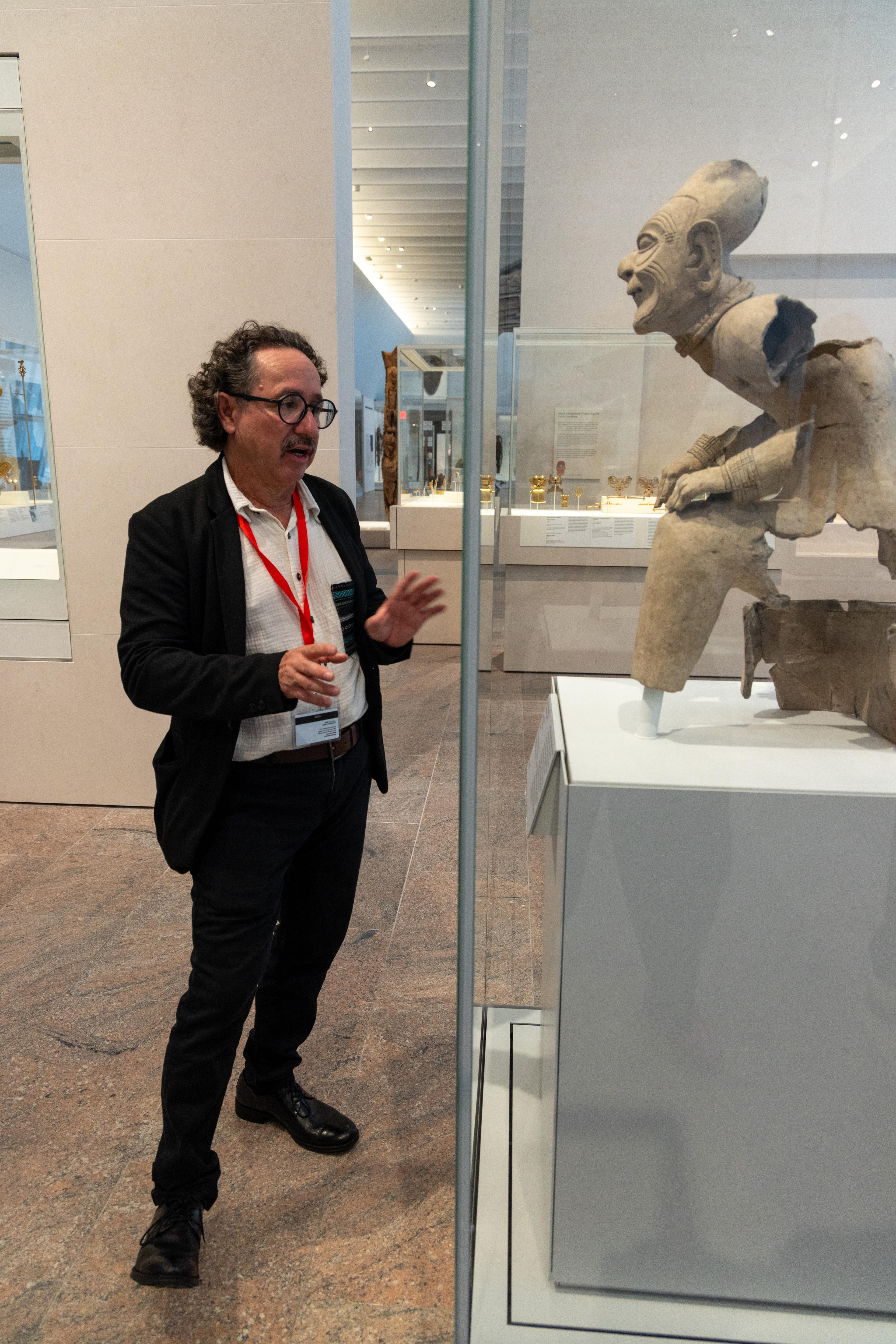
Florencio Delgado Espinoza tours the Arts of the Ancient Americas galleries. Photograph by Anna-Marie Kellen, Photographic Program Manager, Met Imaging
In his research, Delgado Espinoza seeks to find the deeper meanings expressed through ancient artifacts. “Being an anthropologist, an archaeologist, of course, I see the image. But I also wanted to see the symbolism, what it means, the context. I think this is important to look at.”
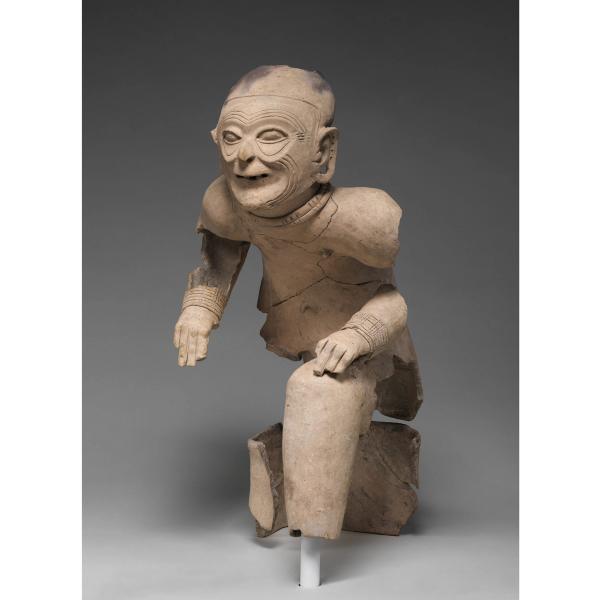
At The Met, Delgado Espinoza took a close look at a large La Tolita-Tumaco figurine depicting an elder, also called a cacique, in a seated position. “Caciques in Ecuador usually are seated on a stool, part of an interesting and clear tradition in Ecuador and the South American lowlands that is associated with power. And this, as far as I know, will be the earliest evidence in Ecuadorian archaeology of an important personage sitting on a stool.”
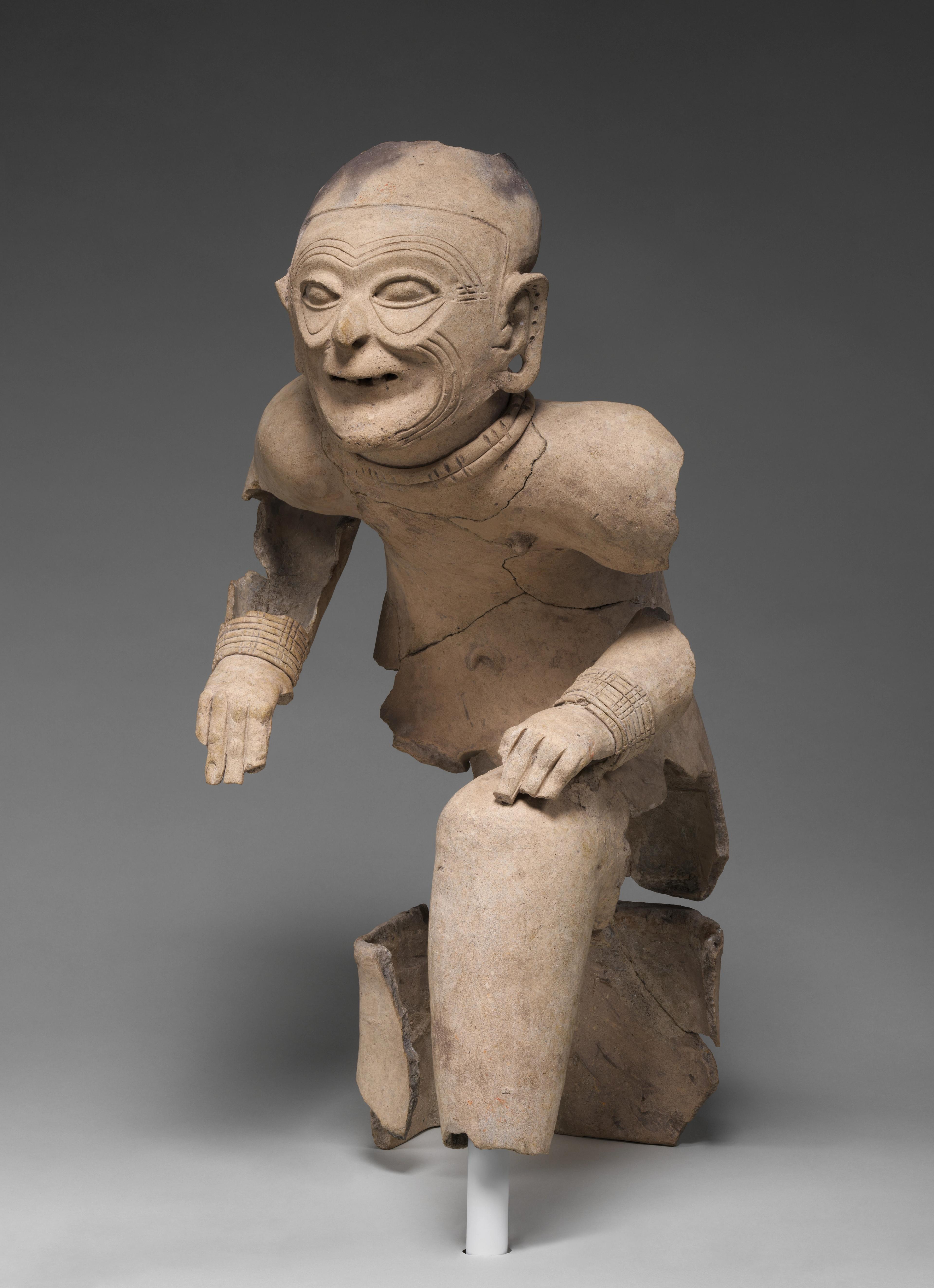
Seated elder, 200 BCE–300 CE. Colombia or Ecuador. Tolita-Tumaco. Ceramic, H. 25 in. × W. 14 1/2 in. × D. 18 3/4 in. (63.5 × 36.8 × 47.6 cm). Gift of Gertrud A. Mellon, 1982. 1982.231
Deep wrinkles on the face of this figure indicate advanced age and wisdom. “A cacique is meant to signify a person with power. And basically, what we are observing in the archaeological record in Ecuador is that this kind of priesthood arises. Priests and people who are working in this ideological realm usually are mature people that have lived and have experience. And age is important because these caciques are the bridge between the gods, the underworld, and the present reality. So, usually in local communities, the caciques are wise people.”
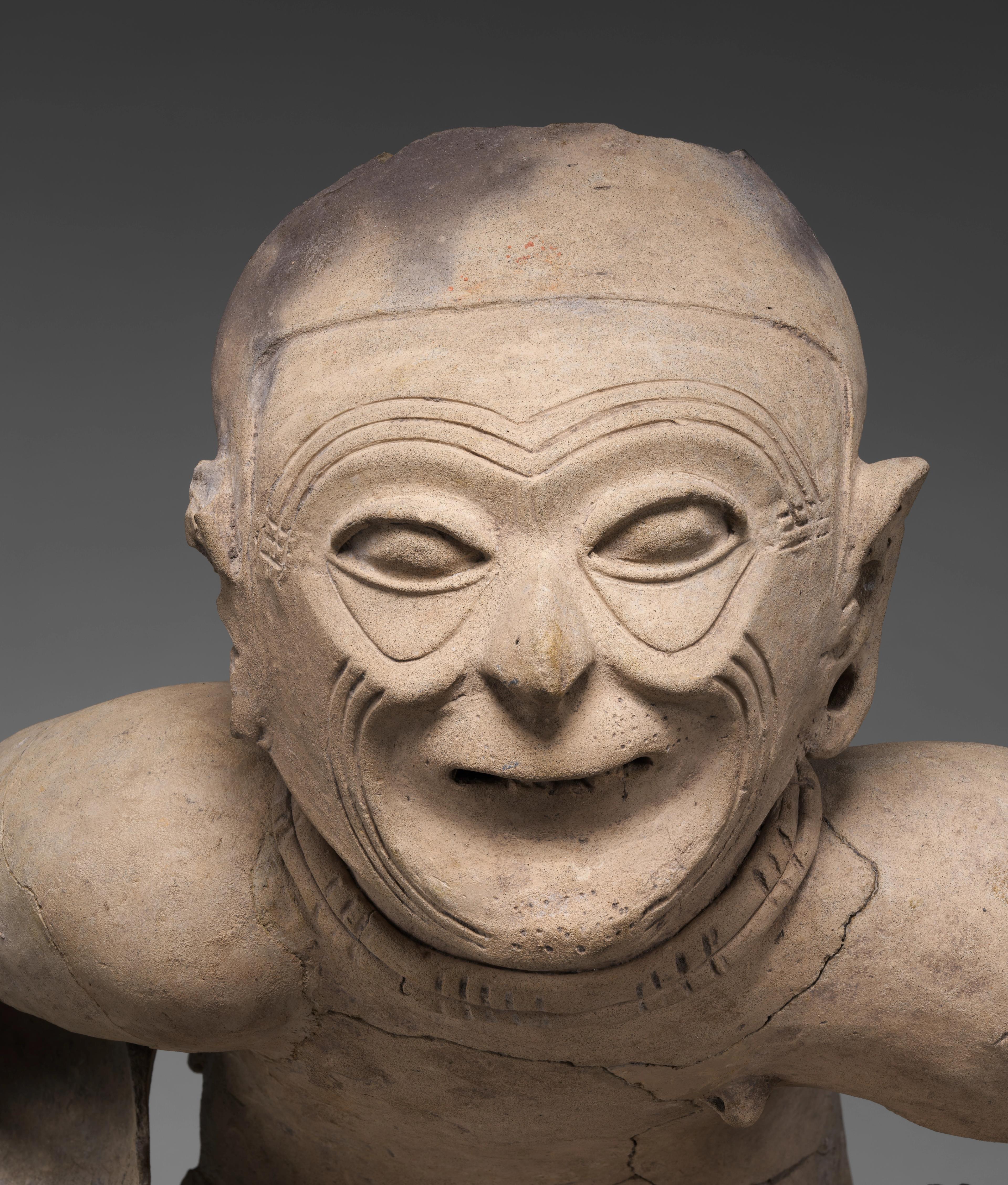
Close-up detail on the face of Seated elder.
Other elements of the figure evoke supernatural power or a trancelike state. “A lot of people associate the eyes of this image to a hallucinogenic stage. People in trance usually are represented with this kind of eyes in the Ecuadorian figurine tradition. So that's what struck me, the fact that that these eyes look to be in trance.”
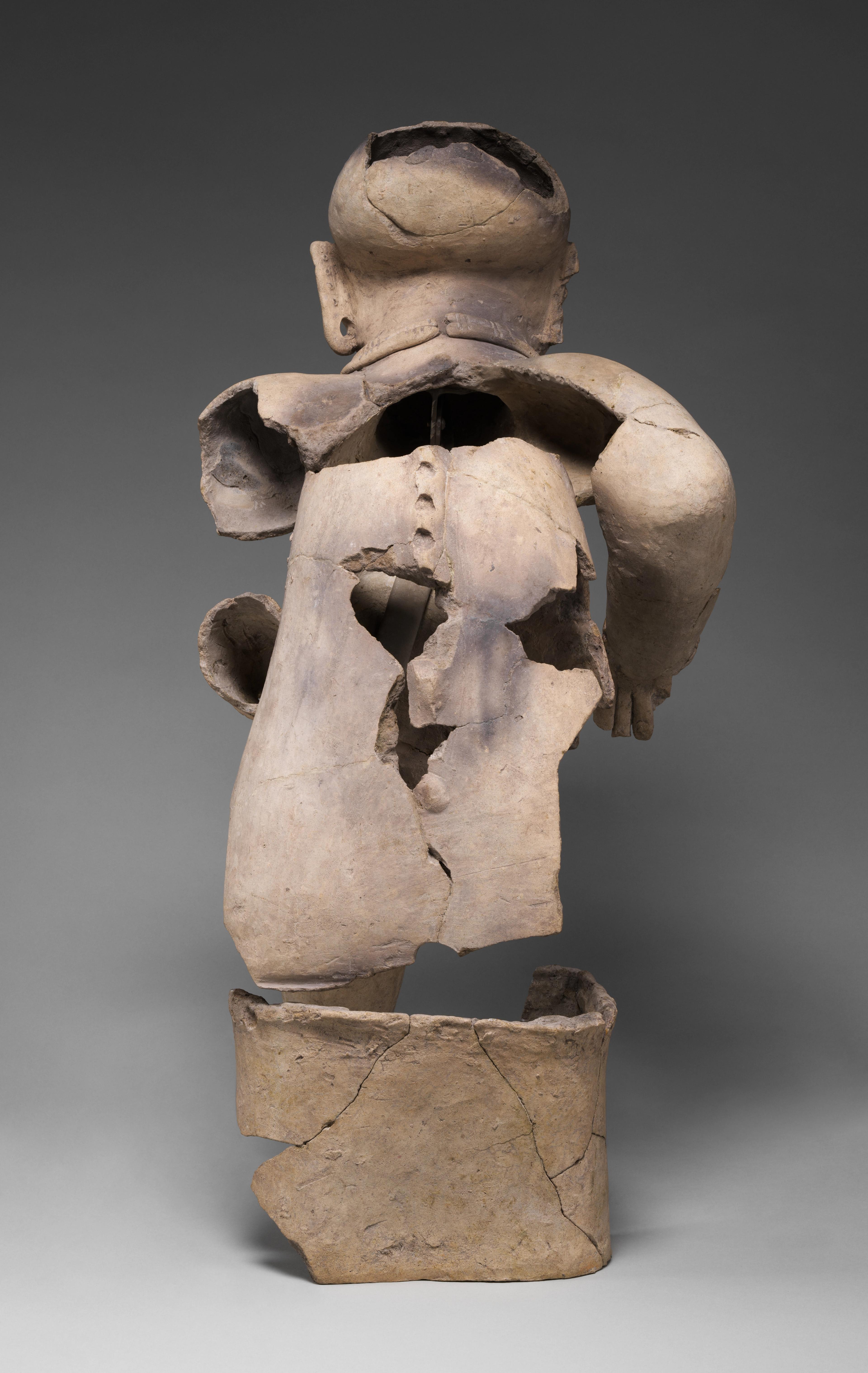
View of the back of Seated elder, showing the detail along the spine of the figure.
This elder might be in a state of partial transformation. “There are images of La Tolita where they are converting into strange figures, reptiles, whatever. That's why the part in the back that looks like a reptile makes me wonder because I have seen other images where they are being transformed into caimans or iguanas or any reptilian type, and even birds.”
Such an allusion to transformation would have been a remarkable display of power. “People transform themselves, showing everybody what powerful healers or shamans they are. People love these caciques, but also, they really were scared of them because they have the power. So it's love and fear. You just don't want to mess with those things. It's like today, you don't want to mess with brujeria (witchcraft).”
Photograph by Anna-Marie Kellen, Photographic Program Manager, Met Imaging
Delgado Espinoza emphasizes that objects like this continue to have a life beyond their original contexts. “Usually, we have been told to believe that past and present are two different spheres. Even during the early colonies, Spaniards through the law of extirpación de idolatrías (extirpation of idolatries) tried to erase any connection of people with these objects and with their past. Fortunately, that didn't happen. In Ecuador right now, for instance, there is a strong movement toward a new genesis where local communities are looking into the archaeological record, working with the archaeologists, with these pieces, that gives them symbolic power, that connects them with an ancient past.”
Hear from Delgado Espinoza in the Arts of the Ancient Americas Audio Guide in English and Spanish.
1615. Seated elder, Tolita-Tumaco artist(s)
Florencio Delgado
FLORENCIO DELGADO: This is a large La Tolita-Tumaco figurine. We believe that he represents an important person because we are seeing the seated position and something in the back that looks like a reptile. Their eyes are in a situation of probably trance.
JOSÉ MARÍA YAZPIK (NARRATOR): The stool is a symbol of power shared by many ancient American cultures and this is one of the earliest known depictions of a seated leader from Ecuador.
Florencio Delgado Espinoza, professor of archaeology at the San Francisco University in Quito, Ecuador.
FLORENCIO DELGADO: We think it would represent a religious event, and an important person in La Tolita times. Priests and people who are working into this ideological realm usually are mature people that have lived and have experience. And age is important.
JOSÉ MARÍA YAZPIK: Deep wrinkles on the face of this leader, also called a cacique, indicate advanced age and wisdom. The way the figure is adorned with necklaces and bracelets shaped in clay indicate wealth and power. Gold ornaments may have once hung from the nose and ears.
FLORENCIO DELGADO: I think the large figure was displayed probably in principal sites where caciques had these ritual ceremonies that involve drinking, eating, a lot of commensal activities. And probably this image was settled there and displayed for the public.
JOSÉ MARÍA YAZPIK: The forward thrust of the body, the trancelike gaze, and especially the reptilian spine might indicate a supernatural transformation.
FLORENCIO DELGADO: People love these caciques, but also they really were scared of them because they have the power. So, it's love and fear.
1615. Anciano sentado, artista(s) de Tolita-Tumaco
Florencio Delgado
FLORENCIO DELGADO: Lo que estamos observando es una imagen, digamos, un personaje de gran tamaño. Al parecer representa una persona adulta y eso se puede mostrar en los rasgos de la cara. Pero también tiene otros aspectos interesantes, como la espalda con lo que parecería ser algo tipo reptil. Los ojos que al parecer muestran alguna situación en trance.
Cosas que nos llevan a pensar. Puede tratarse de un personaje de alto rango dentro de esta sociedad estratificada.
JOSÉ MARÍA YAZPIK (NARRADOR): El taburete es un símbolo de poder compartido por muchas culturas antiguas de América y esta es una de las primeras representaciones que se conocen de un líder sentado, también conocido como cacique, de Ecuador.
Florencio Delgado Espinoza, profesor de arqueología de la Universidad San Francisco de Quito, Ecuador.
FLORENCIO DELGADO: El término cacique en realidad es un término exógeno. Sin embargo, lo que representa es básicamente personas con poder y este poder. Se dice que el poder está asociado más con una élite o con el manejo ideológico o religioso, o con una especie de teocracia en donde estos caciques también representan los sacerdotes. Aquellos que miden el tiempo, velan por la salud de la comunidad, pueden hablar con los dioses y transformarse igual, y volar y hacer una serie de cosas. Entonces el poder al parecer de estos personajes, de estos caciques, se basa justamente en esa manipulación de lo religioso, de lo ideológico.
JOSÉ MARÍA YAZPIK: Las marcadas arrugas en el rostro de este líder indican edad avanzada y sabiduría. La forma en que la figura está adornada con collares y brazaletes modelados en arcilla nos hablan de riqueza y poder. Es posible que alguna vez hayan colgado adornos de oro de su nariz y sus orejas.
FLORENCIO DELGADO: Pues claro, puede ser un personaje sabio y la sabiduría representa obviamente edad, tiempo, tiempo y conocimiento. Que debe haber funcionado dentro de un espacio ritual, y que a lo mejor era un personaje de una edad avanzada. Y entonces seguramente eso es lo que podrían estar representando los Tolita Tumaco en esta imagen.
El cacique para la comunidad es aquel personaje a donde la comunidad recurre… y recurre por muchísimas razones. Y un buen cacique es alguien que intercede con los dioses, con el otro mundo, para traer beneficio a la comunidad.
Este personaje seguramente ha sido mostrado en algún espacio público donde los caciques están buscando seguidores y no solo los están digamos entre comillas enamorando, pero también les están metiendo miedo.


