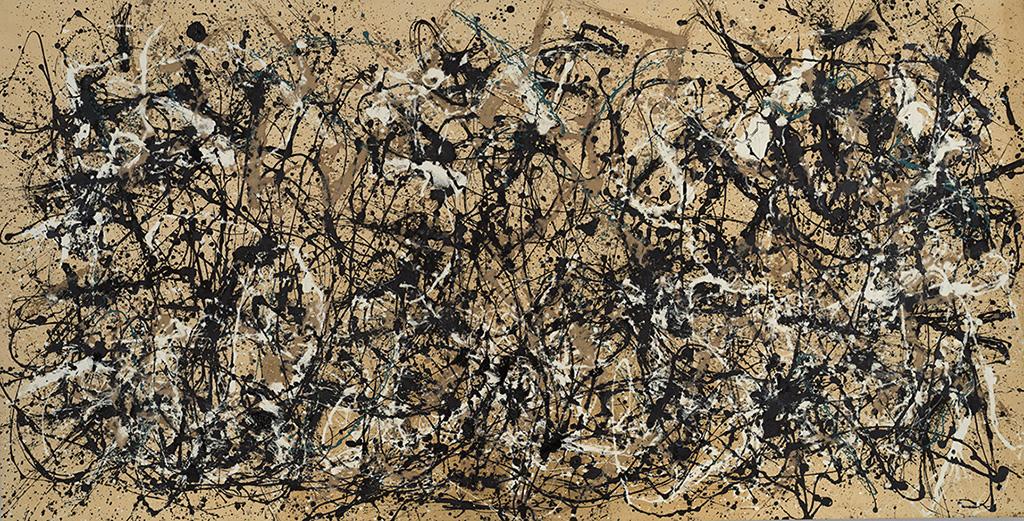
Jackson Pollock (American, 1912–1956). Autumn Rhythm (Number 30), 1950. Enamel on canvas, 8 ft. 10 1/4 in. × 17 ft. 4 in. × 2 5/8 in. (269.9 × 528.3 × 6.7 cm). The Metropolitan Museum of Art, New York, George A. Hearn Fund, 1957 (57.92). © 2015 The Pollock-Krasner Foundation / Artists Rights Society (ARS), New York
My name is Robert Longo and I am an artist.
As Americans we grew up with this idea of "if it's big, it's good." I looked at Pollock as examples of why I wanted to work big: I wanted to compete with the world around me. These paintings compete with movies.
The painting is a recording of almost like a psyche. You get a kind of manifestation of a human being's presence. You can see Pollock's physical movements. I'm sure somebody could actually analyze this painting and tell you how tall he was and how much he weighed. This painting is like a one-of-a-kind recording.
I think his subconscious was really activated. I've read and heard him talk about how he makes no sketches or plans, but clearly there is a strategy. I think the painting's done in three distinct sections. There's almost these kind of humanoid shapes—that's the initial black that he put down. Then he starts to bury it with the white and the green. And he starts to add these bird shapes, these "V" shapes—in the top you can really see them kind of clearly.
As an artist, I think you're a reporter of the time that you live in. This guy was dealing with making paintings after the world basically tried to destroy itself. I mean, I also think it's on the scale of the grand war paintings: Gericault or David. But paint was no longer in the service of illusion. Paint became the picture. His paintings create a dead end. How do you extend after Pollock?
There's almost a democracy that exists in this work. You see it all at once; but then you get to choose to look at it however way you want to look at it, because there isn't any narrative structure in it. I think about, like, my favorite movie; the Pollock painting, I've looked at a gazillion times more.
I think he realized people would interpret things in his paintings, but great art poses questions, and the more questions it poses the better it is. I also think it's an attempt to try to understand, the way sciences or philosophy... but art has a capacity to hold all these other ideas, and maybe enable us to understand our own contemporary situation.
I really do believe in art. I think it's my religion. It's a form of believing. And I think this painting carries all that intensity.