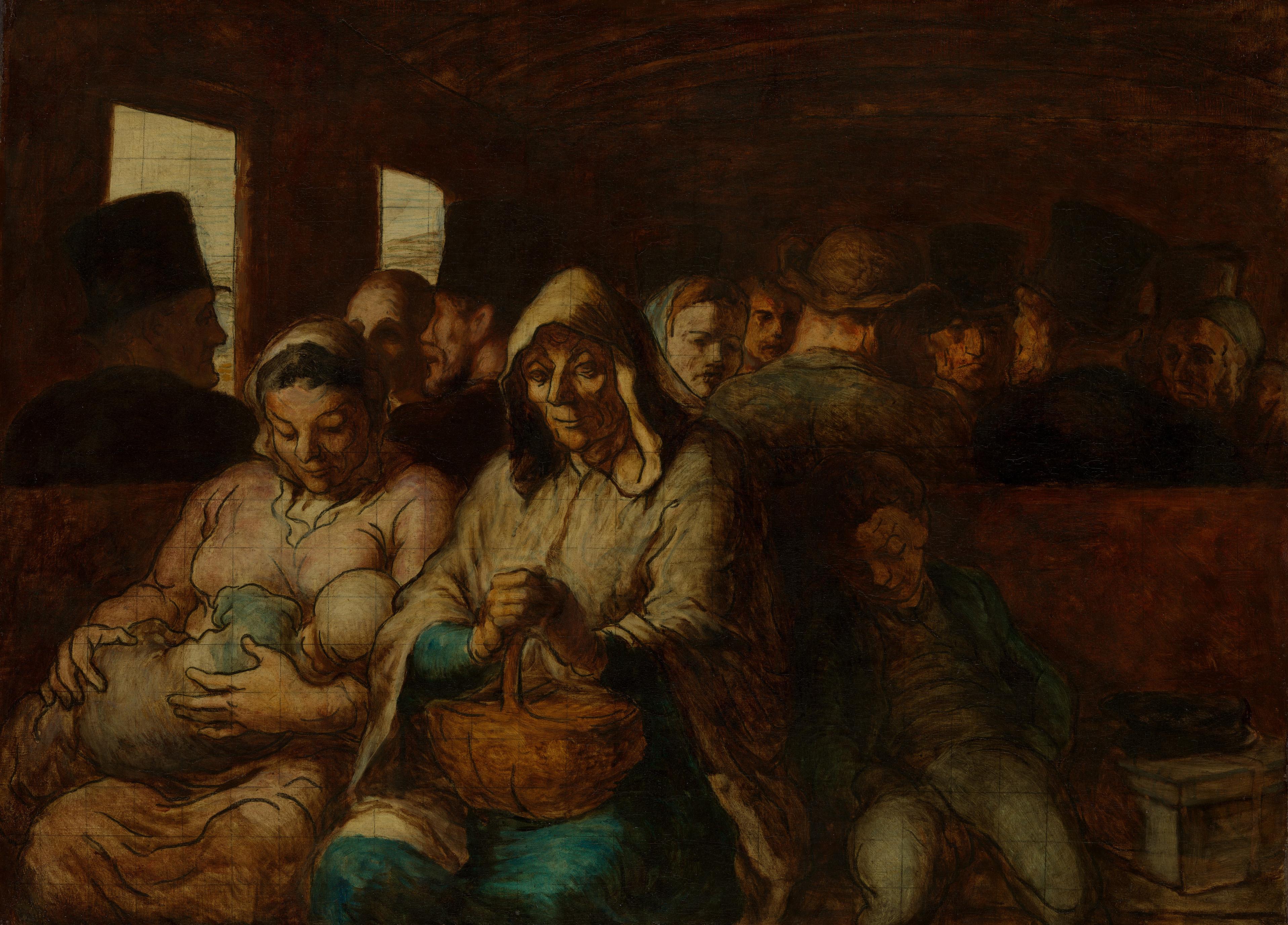
Honoré Daumier (French, 1808–1879). The Third-Class Carriage, 1864. Oil on canvas, 25 3/4 x 35 1/2 in. (65.4 x 90.2 cm). The Metropolitan Museum of Art, New York, H. O. Havemeyer Collection, Bequest of Mrs. H. O. Havemeyer, 1929 (29.100.129)
My full name is Caledonia Curry, and my artist name is Swoon.
A thread weaving through art history that I have always gravitated toward is daily life and the simplicity of one human observing another.
This painting was so important to me when I was fifteen/sixteen. It rushes through my whole nervous system. Daumier is creating a portrait of the time: you’re seeing the train, you’re seeing the rows of passengers, you’re getting the social landscape, but for me it’s so much more than the sum of its parts.
You’re seeing the relationship between the grandmother and the mother who’s breastfeeding and the kid who’s leaning on her. It gets you, and then you look at it more closely and you see that it’s got all this roughness and all this approximation. Like, what’s this grid doing? And how is it that the intimacy of that mother’s expression is formed by a couple of rashly simplistic brushstrokes?
Daumier, I think because he was a caricaturist, had this cartoonish way with his lines, but then when he took that energy into painting he had this immediacy and this quickness and this roughness—letting the forms be simple—that was really radical for painting at that time. Some people have said that this painting sentimentalizes poverty, and I disagree. I think he’s getting the complexity of life here. I feel that there’s something warm and rough, and something beautiful and difficult. There’s compassion in this piece.
He’s interesting for me as an artist and an activist. He is a relentless social observer. He’s always expressing his point of view in his work. That has always had a tenuous relationship within academically recognized art circles, and so I think it’s natural to want to sell him short, to be like “oh, he’s a satirist,” or, “he was always hitching his political ideals to this work.” But I think that there’s a strength in that that shows up in this painting. There was something deeply anti-authoritarian about just looking and observing and telling the truth as you saw it. You feel the love that is contained within looking. A painting can convey an entire emotional position on the world.
Artists are always asking themselves, “how do I make something unique and how do I make something relevant?” Daumier’s position as seen through this work is just: look at people. Observe what’s going on, record that, give it fidelity in its simplest truth. One of the highest functions of art I have identified within my own work is to be a vessel for empathy. When I see this painting, it just strikes the flint. I try to walk in those footsteps.